On Friday, German Chancellor Friedrich Merz openly questioned the way the United States and Israel are conducting the war against Iran.
He was speaking at the F.A.Z. Congress in Frankfurt, an event organised by the Frankfurter Allgemeine Zeitung, which regularly presents political and economic assessments of importance to the German public and market.
Merz made it clear that he did not see a convincing plan that could lead to results. His assessment is that the current operations lack a well-defined political objective and that there is a serious risk the conflict will continue without altering the balance of power.
He particularly emphasised that the idea of regime change in Iran has no basis in past experiences and that such attempts generally produce new instability rather than a solution.
This assessment marks a clear departure from the message Merz presented on 3 March during his meeting with Donald Trump in Washington, when he spoke about the joint position of the United States and Germany towards Iran.
Limitations of the alliance
In Frankfurt, Merz revealed the content of his recent conversation with Trump. He emphasised that he had tried to clarify that the war against Iran is not a NATO war.
That formulation sets the limit of Germany's political and military commitment. It means Berlin rejects automatic collective responsibility for operations it did not initiate or help plan.
Europe has no operational influence on the course of the war but bears its consequences
At the same time, Merz said that Germany participates in diplomatic efforts through contacts with the Gulf states and within the G7, with limited results regarding influence on Israeli decisions.
This indirectly confirmed that Europe has no operational influence on the course of the war but bears its consequences.
G7 without a unified stance
A meeting of G7 foreign ministers in Vaux-de-Cernay, southwest of Paris, confirmed the lack of a unified policy.
In addition to the G7 members, representatives from Saudi Arabia, Brazil, India, South Korea, and Ukraine were also present, indicating that the crisis has already expanded beyond the Western coordination framework.
Rubio stated that the president would have to consider the level of European support in further decision-making on Ukraine
US Secretary of State Marco Rubio made a remark interpreted in European capitals as a political signal: according to him, the United States continually bears the burden in conflicts that involve other nations, and when it needs support from allies, it receives a lack of support in return.
This message was made concrete before arriving in Paris, when Rubio stated that the president would have to consider the level of European support in further decision-making on Ukraine.
Ukraine as a means of pressure
This opens the possibility that American support for Ukraine is no longer treated as a stable constant but as part of a broader political exchange.
Until now, European governments have assumed that American military and financial support for Kyiv is independent of other conflicts. Rubio's statement introduces a different logic.
This means a choice between two unfavourable scenarios
For European governments, this means a choice between two unfavourable scenarios.
In the first, they refuse to engage in the Strait of Hormuz and risk a reduction in US support for Ukraine.
In the second, they accept greater involvement in a conflict for which they have neither political consensus nor a clearly defined goal.
Hormuz as a concrete dispute
The issue of the Strait of Hormuz has become a central point of divergence. The United States is asking European countries to assume some responsibility for shipping safety.
European governments refuse to enter the operational phase of the conflict while the war continues.
The G7 joint statement confirms readiness to ensure freedom of navigation after hostilities end, but not during them.
There are no decisions on operations that could be interpreted as direct involvement in the war
Germany's position is clear: engagement in demining and protection of maritime routes is possible, but only with an international mandate and the approval of the Bundestag, and only after the conflict ends.
France and the United Kingdom take a similar position. Military presence in the region exists, but it only serves to safeguard their own interests and the interests of their citizens.
There are no decisions on operations that could be interpreted as direct involvement in the war.
Economic pressure
The markets have already reacted. The price of Brent oil has reached around $110 per barrel, while the price of gas at the European TTF hub is about 54 euros per megawatt-hour.
The European Commission warns of the risk of stagflation, with a potential reduction in growth and rising inflation.
The OECD has lowered its UK growth forecast for 2026 to 0.7 per cent. American stock markets recorded the sharpest daily drop since the war began, accompanied by a simultaneous rise in energy prices.
In such an environment, political decisions are made under the pressure of limited economic capacity. European governments estimate that further expansion of engagement carries greater risk than potential benefit.
The goal problem
Merz's assessment raises a question that has not previously been publicly articulated at the European top: what is the political goal of the war, and are the means used consistent with that goal?
The US claim that the objectives can be achieved without ground troops indicates an intention to avoid prolonged military engagement.
Air operations and limited strikes rarely produce a stable political outcome without a clear plan for the post-conflict period
However, the experience of previous conflicts shows that air operations and limited strikes rarely produce a stable political outcome without a clear plan for the post-conflict period.
If such a plan does not exist or is not realistic, the war enters a phase of prolonged duration without a clear end.
European approach
European governments do not offer an alternative strategy for Iran. Their approach is limited to risk control and consequence management.
This means avoiding direct military engagement, preserving energy stability, and maintaining support for Ukraine.
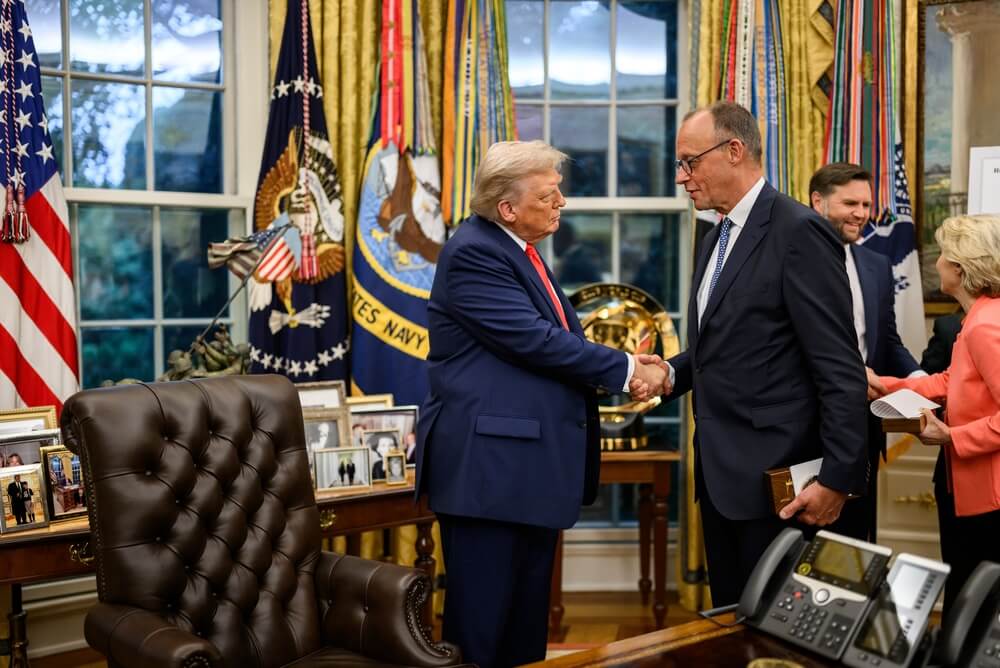 The US is conducting an operation it believes is necessary and feasible. In European capitals, a different assessment prevails - Donald Trump with Friedrich Merz
Such an approach matches their capacities and political constraints but does not solve the fundamental problem. Europe lacks the instruments to influence the course of the war and does not wish to take responsibility for its outcome.
In the coming period, relations between the United States and Europe will depend on several interrelated decisions.
If Washington formalises the link between engagement in Hormuz and support for Ukraine, European governments will be forced to redefine their priorities.
If the war in Iran continues without a clear outcome, political pressure within Europe will increase, with positions advocating distancing gaining strength.
A further rise in oil and gas prices directly constrains political decisions in Europe.
The longer supply disruptions last, the sooner governments will be forced to choose between economic stability and foreign policy obligations. The room for manoeuvre is already shrinking and will not expand if the crisis continues.
What Friedrich Merz said in Frankfurt does not apply only to Berlin. It is an attitude now clearly visible across Europe.
The United States is conducting an operation it believes is necessary and feasible. In European capitals, a different assessment prevails: the goal is not clearly set, and the way the war is conducted can hardly lead to a stable outcome.
This does not mean the end of the alliance, but there is no longer a common approach to this war.
