The entry of the digital euro into the technical phase of consideration in the EU Council marks a transition from concept to political decision.
After several years of preparation within the European Central Bank (ECB) and coordination with member states, the project is now entering the institutional process in which the rules, competences, and method of implementation are determined.
Thus, the digital euro transitions from being an expert monetary topic to an issue that directly impacts the EU's power distribution.
EU institutions define the digital euro as a digital form of central bank money, intended for everyday use by citizens and businesses, which does not abolish cash or change the basic structure of the financial system.
However, the project does not arise because existing payment systems are ineffective but because a large part of digital transactions in Europe relies on private and externally controlled payment infrastructures.
In conditions of geopolitical tension and financial pressure, such dependence becomes a strategic risk, which is why the digital euro represents the EU's attempt to regain control over a key part of its own monetary infrastructure.
Privacy, oversight, and political consequences
The European payment area currently relies heavily on infrastructures not directly controlled by European institutions. Private ownership of card schemes, payment processors, and key digital channels often places them outside European jurisdiction.
Under normal circumstances, this is a matter of efficiency and market dynamics. However, in situations involving sanctions, financial conflicts, and political pressure, it becomes a security issue.
The digital euro was conceived as a tool for the European Union to adapt the monetary framework to the digital economy, aiming to maintain control over the payment system in an increasingly privatised and externally dependent environment.
The institutions will determine the threshold below which transactions are effectively not monitored and above which full oversight begins
This phase is sensitive because the debate is no longer about the digital euro's existence, but its practical use. The way it is designed has immediate political consequences. The key issue is privacy.
The EU claims that the digital euro will not be used to monitor citizens, but at the same time it acknowledges that central bank digital money, unlike cash, leaves a trace.
Therefore, models are being considered in which smaller payments would allow a high degree of privacy, while larger transactions would be subject to existing rules to prevent money laundering and the financing of crime.
In other words, the institutions will determine the threshold below which transactions are effectively not monitored and above which full oversight begins.
A political balancing act
Equally important is the relationship between the digital euro and commercial banks. Allowing citizens to hold digital money directly with the central bank alters the current balance between the public and private sectors in the financial system.
Banks fear an outflow of deposits, especially in times of crisis, while the ECB seeks to reassure the market by proposing limits on the maximum amount of digital euros per user.
Here, it is clear that this is not a technical compromise but a political balancing act between system stability and strengthening the role of the state in the monetary sphere.
It is unclear who would bear the risk in cases of abuse and how to prevent multiple uses of the same funds
One unresolved question concerns the possibility of using the digital euro without an internet connection. This option is being considered to enable use in emergency situations and to give digital money cash-like functionality.
However, such a solution immediately raises practical issues of liability and security. It is unclear who would bear the risk in cases of abuse, how to prevent multiple uses of the same funds, or how to ensure control without adding additional supervision.
These issues have not yet been resolved, but their resolution will directly determine how the digital euro will function in practice.
A tool for expanding monetary influence
A less visible but strategically important aspect of the digital euro concerns its influence outside the eurozone. The EU single market already acts as a regulatory magnet.
When the digital euro becomes a standard, it will set technical and legal requirements for countries and companies that are not formally part of the eurozone but operate within the European Economic Area.
Thus, the digital euro becomes a tool for expanding the EU's monetary influence, even without a formal expansion of the currency itself.
What distinguishes this initiative from earlier European projects is the open recognition that money can no longer be regarded as a neutral technical category.
Introduction of digital euro carries real risks for privacy, the stability of the banking system, and public trust
As financial flows are increasingly used as instruments of political pressure, the question of who controls payment systems and transaction channels becomes a security issue.
The digital euro is the EU's attempt to address this, but the manner of its introduction carries real risks for privacy, the stability of the banking system, and public trust.
If the design is overly restrictive, it may discourage users and maintain its marginal status. If it is too flexible, it could undermine confidence in the privacy and stability of the system.
Between these two extremes lies the political space in which decisions will be made that go beyond the mandate of the central bank and enter the sphere of sovereignty of the member states.
Beyond a technical project
The digital euro should not be viewed merely as a technical project or as a response to the emergence of cryptocurrencies.
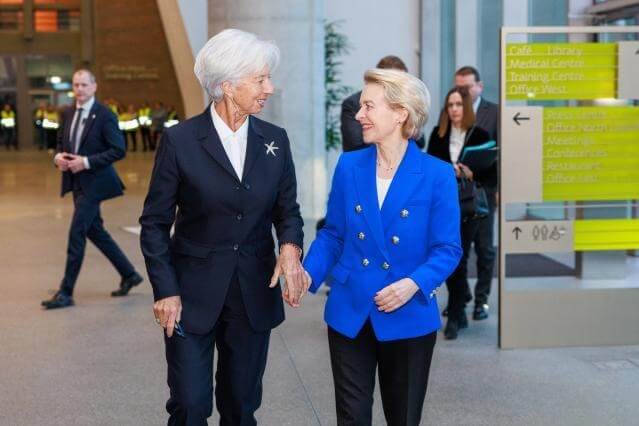 The outcome of the digital euro project will have long-term consequences for the EU's position in the global financial system - Christine Lagarde with Ursula Von der Leyen
It is a political test of the EU's ability to implement change in the monetary system without losing trust and institutional balance.
At a time when the Union faces external pressures and internal differences among member states, the manner in which the digital euro is introduced will demonstrate whether the EU can adapt its institutions to the digital economy while maintaining control over key decision-making levers.
The outcome of the digital euro project will have long-term consequences for the EU's position in the global financial system.
The current setting of the rules, competences, and limits of use will determine whether the Union strengthens its monetary autonomy or further strains trust in its institutions.
This is precisely why this phase, regardless of the technical framework in which it is conducted, represents a key political moment for the future of the European monetary system.
