The UK government’s push to seek closer ties with its former partners in the European Union has sparked a revival of the unlamented Brexit debate that previously dominated British politics.
Any mention of the B-word was effectively taboo in Labour’s winning election campaign last year, in which Keir Starmer’s party sought to put the country’s divisions over Europe behind it.
The new prime minister nevertheless pursued a pledge to mend fences with Britain’s continental neighbours, leading to a modest ‘reset’ in UK-EU relations earlier this year.
This month, however, he went further by publicly expressing what most of the country was already thinking: Brexit isn’t working.
He told an audience in the City of London financial district: “The idea that leaving the EU was the answer to all our cares and concerns has clearly been proved wrong.”
Brexit hasn’t worked – yet
Although he expressed his respect for the “fair, democratic expression” of the leave vote in 2016, his remarks spurred expectations among pro-Europeans in the Labour camp of revisiting a flawed exit deal.
That in turn has reopened previously resolved arguments over whether the UK would be better off seeking to rejoin the EU’s customs union or even its single market, with little reflection on what the EU itself might think.
“Thus far, we have endured Brexit’s downsides, through new trade frictions and protracted uncertainty, with any upsides paling in comparison” - Ryan Bourne
The renewed debate has put even previously ardent leavers on the back foot, with some going at least half-way to following Starmer’s lead by acknowledging that Brexit hasn’t worked - yet.
Ryan Bourne, a member of the former Economists for Brexit group, acknowledged in The Times last month that “thus far, we have endured Brexit’s downsides, through new trade frictions and protracted uncertainty, with any upsides paling in comparison.”
Others have adopted an “anything but Brexit” approach, blaming the country’s continuing problems on a range of issues unconnected with the 2016 vote, while at the same time claiming the UK is actually doing better than some of its worst-performing EU neighbours when it comes to economic growth.
A referendum on rejoining? Not on the cards
Many of those voters who believed the pre-referendum hype that going it alone would lead to economic renewal and harden the UK’s borders against a migrant ‘invasion’ have meanwhile come to regret their choice.
Perhaps they had been captivated by what Starmer termed the “wild promises” that were made to the British people that were not fulfilled.
An August poll, published in The Sunday Times, found less than 30 per cent of Britons would now vote to leave the EU compared with the 52 per cent who voted ‘out’ almost a decade ago.
Neither a Europe-friendly Labour government nor its counterparts in the EU wants to reopen barely healed Brexit wounds
Almost half of respondents even thought there should be a referendum on rejoining the EU within the next five years. That option, however, is not on the cards. Neither a Europe-friendly Labour government nor its counterparts in the EU wants to reopen barely healed Brexit wounds.
A cautious Starmer, who had backed a second referendum before the final Brexit deal was done, pushed back against hints from within his own government that closer ties with the EU might include a bid to rejoin the customs union.
What exactly is Starmer promising?
The option, if it even amounts to that given potential EU resistance, has gained traction within Labour circles since Starmer’s deputy, David Lammy, pointed out the benefits it granted to other non-EU member states.
Such a move would require the UK to follow the 27 EU member states in charging the same taxes on goods imported from outside the bloc. It might also impact some of the post-Brexit trade deals the UK has been able to secure since its official exit.
Talks broke down last month over a UK bid to win a larger stake for its defence companies in a 150 billion euro EU loan scheme
His boss has since reasserted that Labour would continue to abide by its manifesto pledge not to seek to rejoin the customs union or the single market or to accept freedom of movement for EU citizens.
So what exactly is Starmer promising when it comes to building on the summer reset already agreed with the EU?
Both the aspirations and the benefits secured have so far been modest, focused on issues such as reducing post-Brexit paperwork and red tape for British businesses and enhancing student exchanges.
On the even more pressing topic of defence, however, talks broke down last month over a UK bid to win a larger stake for its defence companies in a 150 billion euro EU loan scheme.
Anglo-European unity on display
Anglo-European unity was on display this week as French and German leaders joined Starmer in London to express their solidarity with Ukraine. When it comes to the nitty-gritty of movement and trade, however, the Europeans will play a harder game.
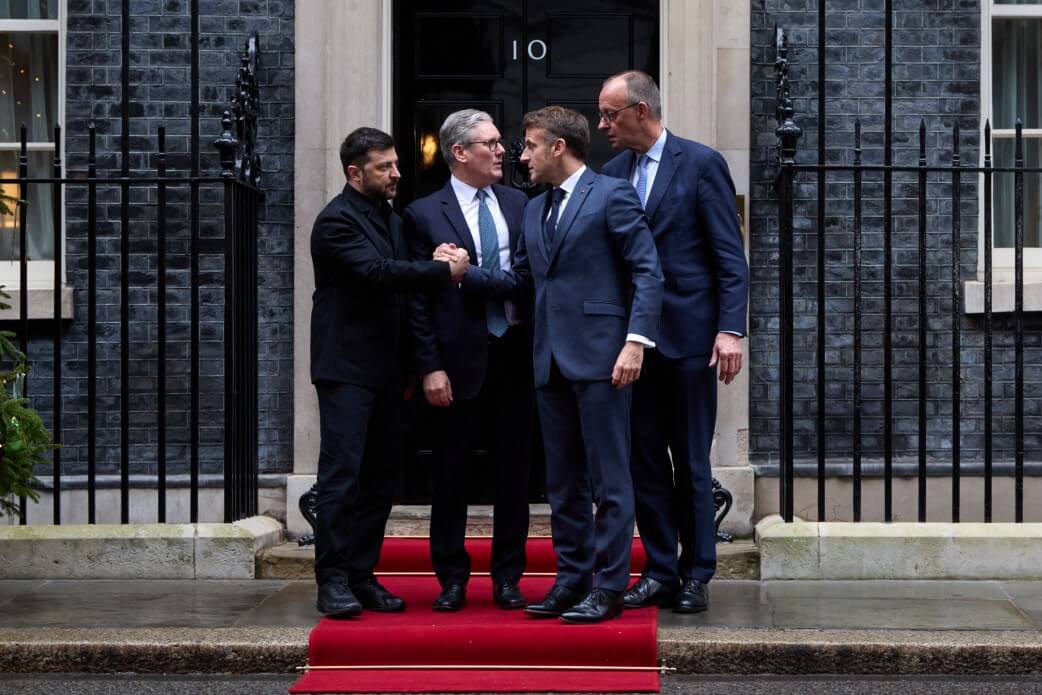 Anglo-European unity was on display this week as French and German leaders joined Starmer in London to express their solidarity with Ukraine
As on other issues, Starmer needs to outline a clearer vision of where he would like to see the UK-Europe relationship stand by the end of Labour’s term.
Raising expectations now, at a time when he and his government are trailing in the polls, is unlikely to reverse their fortunes in the absence of tangible results.
Perhaps one of the gloomiest predictions of what lies ahead came from the Eurosceptic economist Roger Bootle, who acknowledged in The Telegraph this month that leaving the EU had probably brought some significant economic loss.
“Far from being over,” he wrote, “the Brexit wars may be raging for many more years yet.”
