For years, security analyses of the Arctic have focused primarily on the Russian military presence and the region’s strategic implications.
NATO's internal planning, command, and responsibility allocation in the North have received much less attention. In recent weeks, that distance has disappeared.
The Arctic ceased to be an abstract northern margin and became a testing ground for NATO’s ability to reconcile interests, responsibilities, and political limits within its own membership.
Helsinki’s initiative to harmonise the Arctic security plan by July, ahead of the NATO summit in Turkey, arose from immediate political and security developments in northern Europe, not from abstract strategic ambitions.
Greenland has shown that the North is no longer just a matter of relations with Russia but also of relations between allies.
When the territory of one member state is at the centre of global strategic competition, without a clear internal agreement on the role and limits of action, the alliance enters a zone of uncertainty that is political rather than military.
Finland is seeking to move this issue from political discussion to practical planning. Finland's message is that managing the northern part of the NATO area as a collection of separate national zones is not feasible.
The Arctic requires permanent surveillance, logistics that function in isolation, and clearly defined accountability within the chain of command.
Without such an agreement, the security of the North remains a patchwork of partial solutions dependent on the current will of individual states.
The North is no longer remote
With the accession of Finland and Sweden to NATO, northern Europe is no longer a secondary direction.
The alliance now has uninterrupted territory from the North Atlantic to the Russian border, with a direct link between air, sea, and land forces.
This changes how the North is planned and defended. The question is no longer whether the Arctic is strategically important, but who manages that space in peace and crisis, makes decisions, and takes responsibility when risks materialise.
The previous approach relied on the assumption that the North is stable precisely because it is remote. That assumption no longer holds.
Russia’s military activity in the North has been ongoing for years and is not new. What is new is the direct connection between the Arctic and political issues within the Alliance.
Greenland was a catalyst in this regard, as it raised the issues of sovereignty, presence, and control simultaneously. When these issues are not addressed collaboratively, every alliance transforms into a collection of parallel policies.
The northern flank is not a place where strength is measured by quantity but by adaptability
The Finnish initiative seeks to prevent this. It is based on a simple assumption: if the Arctic becomes part of NATO's main security area, it must be included in central planning rather than treated as a separate issue managed only by directly interested countries.
This means the North should not be regarded as a "Nordic problem" but rather as a matter of collective defence.
The Finnish proposal addresses the practical requirements of defending the North. It concerns the ability to maintain, move, and deploy forces in extreme climates, over long distances, and with limited infrastructure.
In such an environment, logistics, reliable communication, and clearly defined responsibilities in the chain of command are essential. Without these, the presence of forces does not guarantee real security.
That is why their argument is based on experience rather than theory. Operating in Arctic conditions requires specific training, adapted equipment, reliable supply systems, and medical support capable of functioning in isolation.
These are capabilities that many countries lack, regardless of the size of their military budgets. In this respect, the northern flank is not a place where strength is measured by quantity but by adaptability.
Why the Arctic problem is political, not military
However, the core of the problem is not military but political. NATO now faces the challenge of managing an area where its members' interests do not fully align.
The Arctic is a region where the United States, Canada, the Nordic countries, and Denmark are present, with Greenland as a distinct entity.
Each of these countries has its own priorities, domestic political constraints, and different perceptions of risk. Without a common framework, these differences become weaknesses.
The joint plan advocated by Finland is meaningful only if it addresses this weakness. This does not necessitate the homogenisation of all interests, but rather the establishment of order in their harmonisation process.
The Arctic plan is only meaningful if it pre-establishes political decision-making within the Alliance
In Arctic conditions, the speed of decision-making is crucial, not just the extent of presence. If decisions depend on ad hoc political coordination, the system fails.
This is precisely why the Arctic plan is not merely a technical document but also a matter of political control. It demonstrates whether NATO can function as an organisation that responds not only to external threats but also to internal tensions.
Greenland has shown how quickly such tensions can arise. The next crisis may have a different cause, but the effect will be the same without the framework.
The Arctic plan, therefore, is only meaningful if it pre-establishes political decision-making within the Alliance.
Formal unity or political cohesion?
The Arctic does not distinguish between military and civilian infrastructure. Ports, airports, communication systems, and energy facilities serve both states and armed forces.
If their protection, management, and priorities are not agreed upon in advance, a vacuum of responsibility arises during a crisis.
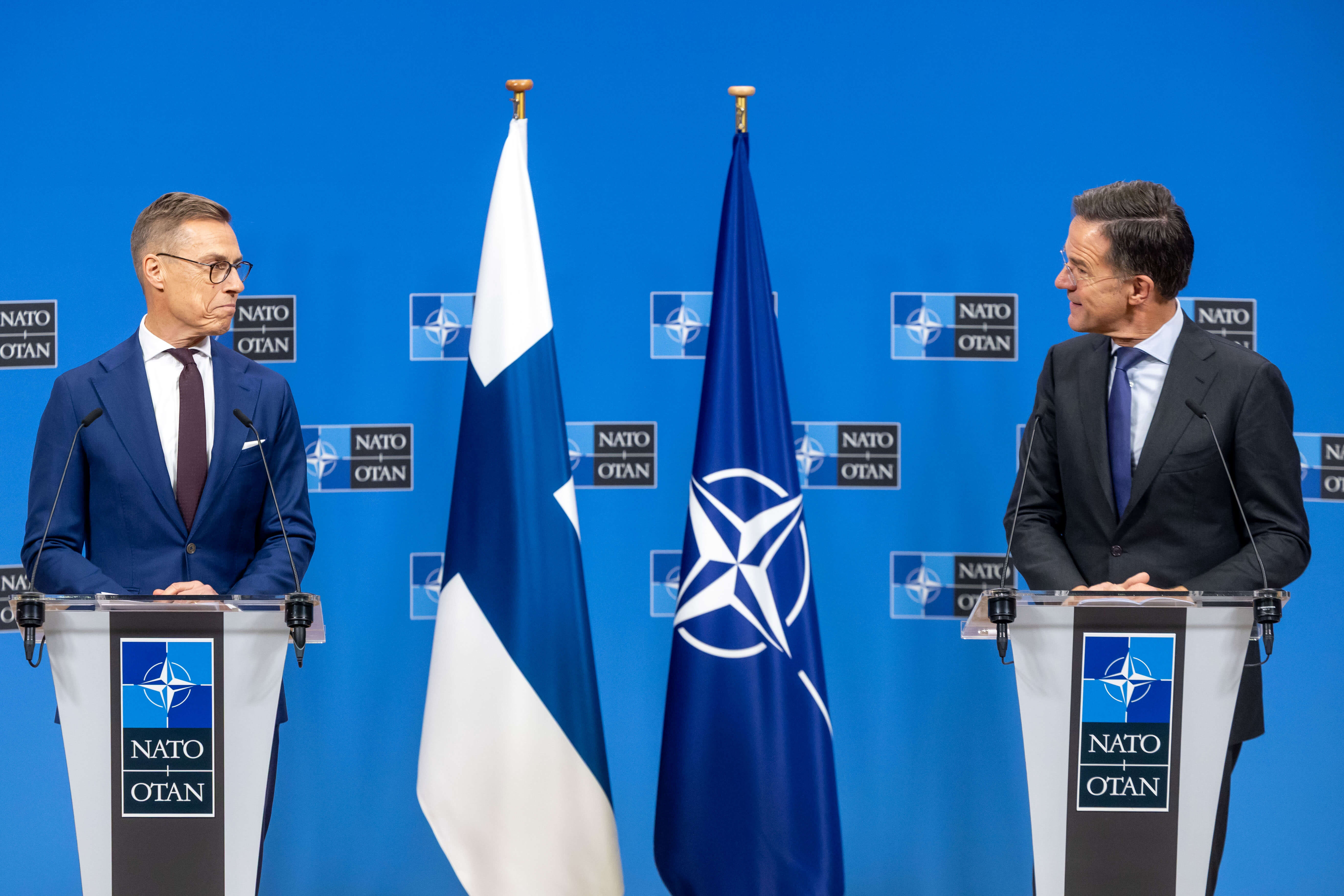 By July, it will be clear whether NATO has the capacity to address the North with a political decision or whether it will resort to temporary solutions - Alexander Stubb with Mark Rutte
Without a common framework, the North's defence remains a collection of disjointed national measures that do not form a single operational entity.
Europe's capacity to take on a larger portion of the Alliance's responsibilities is thus also put to the test by the Arctic plan.
If the northern flank becomes an area where European states can organise surveillance, logistics, and basic infrastructure without constant reliance on American initiative, it changes the dynamics within NATO – not through separation, but through balance.
If this does not happen, the consequences will not be dramatic overnight; they will be gradual. There will be more uncertainty, more ad hoc solutions, and greater reliance on political impulses instead of plans.
In such an environment, the Arctic becomes a source of constant tension rather than stability. This is why the Finnish initiative is significant now. The Arctic has become the place to determine whether NATO possesses political cohesion or merely formal unity.
By July, it will be clear whether NATO has the capacity to address the North with a political decision or whether it will resort to temporary solutions.
In this process, the Arctic does not pose a new question but reveals how the Alliance functions when the interests of its members are not fully aligned.
