The Trump administration’s new National Defense Strategy (NDS) places “deterrence” at the center of America’s grand strategy.
Deter China from dominating the Indo-Pacific. Deter threats to American access to Asian markets. (Taiwan, strangely, goes unmentioned.)
The document bears the traces of dual authorship: the cool strategic realism of Elbridge Colby (grandson of former CIA director William Colby) on China, and the fevered nativism of Trump’s White House deputy chief of staff Stephen Miller on migration.
It rebrands alliance-shedding as “burden-sharing.” And by demanding that China stay out of the Western Hemisphere while insisting on total US access to the Indo-Pacific, it explodes the very concept of spheres of influence.
But the document’s central concept, deterrence, has a specific meaning, developed through decades of strategic theory. And the authors of the NDS seem to have lost the thread.
Trump cannot keep promises
The late Nobel laureate economist Thomas Schelling, whose work remains foundational to strategic thinking, understood that deterrence is not primarily about capability.
Escalation takes the form of a “competition in risk-taking” governed as much by the “balance of resolve” as by the balance of forces.
Deterrence works by convincing adversaries that your commitment is so deep, so credible, so embedded in your identity and institutions, that you cannot back down even when doing so would be sensible.
This requires what Schelling called “commitment mechanisms” – ways of binding yourself that make retreat impossible.
The idea that Donald Trump – a notorious bluffer with commitment issues – would adopt a position from which he could not back down is risible
The classic example: burning bridges behind your army. You signal resolve by eliminating your own options.
The idea that Donald Trump – a notorious bluffer with commitment issues – would adopt a position from which he could not back down is risible.
Trump has shown countless times that he cannot keep promises. His reversals on TikTok, tariffs, and Ukraine demonstrate to any rational observer that his commitments have the lifespan of a mayfly. Yesterday’s red line is today’s bargaining chip.
Trump escalates rhetorically, then folds when costs loom or his attention whimsically shifts. This is not the behavior of someone willing to burn bridges.
Having watched this pattern unfold repeatedly, Chinese President Xi Jinping has no basis for believing that today’s US commitment to the first island chain (the Western Pacific archipelago that contains China’s naval power) will survive contact with tomorrow’s mood, business interest, or news cycle.
Trump’s war on checks and balances
In fact, Trump is at war with the very idea of pre-commitment. As Douglass North and Barry Weingast demonstrated in their classic study of institutional credibility, a ruler can make credible commitments in one of two ways: by establishing a precedent of responsible behavior, or by being constrained by rules and institutions that do not permit leeway for violating commitments.
The first method rarely works: the pressures of power eventually lead to violations. The second requires precisely what Trump is dismantling.
Trump’s war on checks and balances is simultaneously a war on American credibility abroad
Domestically, Trump’s assault on independent institutions – the Federal Reserve, the judiciary, inspectors general, the civil service – reflects not merely a desire for power but a deep hostility to any constraint on presidential discretion. He cannot tolerate having his hands tied.
But the independence of such institutions is precisely what makes long-term commitments credible to foreign observers.
When adversaries see a US president who insists on the power to reverse any policy, fire any official, and escape any constraint, they draw the obvious conclusion: no commitment this man makes will outlast his next impulse.
Trump’s war on checks and balances is simultaneously a war on American credibility abroad.
Alliances are built on reciprocal sacrifice
Loyalty is the currency of alliance. Colby’s own framework requires coalition commitment – the US cannot defend the first island chain in the South China Sea alone.
But alliance credibility compounds the commitment problem. Alliances are built on reciprocal sacrifice: we defend you, you defend us, and we honor those who died for the common cause.
Trump seems to understand none of this. At Davos, he claimed that NATO allies in Afghanistan “stayed a little back.”
NATO Secretary-General Mark Rutte reminded him: “For every two Americans who paid the ultimate price, there was one soldier from another NATO country who did not come back to his family.”
In fact, Denmark, currently under pressure from the US as Trump demands control of Greenland, suffered the highest per capita casualties in the coalition.
If Trump cannot remain loyal to those who slavishly advance his interests, why would any foreign leader believe he will honor commitments to allies who occasionally disagree?
The president evidently couldn’t care less. He once stood in a military cemetery and asked what fallen soldiers “got out of it.”
The question was not rhetorical. He genuinely cannot fathom why anyone would die for a cause, a country, or a comrade.
A man to whom sacrifice is incomprehensible cannot honor the dead – and cannot sustain the bonds that alliances require.
Trump cannot honor the living, either, discarding loyalists the moment they become inconvenient.
Anyone who served him faithfully but failed to serve him completely is jettisoned.
Think of his first vice president, Mike Pence. If Trump cannot remain loyal to those who slavishly advance his interests, why would any foreign leader believe he will honor commitments to allies who occasionally disagree?
The real danger
Last but not least, Trump cannot absorb costs. This is where the deterrence logic breaks down most completely.
Schelling understood that credible threats require communicating willingness to endure pain in order to inflict it.
You must seem capable of hurting yourself to hurt your adversary. But a crucial distinction must be drawn: the pain must be experienced as pain by the one absorbing it.
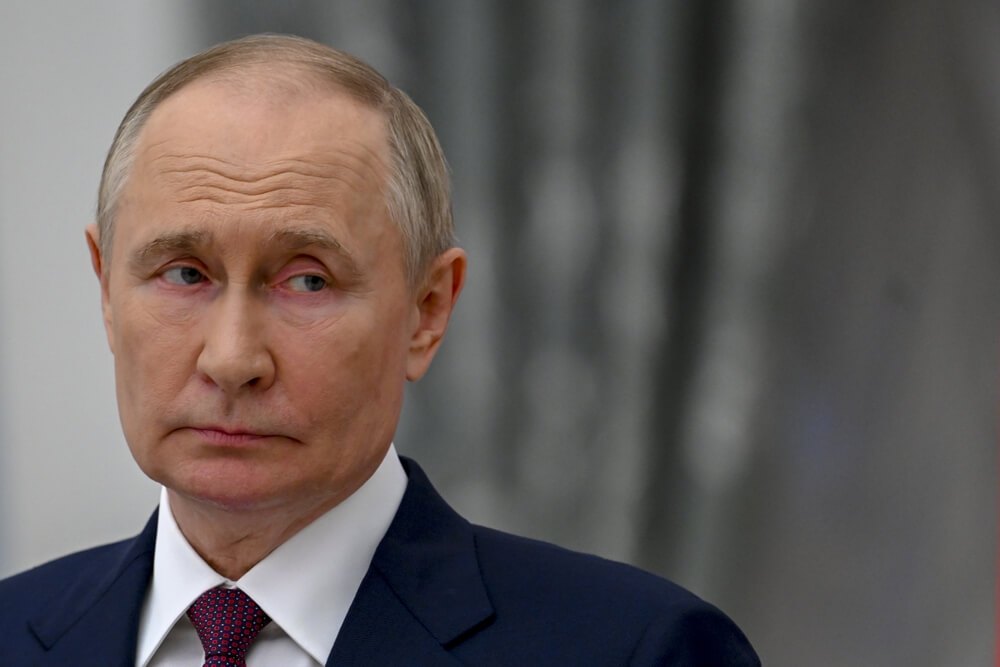 When adversaries conclude that a US president will always back down, they may go too far - Vladimir Putin
Trump’s tariff policy reveals the problem precisely. He celebrates tariffs as triumphs even as they raise prices for American families. He does not experience their pain as his cost but as his victory.
A leader who is indifferent to – or even gratified by – the suffering he inflicts on his own people cannot use that suffering as a credible signal of resolve.
Adversaries see not a leader steeled for sacrifice, but one who simply doesn’t notice the damage.
This brings us to the real danger. When adversaries conclude that a US president will always back down, they may go too far.
They may miscalculate in ways that kill US troops or strike US assets, igniting a domestic reaction that Trump cannot control.
The US could stumble into a war not because Trump committed to a position and held it, but because an adversary, convinced they were calling another bluff, discovered too late that they had crossed a line the American public would not tolerate.
Wars often begin through such a miscalculation: one side’s perceived weakness invites a provocation that triggers an uncontrollable response.
Schelling understood this. Deterrence fails not only when threats lack credibility, but when the absence of credibility tempts adversaries into recklessness. A leader who cannot commit is not merely ineffective; he is dangerous.
Trump’s NDS speaks the language of deterrence fluently. But strategy documents do not deter. Leaders do. Institutions do. Credible commitments, sustained over time, do.
Xi and Russian President Vladimir Putin can read America’s vainglorious, erratic, and hollow president as clearly as the rest of us. The danger is that they will read him too well.
Stephen Holmes is a Professor of Law at New York University School of Law and a Berlin Prize Fellow at the American Academy in Berlin.
