The World Economic Forum (WEF) in Davos, from 19 to 23 January, has become the venue where key messages about the future of the global order take shape.
In this context, the speech by Ursula von der Leyen, President of the European Commission, was one of the most significant moments of this year’s meeting.
She made it clear that Europe is entering a phase of profound transformation, with strategic autonomy as a central priority.
This concept, which means the European Union can make independent decisions and protect its interests in key areas such as energy, technology and security, is not new.
However, von der Leyen presented it as an urgent necessity, driven by ongoing global changes that are transforming the world at a structural level.
The President of the European Commission delivered her speech at a time when global leaders face a wave of challenges: from Russian aggression against Ukraine to threats in the Arctic and the increasingly pronounced unilateralism of major powers.
Von der Leyen stressed that these shocks are not temporary but permanent and that Europe must adapt quickly and decisively. “That geopolitical shocks can – and must – serve as an opportunity for Europe,” she said, adding that it is time to build a new form of European independence.
This message is not merely a reaction to current events, such as Donald Trump’s return to the White House or increased Russian attacks. Rather, it reflects a deep conviction that the old global order no longer exists and that nostalgia will not resolve Europe’s structural dependencies.
Strategic autonomy in action
Energy security was central to the speech. Europe is building a genuine energy union through the Action Plan for Affordable Energy, focusing on domestic sources, interconnectors and networks that reduce price volatility.
Von der Leyen emphasised that the goal is to eliminate manipulation and supply shocks, relying on nuclear energy and renewable sources. Domestic, reliable and cheaper energy should drive economic growth and ensure independence from external factors.
Similarly, the supply chain for critical raw materials is becoming a priority, as it represents one of the key bottlenecks in the global economy.
In the field of technology, the President of the European Commission underlined that European companies are adopting artificial intelligence as rapidly as their American counterparts.
Support is directed towards building "AI factories" and large-scale production capacities, with the guiding principle of "AI first" for Europe. This includes dual-use technologies, serving both civilian and defence needs.
Von der Leyen emphasised the need for innovation, skills, and attracting investment in order for Europe to remain competitive in the race for technologies of the future.
Defence, however, is the area where Europe has made the most progress recently. According to her, more has been achieved in the past year than in previous decades.
Defence spending is set to reach €800 billion by 2030, with record national contributions from member states. The market value of European defence companies has tripled since January 2022, and three startups in defence technology have achieved "unicorn" valuations—companies valued at over 1 billion euros.
Support for Ukraine remains crucial. Europe has secured a €90 billion loan for 2026–2027, intended for defence, negotiations, and basic services, along with the immobilisation of Russian assets.
Strategic autonomy is not isolation, but smart positioning in a multipolar world
A particularly interesting part of the speech was devoted to the Arctic, where Europe shares interests with the United States but criticises the proposed tariffs.
Von der Leyen proposed a package of measures: solidarity with Greenland and Denmark, significant European investment in the region, development of icebreaker capabilities, and strengthening partnerships with the United Kingdom, Canada, Norway, and Iceland.
This demonstrates that strategic autonomy is not isolation, but smart positioning in a multipolar world.
The economic dimension of this strategy is equally important. Von der Leyen presented trade agreements as a major tool for risk reduction and diversification.
An agreement was signed with the Mercosur bloc (South American countries), creating the largest free trade area in the world, with over 700 million consumers and more than 20 per cent of global GDP, while complying with the Paris Climate Agreement.
New agreements have been concluded with Mexico, Indonesia, and Switzerland, while negotiations are underway with Australia, the Philippines, Thailand, Malaysia, and the United Arab Emirates.
She particularly highlighted the negotiations with India as the "mother of all deals", which would include two billion people and about 25 per cent of global GDP. The message is clear: Europe chooses fair trade and partnership over tariffs and isolation.
To support these ambitions, the European Commission proposes initiatives such as "EU Inc.", a new regime for companies that allows rapid online registration, uniform rules across the Union, and easier capital raising, similar to systems in the US or China.
There is also the Savings and Investments Union, aiming to create a deep capital market for cheaper financing while removing obstacles in the single market.
Can Europe turn strategy into power?
This is not merely a response to the Trump administration or Chinese competition; the real significance lies deeper. Strategic autonomy is not a defensive measure against external threats but an offensive strategy for the internal consolidation of the European Union.
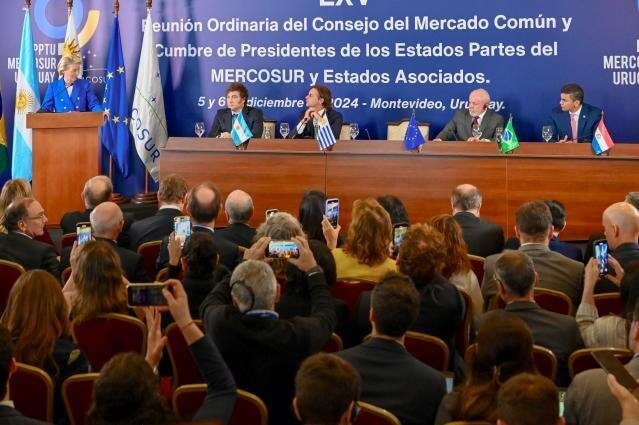 Trade agreements with countries of the Global South, such as India and Mercosur, offer an opportunity for diversification
Europe faces the risk of fragmentation if it does not act quickly: 27 different regulations continue to hamper growth, and national interests often prevail over common ones.
Von der Leyen calls for an "urgency mindset," but the real turning point will be whether member states actually surrender some of their sovereignty in favour of a stronger union.
The forecast for the coming years suggests that the success of this strategy could turn Europe into a true third pole of global power – not just between the US and China, but as a leader in areas where other powers lag, such as the green transition and regulatory standards.
However, a potential risk remains. If the reforms remain on paper, Europe could become a marginal player, dependent on foreign technologies and energy.
Trade agreements with countries of the Global South, such as India and Mercosur, offer an opportunity for diversification, but require compromises that some members find difficult to accept.
Ultimately, Ursula von der Leyen's speech at Davos signals that Europe is entering a decade of profound change. This is not just a reaction to crises, but an attempt to use them to create a more resilient and competitive Union.
The world is watching to see whether Europeans will have the will to implement what they have set out to do. If they succeed, 2030 could usher in a Europe that not only survives but also shapes global rules.
