Washington’s ‘epic fury’ at its European allies has flared up again after a short lull, with Donald Trump threatening to pull US troops out of Germany in response to criticism from chancellor Friedrich Merz over the Iran war.
In recent days it had seemed that the let-up in the fighting in the Middle East had also eased the outbursts from the US president and his officials aimed at not only their enemies but also their allies.
The world might, in fact, be in a period of both shadow war and shadow alliances. Just as the conflicts in the Middle East remain unresolved, and therefore volatile, the damage to America’s network of alliances persists and might soon erupt in a more dramatic fashion.
NATO remains the focus of the US president’s ire. An upcoming summit in Ankara the first week of July could become the scene of a significant showdown.
That’s just one hotspot in the patchwork of fraying Western alliances and close cooperation frameworks.
The other one that stands out is, of course, the US-UK special relationship, recently further undermined by the Iran war and also by a leaked Pentagon memo questioning Washington’s stance on the Falkland Islands.
But there’s much, much more. Amid a wave of global instability and uncertainty and a shift in economic power as well as changing demands for raw materials, interests are being recalibrated at a furious pace. This goes especially for US-centred networks but also applies more widely.
Alliances shifting at breakneck speed
Take, for example, the close relationship between Beijing and Moscow, which is now almost taken as a given. This is mostly a fairly recent development, since Russia started picking pieces off Ukraine in 2014 and accelerated just before its full-on invasion.
In the meantime, Russia’s own alliances have been suffering, as was most clearly illustrated by its abandonment of Armenia in that country’s conflict with Azerbaijan.
Even Kazakhstan, despite signing a ‘Comprehensive Alliance Declaration’ with Russia in 2025, has been slowly distancing itself from its larger neighbour.
Both the Gulf Cooperation Council and OPEC have come under pressure from the UAE’s withdrawal from the latter
In both cases, the West, or at least the US, has been one of the beneficiaries as these countries seek to leave or deviate from the Russian orbit.
The Middle East is another area where alliances are shifting at breakneck speed. Some of this is a consequence of the war on Iran, some of it has been longer in the making.
Both the Gulf Cooperation Council and OPEC have come under pressure from the UAE’s withdrawal from the latter.
This reflects a growing rupture between erstwhile close allies Saudi Arabia and the UAE. Just five years ago, both were still united in their ostracism of Qatar. Now Doha and Riyadh couldn’t be closer.
Aggressive campaigns and regional rivalries
In the background are aggressive campaigns by both Israel and Turkey to expand their influence in the region.
Turkey holds good cards in Syria, where it backed the winning faction in its civil war. And Ankara is in discussions with Saudi Arabia and Pakistan on a defence pact, sometimes dubbed an ‘Islamic NATO’.
While a catchy moniker, the reality probably remains that Turkey and Saudi Arabia will also continue to be regional rivals.
Israel, meanwhile, has a completely different set of relational issues to deal with. Its ambitions to pull Saudi Arabia into the orbit of Trump’s Abraham Accords are stalled for at least the foreseeable future.
Post-Trump, Israel could be in for a much less invested US president, at the very least
Its own aggressive policies make a rapprochement with Syria’s new government less than likely and continue to put pressure on its relations with Jordan and Egypt.
More crucially, though, Benjamin Netanyahu’s decision to ‘Trump-maxx’ can have serious consequences for Israel’s long-term relationship with the US.
While Israel’s reaction to the Hamas attack of 7 October 2023, i.e., the carnage in Gaza, had already undermined public support in the US, the hugely unpopular joint Israeli-US attack on Iran has further eroded sympathy for the country.
Post-Trump, Israel could be in for a much less invested US president, at the very least, and also for much more blowback in Congress, where its once highly effective lobbying machine is sputtering.
One consequence is the now almost omnipresent discussion on phasing out of US military aid for Israel. While this is often presented by both sides as a chance to strengthen the alliance, it’s hard not to see it as the beginning of the end of the very close relationship between these allies.
Geopolitical vandalism
There are many more alliances and frameworks around the world that are coming under pressure in Africa, Latin America and Asia, reflecting the rapidly shifting geopolitical, economic and technological tectonic plates.
To focus on intra-Western relations, some have seized on this changing world to justify a more opportunistic US approach to international alliances. “The Trouble With Permanent Alliances”, was one headline on an article in Foreign Affairs, for example.
While not agreeing with Trump’s methods, it basically argues that the US should loosen ties with the waning European nations and concentrate on rising ones in order also to better manage its relationship with the two other powers that count, China and Russia.
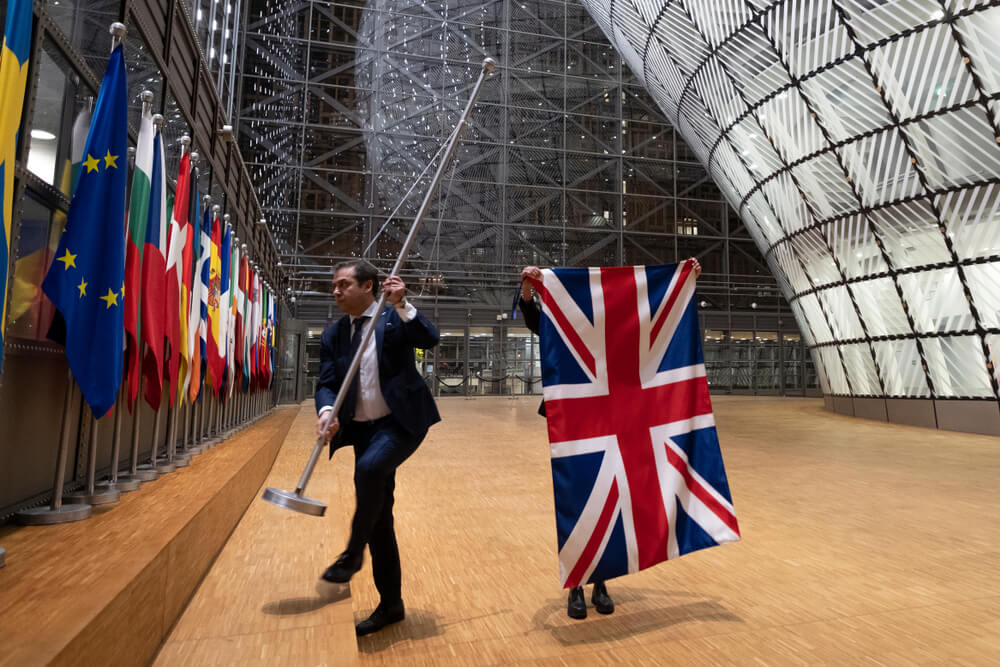 The British withdrawal from the EU was a random act of geopolitical vandalism
While it’s hard to deny that realities change, there’s also a danger in introducing more randomness and instability into international relations.
Take Brexit: the British withdrawal from the European Union appears to have been wholly unprovoked by changes either in the bloc or outside it. It was a random act of geopolitical vandalism. It will take decades or more to repair the damage it did to the Western alliance.
The idea that all alliances should be time-limited and purely opportunistic seeks to impose a one-size-fits-all logic on a much more complex world.
Yes, some pacts might have a sell-by-date, but others form the pillar of a stable world order and should not so easily be messed with. Ultimately, these are about guaranteeing the survival of shared value systems, not just strategic interests.
To put it in Lord of the Rings terms that might be recognisable to the tech-bros who underpin so much of the Trump agenda: Don’t be like Rohan and turn away from your allies. In the end you’ll still have to come to their aid.
Of course, the question then becomes if America under Trump and Europe still share roughly the same value system? Short of the US becoming an oligarchical dictatorship in the near future, there’s no reason to suspect otherwise.
This makes the Trump threats against Greenland, for example, and his now very possible, if not probable, disengagement from NATO fall into the same category as Brexit: geopolitical vandalism.
Not everybody is as gloomy about the future of the military alliance. In a piece for Politico, former US ambassador to NATO Ivo Daalder argues that a ‘more European NATO’ could emerge, to the benefit of both sides.
For that to happen, though, the Trump administration will have to stop treating its allies as the enemy, something that, since the Iran war, looks less likely than ever.
