For thirty years, economists used a single term when discussing Saudi Arabia in the oil market: swing producer.
It was the only country with enough spare capacity to adjust production whenever prices moved in an undesirable direction, thereby correcting the course.
That role formed the basis of the global energy order – a tacit agreement between Riyadh and the rest of the world, in which Saudi Arabia provided some predictability and, in return, the world accepted Saudi dominance within OPEC and refrained from asking too many questions about other matters.
That role is now defunct. Due to a series of decisions, circumstances, and fiscal pressures, Saudi Arabia today has both less capacity and less motivation to play the same role.
How a cycle fell apart
The beginning of 2025 seemed to mark another typical OPEC+ cycle. The group’s eight key countries, after a series of voluntary cuts introduced in 2023, started phasing out an additional set of production cuts, with a total impact measured in several million barrels per day.
The rationale was straightforward: as the market stabilised, the group would gradually return relatively small volumes of oil each month – hundreds of thousands of barrels per day – over the period from spring 2025 to 2026.
For Saudi Arabia, this meant a significant increase in its formal quota, for the UAE, an even more marked rise in production capacity.
Key countries implemented the announced increase but paused further steps during the first three months of 2026
As usual, the announcements emphasised that the plan was gradual and flexible – standard OPEC wording indicating it reserved the right to halt everything if price trends became unfavourable.
At the end of 2025, that right was exercised. Key countries implemented the announced increase but paused further steps during the first three months of 2026, citing seasonally weaker demand and rising risks of oversupply.
Up to that point, everything still resembled normal market management. Then came the crisis in the Strait of Hormuz.
Hormuz: when quotas become irrelevant
The American and Israeli strikes on Iran and the subsequent closure of the Strait of Hormuz invalidated the key assumption underlying the entire OPEC+ strategy: that Gulf producers can physically deliver the oil promised in their quotas.
When the main export route for a significant portion of global supply is partially blocked, formal quotas become less important than actual logistics.
In May 2026, OPEC+ announced a total output increase of 188,000 barrels per day. This decision served more as a political signal than a genuine tool for market supply: the UAE was already leaving the organisation at that time, and the remaining members lacked the capacity to translate the quota increase into actual deliveries while the strait was partially blocked.
The estimated gap of more than 2 million barrels between what is on paper and what reaches the market is more telling than any official announcement
Saudi Arabia’s nominal quota rose to just over 10 million barrels per day, while actual deliveries remained closer to 8 million, according to independent estimates by analysts such as S&P Global Commodity Insights and Wood Mackenzie.
The estimated gap of more than 2 million barrels between what is on paper and what actually reaches the market is more telling than any official announcement.
Analysts have noted for years that almost all relevant spare capacity within OPEC+ is in Saudi Arabia, while most other producers operate near their limits.
There is also a fundamental paradox: every barrel Saudi Arabia adds now leaves less in reserve for the next shock. The more it acts as a stabiliser today, the less it can be a stabiliser tomorrow.
Fiscal math that does not add up
Behind operational restrictions lies an even more serious problem: Saudi Arabia does not have the fiscal space to act as a stabiliser indefinitely.
The IMF estimates that the country requires an oil price between $80 and $90 per barrel, with some projections closer to the upper end of that range, to roughly balance the budget.
The budget deficit has risen above 5 per cent of GDP again in 2025, and projections for 2026 indicate continued high deficits even with relatively firm prices.
As the gap between revenue and expenditure widens, the government increasingly relies on borrowing.
Recent years have shown that actual results are generally weaker than these initial plans
Estimates from leading investment banks suggest that Saudi Arabia’s total borrowing in 2026 could reach about $25 billion, significantly higher than the $14 to $17 billion projected by the government in its official forecasts.
Recent years have shown that actual results are generally weaker than these initial plans.
Price volatility directly undermines income planning. Brent’s decline from above $100 to around $90, which Goldman Sachs and JPMorgan analysts forecast for the second half of 2026 if the Hormuz passage normalises, could potentially wipe out tens of billions of dollars in expected annual revenues, estimated at $40 billion to $50 billion depending on volume and domestic consumption assumptions.
This is equivalent to the entire annual budget of the Saudi Ministry of Defence.
Vision 2030: an oil-financed plan
This fiscal situation directly affects Mohammed bin Salman’s most ambitious political project. Vision 2030, a plan to diversify the economy with total costs in the trillions of dollars, is fundamentally financed by oil, either through budget revenues or transfers to the Public Investment Fund.
Megaprojects such as NEOM, the development of tourism on the Red Sea, and the Diriyah Heritage project share one common denominator: the money comes, directly or indirectly, from the monetisation of oil resources.
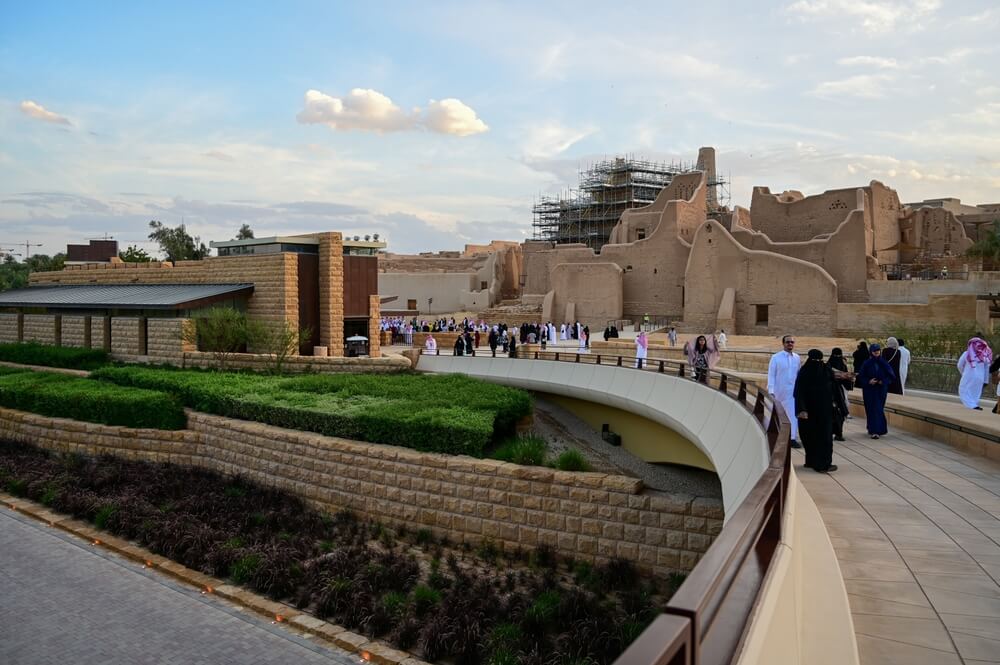 Megaprojects such as NEOM and the Diriyah Heritage project share one common denominator: the money comes, directly or indirectly, from the monetisation of oil resources
The Saudi government is already adjusting its ambitions to reality. Officials increasingly refer to “smarter spending,” meaning projects with lower expected returns are being slowed, restructured, or quietly abandoned.
In its reports, the IMF welcomes the move towards more selective spending, but notes that diversifying the economy is much more difficult under fiscal consolidation than during periods of expansion, especially for a country attempting to reduce its dependence on oil just as its oil revenues are becoming more uncertain and unpredictable.
OPEC+ is held together only by inertia
The organisation is showing signs of erosion not seen since the oil wars of the 1990s. The UAE has left OPEC+, which is not a minor detail, despite what some analysts suggest.
This is one of the few member states with significant spare capacity and infrastructure, enabling a relatively rapid increase in exports. Their exit means OPEC+ has lost its second real lever of market influence, after Saudi Arabia.
The rest of the group is structurally divided. Russia needs high oil prices to finance the war and offset sanctions, which limits Moscow's willingness for deep and long-term cuts.
The fundamental imbalance between supply and demand will once again become the dominant factor
Iraq and Kazakhstan have regularly exceeded agreed quotas for years. Several smaller producers in North Africa and the Middle East are operating close to their physical maximum and have no room for significant adjustment.
What holds OPEC+ together today is not a coherent strategy, but inertia and a lack of better options for key players. In this environment, market expectations and official projections are diverging further.
The International Energy Agency and commercial analysts highlight the risk of a significant global supply surplus in 2026, while OPEC's own documents indicate only moderate surpluses.
The crisis in Hormuz has temporarily complicated this outlook, but as tensions ease, the fundamental imbalance between supply and demand will once again become the dominant factor.
Two scenarios, same structural problem
If the crisis in the Strait of Hormuz is resolved relatively quickly and shipping returns to normal within months, several analyses indicate that oil prices could fall below $80 a barrel, potentially into the $70 range, as logistics and supply stabilise.
This is pushing Saudi Arabia into a fiscal trap again: the deficit is growing, the Public Investment Fund must postpone investments, and Vision 2030 projects are facing a redefinition of scope and deadlines.
In this scenario, Riyadh will be under pressure to cut production to raise prices, but a unilateral cut no longer makes sense. While Saudi Arabia loses market share, Iraq, Kazakhstan and others easily fill the gap, and the price remains unresponsive.
If the crisis persists and prices remain high, the short-term fiscal situation appears improved, but the structural problem is merely deferred.
Neither Washington nor Riyadh is playing the role of stabiliser any longer – one is too focused on domestic politics, the other on balancing the budget
The country continues to spend more than it earns at price levels that, due to ongoing Vision 2030 project expenditure and domestic subsidies, must be higher than ever before. Each period of high oil prices creates an appearance of stability that conceals systemic dependency.
Both scenarios lead to the same conclusion. Spare capacity is not expanding quickly enough because Saudi Arabia, facing fiscal constraints, is not investing as aggressively in upstream as it would prefer. The fiscal breakeven threshold rises each year as Vision 2030 introduces new permanent expenditures into the system.
The relationship between Washington and Riyadh over oil production is becoming more transactional and less strategic. The US administration pressures Saudi Arabia to increase production whenever fuel prices become a political issue at home; Riyadh sometimes agrees, sometimes refuses, but in both cases decides based on its own fiscal interests, not market demands.
As a result, neither Washington nor Riyadh is playing the role of stabiliser any longer – one is too focused on domestic politics, the other on balancing the budget.
A market without shock absorbers
A world without a functioning swing producer is one with permanently higher oil price volatility. Prices will not necessarily remain permanently higher, but they will be permanently more unpredictable.
Any geopolitical incident that, ten years ago, would have been manageable because Saudi Arabia could compensate for production losses now becomes a potential shock.
 Saudi Arabia remains the largest single producer with the greatest spare capacity in OPEC, but that is no longer enough to guarantee the market stability
Any period of weak demand that would once have been mitigated by Saudi cuts now risks turning into a sharper price drop, as Riyadh has neither the fiscal stamina nor the political space to keep output low for long.
Oil markets have operated for decades on the tacit assumption that one player would ultimately stabilise the situation. That assumption no longer reflects reality.
The markets have not yet fully incorporated this into prices, but they will have to, either through higher risk premiums or through more frequent and deeper price fluctuations.
Saudi Arabia remains the largest single producer with the greatest spare capacity in OPEC, but that is no longer enough to guarantee the market stability it has provided for three decades.
The mechanism that absorbed shocks no longer works, and there is no replacement.
