Europe is again debating a question it hoped it had left behind with the Cold War: Would Russia attack NATO? Recent weeks have given the question new urgency.
Russian-linked sabotage, cyber operations, armed drone incursions, and threats to critical infrastructure are no longer isolated episodes.
France and Poland have both warned that Russian hybrid attacks are intensifying and cite intelligence that hints at a possible Russian provocation or attack on the alliance’s Eastern flank. European governments are discussing new response mechanisms.
Yet a familiar counterargument persists: Russia already has its hands full in Ukraine.
NATO would see an attack coming. Moscow understands Article 5. Putin would not dare. All of those might also be true.
But “Putin wouldn’t dare” is not a defense strategy, and disbelief cannot replace a credible deterrent.
Rather than trying to divine Russian intentions, NATO, the United States, and all our allies should concentrate on something more tangible: whether we are adequately prepared if our assumptions prove wrong.
Russia has already demonstrated what it can accomplish in the gray zone: sabotage, cyberattacks, assassinations and attempted assassinations, disruption of undersea infrastructure, election interference and information operations; all actions deliberately calibrated below the threshold of conventional war to test the alliance’s resolve.
NATO now openly describes an expanding Russian campaign incorporating many of these tools.
The danger, therefore, is not simply that we overreact. It is that, in our determination not to “scaremonger,” we look past glaring deficiencies while another revolution in military affairs unfolds in front of us. Three issues deserve particular attention.
Yesterday’s doctrine, tomorrow’s vulnerability
First is the transformation of the battlefield by drones and electronic warfare.
Ukraine has become perhaps the most important military laboratory since World War II.
Cheap drones now perform missions once requiring enormously expensive aircraft or precision weapons.
Electronic warfare (EW), counter-drone systems, AI-fueled software adaptation, and the mass deployment of unmanned systems are changing the battlefield monthly.
NATO recognizes this. At its July 2026 summit, Allies committed more than $40 billion over five years to counter-drone technologies.
NATO Secretary General Mark Rutte acknowledged what Ukraine has already demonstrated: drones have fundamentally altered modern warfare.
That is welcome. But the question should remain uncomfortable for all NATO members: Are we changing fast enough?
As the alliance's largest member and home for many of its most modern and important platforms, is the U.S. adapting fast enough?
A future fight on NATO’s eastern flank would not resemble Desert Storm nor Operation Iraqi Freedom
A future fight on NATO’s eastern flank would not resemble Desert Storm nor Operation Iraqi Freedom.
Large headquarters, logistics nodes, airfields, ammunition depots, and armored formations would operate beneath an increasingly transparent battlespace saturated with drones, sensors, and EW attacks.
Ukraine has shown how quickly yesterday’s doctrine can become tomorrow’s vulnerability.
Recent exercises have exposed serious vulnerabilities in NATO forces, particularly against the kind of drone warfare Ukraine has pioneered. Academics and nationalistic politicians focus too much on points of pride rather than alliance readiness.
The Baltics and Poland are probably more ready than much of the alliance; they have invested heavily in their militaries for years while others downsized.
But serious readiness gaps remain in the UK, Germany, and the United States, and the entire alliance needs to feel more urgency.
Recent exercises have exposed just how much NATO forces still need to learn about the drone-saturated battlefield.
Ukraine should not simply be receiving NATO training. Increasingly, NATO should be learning from Ukraine.
When wars become wars of production
Second, numbers matter. Stockpiles matter, and as Iran has shown, industrial capacity matters, particularly for critical systems. Smaller, cheaper platforms can affect hugely expensive weapons.
Ukraine again demonstrated this. The current conflict involving Iran and the broader Middle East is demonstrating it again with interceptors and precision weapons.
Sophisticated weapons are of limited value when inventories (Patriot interceptors, for example) cannot sustain the rate at which modern warfare consumes them.
NATO is moving in the right direction. Allies announced more than €50 billion in new procurement agreements this summer and are expanding defense production.
Ukraine has reminded us of an older truth: technology changes everything, and wars between major powers can become wars of production
The U.S. is desperately trying to restock interceptor inventories. But rebuilding magazines and manufacturing capacity takes years, while missiles and ammunition can disappear in days or weeks of intense combat.
For decades, Western militaries planned around technological superiority and relatively short conflicts. Europe grew accustomed to a warm blanket of U.S. and NATO air superiority that, it was felt, no rival could challenge.
Ukraine has reminded us of an older truth: technology changes everything, and wars between major powers can become wars of production. We are not producing enough in the right critical areas.
The Pentagon’s Drone Dominance program aims to acquire hundreds of thousands of small drones through 2027. Russia, meanwhile, is producing military drones on a scale measured in the millions.
The dangerous question of deterrence
Finally comes deterrence – and the dangerous question of what Vladimir Putin might “dare” to do.
We should be careful not to pretend we know Putin’s state of mind. Russia’s decision-making system is increasingly opaque, highly centralized, and dominated by a security apparatus with every incentive to reinforce the Kremlin Boss’s worldview.
No intelligence service can reliably tell policymakers exactly what another leader will do, especially one like Putin, literally living with a bunker mindset and corrupt Siloviki not willing to disagree with him. History should therefore make us humble.
In the weeks before February 2022, many officials and commentators remained skeptical that Putin would order the massive invasion they were watching unfold.
Ukrainian President Volodymyr Zelenskyy himself publicly pushed back against warnings he believed were creating panic and damaging Ukraine’s economy – scaremongering was the concern then, just as it has become the buzzword now in the Baltics.
Then Russian forces crossed the border in the largest land invasion in Europe since World War II.
Nor was 2022 Russia’s first willingness to use massive military force against a neighbor.
 We should not build deterrence around our confidence that Russia would never take the risk
Georgia learned that in 2008. Ukraine learned it in 2014 and again on a vastly greater scale eight years later.
That does not mean a Russian attack on NATO is inevitable, at any level, limited or otherwise, nor even that Moscow has decided upon such a course itself (Putin’s own Siloviki, like Stalin’s lieutenants, probably don’t know what an increasingly more erratic and aging “Boss” thinks).
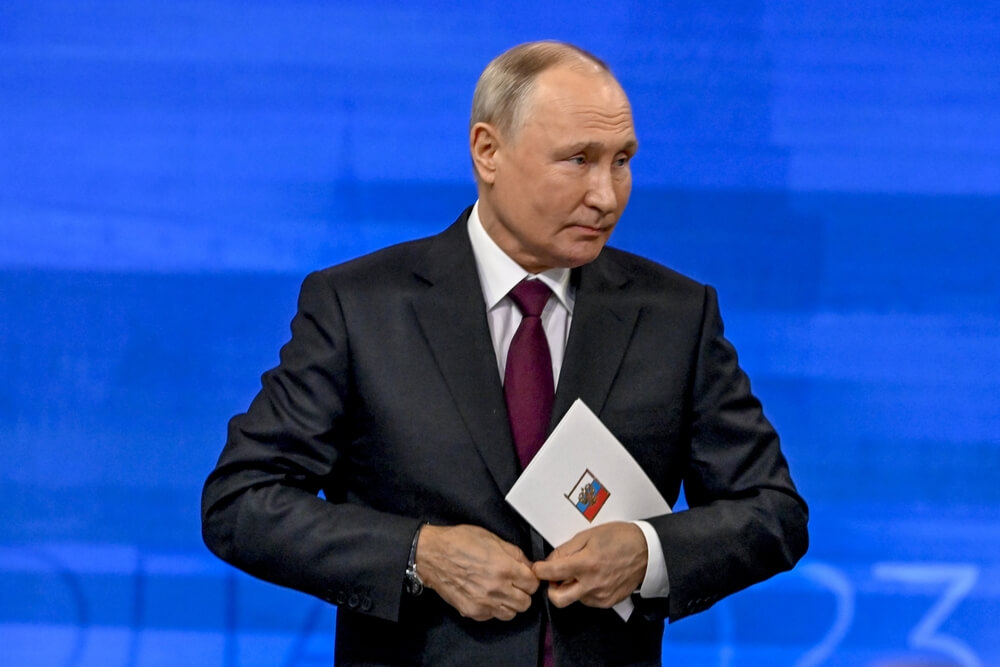
But this all means something more important: we should not build deterrence around our confidence that Russia would never take the risk.
Experts have been proven wrong on that score countless times as an autocrat’s calculus shifts on impulse alone.
Putin’s record over more than two decades shows repeated willingness to escalate, absorb extraordinary costs, and test how far his opponents are prepared to respond.
NATO officials themselves now describe Russian behavior as demonstrating an increased appetite for risk.
Preparation is not panic
Preparing seriously for that reality is not warmongering or scaremongering. It is how wars are prevented.
The most dangerous assumption in deterrence is not believing your adversary is ten feet tall. It is believing you know where he will stop.
Russia may never directly test NATO with a kinetic strike, provocation, or massive cyber-attack.
After Georgia, Crimea, Ukraine, and years of hybrid operations against the West, assuming that Moscow wouldn’t dare is not strategy
But after Georgia, Crimea, Ukraine, and years of hybrid operations against the West, assuming that Moscow wouldn’t dare is not strategy.
In the former case, we risk being overprepared; in the latter, we risk war by letting our adversary think they can win.
Preparation is not panic. Readiness is not escalation. And deterrence ultimately rests on more than declarations; it rests on convincing an adversary that aggression will fail and the costs will be immediate.
The start of that is hitting back on Russia for every armed drone incursion, like Leipzig, every act of sabotage, every cable-cut or attempted assassination.
It is a gamble not to see the threat, and not responding with force is doubling down. Unlike 2022, 2014, or 2008, we can’t afford to gamble again.
Sean Wiswesser is a former CIA Senior Operations Officer and expert on Russian Intelligence, Espionage, and Defense Issues.
