In Lublin, in eastern Poland, an anti-aircraft shelter from the mid-1980s, built beneath the premises of the city’s bus company, is back in operation.
After renovation, it can accommodate 200 people and supply them with air, water and electricity for three days, independently of the public network.
One change also carries symbolic weight: the emergency exit now faces west instead of east.
When the shelter was built, Poland was part of the Soviet bloc and, according to official doctrine, the enemy was expected to come from the west. Today, the danger comes from the opposite direction.
That shelter is not a museum piece. Poland is on high alert after several incursions by Russian missiles and drones into its airspace, with residents of eastern regions receiving evacuation warnings whenever Russia attacks western Ukraine.
Last week, a regional television station interrupted a live programme for 20 minutes because its journalists had to take shelter.
Prime Minister Donald Tusk said at a cabinet meeting this week that Poland is scrambling fighter jets day and night because Russian attacks on western Ukraine, right next to the Polish border, have become a daily occurrence.
In recent years, Poland has spent tens of billions of euros on tanks, missile systems, aircraft and ammunition, and for 2026 it has allocated about 200 billion Polish zlotys for defence, approximately 51.3 billion dollars, or 4.81 per cent of GDP.
Increasingly, security funding is being directed towards the less visible challenge of keeping cities, hospitals, water systems, the power grid and millions of civilians functioning if the country comes under prolonged attack.
The scale of that task is best illustrated by the numbers. About 2,000 fully equipped shelters have space for around 300,000 people, fewer than one per cent of the population of 38 million.
Poland has also recorded more than 86,000 basements, underground garages, underground stations and other spaces that could accommodate about 23 million people, but most do not have ventilation, autonomous power supplies, water or other systems that purpose-built shelters have. Even today, many citizens do not know where to take shelter.
Railway to Lublin as a warning
In recent years, European security policy has focused on increasing troop numbers, ammunition stocks, air defence and fighter jets.
The war in Ukraine has shown how heavily military capability depends on energy, transport, telecommunications and healthcare.
A power outage hampers military operations and logistics, a damaged railway slows the movement of units and equipment, a communication breakdown disrupts crisis management, and hospitals must care for civilians and soldiers simultaneously.
Poland did not have to learn that lesson only from Ukraine. In November 2025, an explosive device destroyed part of the railway from Warsaw to Lublin near the village of Mika and, on the same line, overhead contact lines were destroyed.
This is the railway used to send aid to Ukraine. The Polish authorities have accused two Ukrainian citizens of the attack, who, they claim, worked for the Russian intelligence service.
Warsaw subsequently closed the last Russian consulate in the country and deployed thousands of troops to guard critical infrastructure.
Civilian systems are not only a target in war; they are being attacked now, below the threshold that would trigger allied defences
Civilian systems, therefore, are not only a target in war; they are being attacked now, below the threshold that would trigger allied defences.
That is why Poland is now including these systems in its defence planning, and this has immediate security value.
A strike on the power grid, railways or telecommunications has the greatest effect when it causes long-term disruption, mass displacement and pressure on state institutions.
The faster the state restores basic services and organises daily life during an attack, the less benefit an adversary can expect from targeting civilian infrastructure.
Civil protection thus becomes part of deterrence. Military power remains its foundation, but the state’s ability to withstand a serious blow depends increasingly on how quickly it can restore key civilian systems.
Thirty-four billion for the neglected part of defence
Poland has begun to turn that problem into budgetary and legal obligations. The Act on Civil Protection and Civil Defence of December 2024 stipulates that at least 0.3 per cent of GDP must be allocated annually to these tasks.
For 2025 and 2026, a total of almost 34 billion zlotys, about 8.7 billion dollars, is planned for a system much broader than shelters alone.
The programme covers backup water and energy supplies, warning systems, communications, medical facilities, stockpiles of supplies and equipment, training for services and citizens, and the organisation of civil defence.
The Ministry of the Interior is also preparing the next programme, for the period from 2027 to 2031, with a preliminary budget of at least 105 billion zlotys, or about 27 billion dollars.
The programme still awaits final government approval, but it clearly shows the scale of the change.
Civil protection is being transformed from an occasional item into a permanent public function
Civil protection is being transformed from an occasional item related to floods, fires and industrial accidents into a permanent public function, to which a substantial share of state funds will be allocated in advance.
The distribution of that money also reveals the plan’s weakest point. For 2027, at least 23.4 billion zlotys, about 6 billion dollars, is planned, and for 2028 more than 24.7 billion, about 6.3 billion dollars.
After that, the amounts fall to 18.4 billion zlotys in 2029, about 4.7 billion dollars, then to 19 billion in 2030, about 4.9 billion dollars, and to 19.5 billion in 2031, about 5 billion dollars.
Funding is thus already reduced by about a quarter within the government’s own plan, before the legal standard of protection is even approximately achieved.
The figures themselves should not be read literally. The statutory 0.3 per cent of GDP partially overlaps with broader defence spending, so that amount cannot simply be added to the military budget and presented as entirely new expenditure.
The burden on cities
Most of the implementation will fall on local authorities and operators who manage cities on a daily basis.
Their tasks will include determining which facilities can be used as shelters, providing backup power for waterworks and hospitals, defining evacuation routes and the movement of military columns, and agreeing what should be repaired first if communications or the transport network are damaged. Central government can provide funding and set standards, but actual readiness will depend on what is done on the ground.
The standard is set high. The law requires cities to provide shelter for at least half of the people who may find themselves in their territory at the time of danger, and part of that capacity must be in facilities with a higher level of protection.
From 2026, the obligation to provide protected space will also apply to new public and multi-family residential buildings, thus returning shelters to urban planning after several decades.
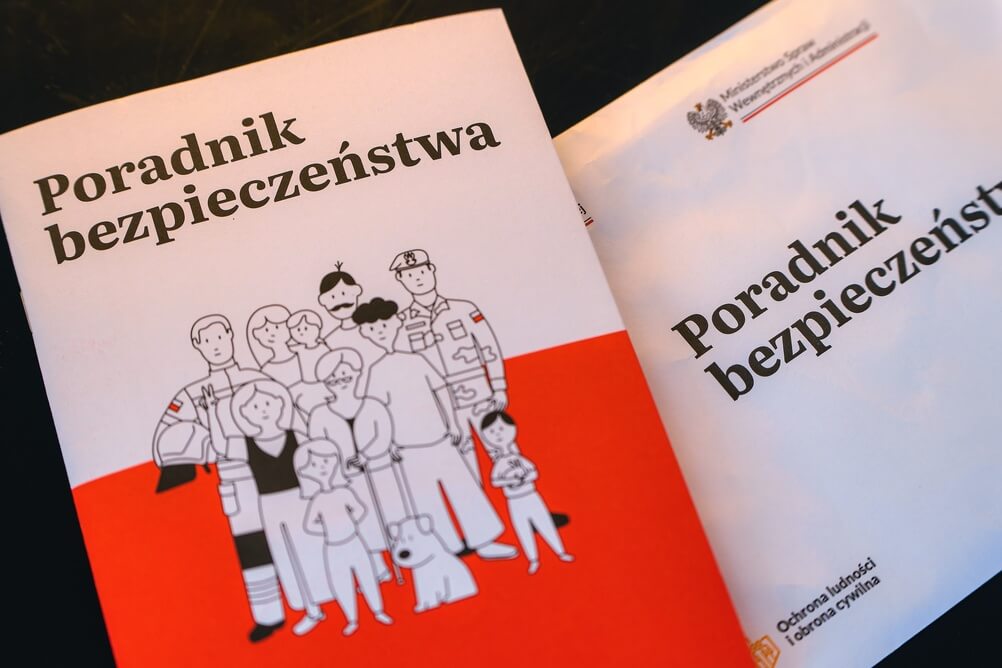 At the end of 2025 and the beginning of 2026, almost 17 million copies of a safety manual were delivered to every Polish household
Between the current figure of fewer than one per cent of places in actual shelters and the legal target lies a multi-year programme of construction and adaptation of existing buildings. Such infrastructure cannot be created within a single budget year.
At the end of 2025 and the beginning of 2026, almost 17 million copies of a safety manual were delivered to every Polish household, with instructions for power failures, evacuation, air raids, cyber incidents and other crisis situations. More important than the document itself is the state’s changed attitude towards the population.
Citizens are once again treated as part of the civil defence system, with predefined procedures, a practice that disappeared in much of Europe after the Cold War. T
he new programme includes practical workshops for citizens and further development of the Civil Defence Corps, because a manual in the letterbox is not yet a practised response.
Resilience enters the NATO equation
The Polish programme is gaining wider importance due to changes within NATO. After the 2025 Hague summit, members will be able to count up to 1.5 per cent of GDP towards a broader security investment category that includes infrastructure, resilience and civil preparedness.
On 15 September, the Alliance announced for the first time the new requirements for member states’ resilience.
Allies are required to have plans for the continuity of government; energy, food and water supplies; health; communications and transport operations; and for the ability of civilian infrastructure to support military operations.
It is particularly important that states determine in advance how they will share limited resources between the population, their own armed forces and allied units that would arrive as reinforcements.
That framework is reshaping the political economy of European defence. Much future security spending will flow through the budgets of cities, energy companies, hospitals, telecoms operators, railways and the construction sector.
Poland is the most interesting case here because it already has a large civil protection programme
Private owners of key infrastructure will have to plan their operations for severe crisis conditions, and governments will have to decide who pays for backup systems and supplies that may not be needed for years under normal circumstances.
The same framework also creates scope for accounting tricks. Under NATO rules, resilience and civil defence expenditure is recognised if it is based on national resilience planning or required to carry out allied plans.
This wording is broad enough to cover almost any infrastructure investment. It will therefore be increasingly important to distinguish investments that genuinely increase the state’s ability to function in a crisis from projects that are simply reclassified to meet a political spending target.
Poland is the most interesting case here because it already has a large civil protection programme, legally guaranteed allocations and one of the highest levels of military spending in NATO in relation to GDP.
In its case, it will be seen most clearly how much the new NATO calculation brings additional capabilities and how much it merely provides a new classification of existing expenditure.
Europe between Finland and Germany
How far Poland has really advanced is best seen in comparison with the rest of Europe.
Finland has about 50,500 shelters with space for around 4.8 million people, approximately 85 per cent of the population, as a result of a legal obligation to build them that has been in force since 1958.
Germany has kept 579 of the former 2,000 public shelters, with about 480,000 places, which is half a per cent of the population.
Ukraine shows the cost of delay
In terms of the actual number of shelters, Poland is currently closer to Germany than to Finland.
The difference is that it has already translated that decision into legislation and a multi-year budget.
Ukraine shows the cost of delay. At the end of September, Russian attacks on Ukraine’s energy infrastructure again caused power outages, disrupted water supplies and traffic.
During the war, Ukraine developed the ability to make quick repairs, provide backup power and adapt public services to frequent shocks, but it paid this price while the war was already under way. Poland is trying to apply the same lessons in advance.
The real test is coming in 2029
The real test will begin when the new facilities and equipment come into use. Civil defence requires regular checks, exercises, maintenance and clear accountability for every part of the system, because a shelter that no one has inspected for years and a generator that has never been tested in crisis conditions very quickly become just entries in state records.
The greatest risk to the programme will arise not when the danger increases, but when it begins to wane.
The government’s plan already anticipates that funding for civil protection will decrease after 2028.
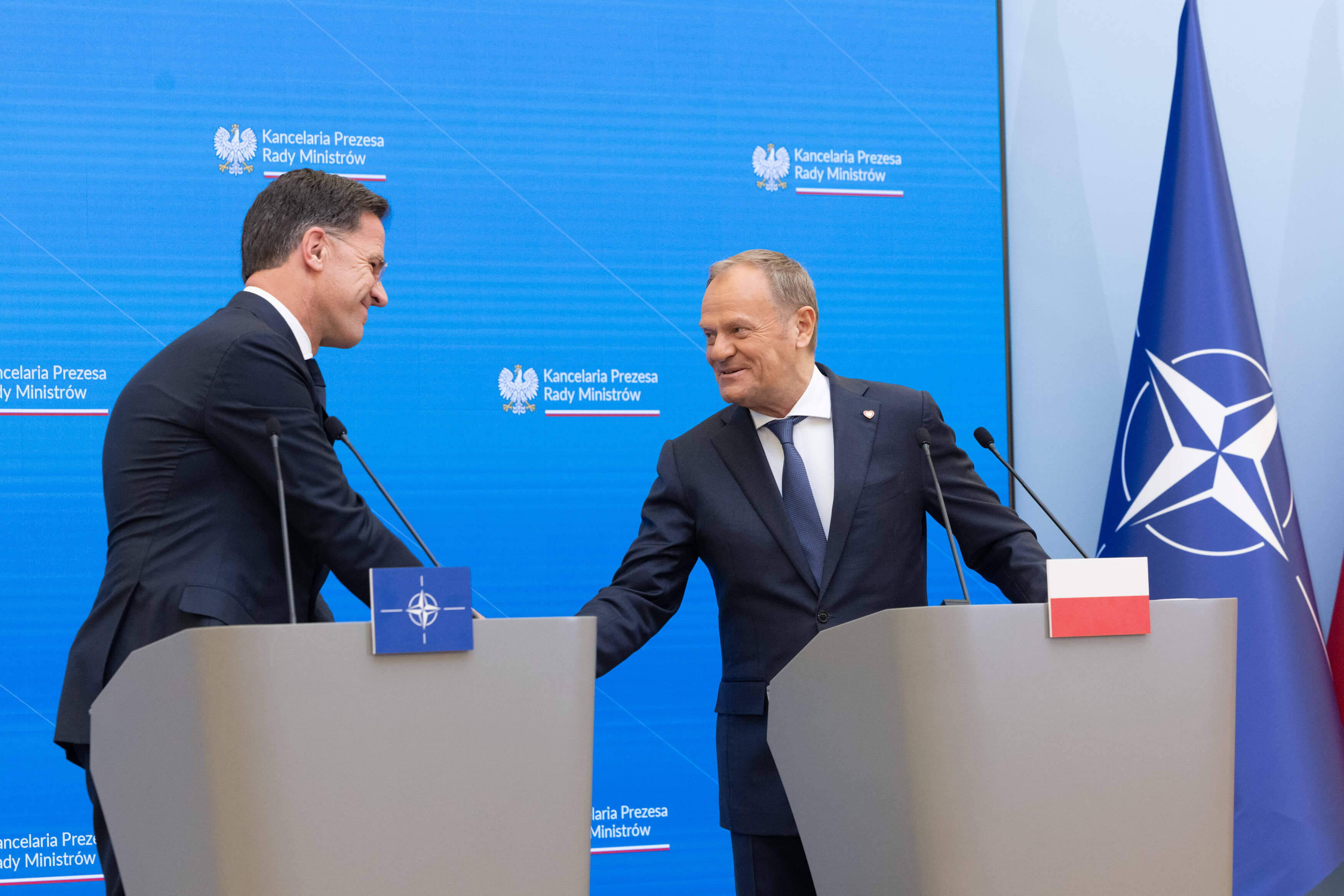 For the rest of Europe, Poland remains an example to learn from, while there is still time - Mark Rutte, Donald Tusk
If the war in Ukraine has frozen or slowed by then, and the sirens in eastern Poland have fallen silent, the public will find it much easier to accept these funds being diverted to other uses.
It will then become clear whether civil protection has really become a permanent function of the state or was only a response to momentary fear.
The European debate on preparedness will then have to move from allocated billions to much more concrete questions: how long hospitals can operate without power, how quickly a city can restore water and communications, how many residents know where to go during an emergency, and how long local authorities can manage a crisis without the full support of central systems.
Poland began to address these questions before the war imposed its own answer. In today’s Europe, this is already a serious strategic advantage.
For the rest of Europe, Poland remains an example to learn from, while there is still time.
Most European governments still measure preparedness by the percentage of GDP and the number of systems procured, while shelters, backup power for hospitals and trained citizens remain at the margins of their budgets.
Such projects are measured in decades, not electoral cycles, and once it is too late, no emergency budget can make up for the lost time.
The question for Berlin, Paris, Rome and Madrid is not whether Poland is exaggerating, but whether they really have as much time as they think.
