The military government in Myanmar has been announcing elections for more than four years as a solution to the crisis created by the February 2021 coup.
Since then, the promise of elections has been repeated in various forms, but the essence remains unchanged: elections are announced under conditions where there is not even a minimum of political competition, security, or institutional independence.
At the end of 2024, the military junta officially announced that the electoral process would begin with voter registration and verification of political parties in 2025, with a tentative plan to hold the vote in late 2025 or early 2026.
Although no precise date has been set, the authorities have made it clear that the entire process, from "preparation" to the formation of a new assembly, should last at least a year and proceed gradually in regions the regime considers to be under security control.
After overthrowing the elected government and arresting the civilian leadership, the military junta suspended key elements of the constitutional order and imposed a state of emergency, which has since been extended several times.
In parallel, the political infrastructure that enabled previous elections was systematically dismantled. Political parties were dissolved or forced to disband, their leaders were imprisoned or exiled, and the media were placed under strict control.
The central figure of the previous political system, Aung San Suu Kyi, is in prison and has been convicted in a series of proceedings that the United Nations and numerous international organisations consider politically motivated.
Her party, the National League for Democracy (NLD), was formally dissolved in March 2023 after it refused to re-register under new rules requiring implicit recognition of the military order established after the coup.
How the elections are legally "prepared"
The key step in preparing the election was not technical but legal. In 2023, the military government adopted a new law on the registration of political parties, which introduced extremely high organisational and financial requirements for national political entities with short deadlines for compliance. As a result, many parties failed to re-register.
During 2024, the regime partially adjusted these requirements, formally softening them, but without restoring essential political competition.
The aim of these changes was not to create space for the opposition but to ensure a sufficient number of "acceptable" political actors to enable the implementation of the electoral process.
In July 2025, the military government announced changes to the electoral framework concerning the method of converting votes into mandates.
The entire process is conducted by the electoral commission appointed after the coup
A combined model was introduced, in which some deputies are elected by the majority system in electoral units, while other mandates are distributed proportionally through party lists.
Although this change is formally presented as a reform, its practical effect is to disperse potential opposition support and prevent the concentration of votes against the regime.
The entire process is conducted by the electoral commission appointed after the coup, without international supervision and without conditions for a free campaign.
There is no equal access to the media, public debates are virtually impossible, and political organising is subject to repression.
Security reality on the ground
The most serious obstacle to holding elections is not procedural but security-related.
According to estimates by the United Nations and independent observers, armed conflicts are ongoing in many regions of the country.
Armed resistance to military rule, including ethnic armed organisations and new formations linked to the parallel National Unity Government (NUG), challenges or prevents the regime's control over significant parts of the territory.
Any potential elections would only be held in parts of the country firmly under military control
In these areas, there is no real possibility of conducting the electoral process. This means that any potential elections would only be held in parts of the country firmly under military control, while millions of citizens would be excluded from voting.
The military government avoids specifying the territorial scope of the elections and how it will address areas where voting is not possible.
This vagueness is not a technical failure but a deliberate political decision.
International reaction
The international community does not regard the announced elections as a democratic process but as an attempt to formally legitimise military government.
Western countries and the United Nations have made it clear that elections held without the participation of key political actors, under conditions of repression and armed conflicts, cannot be recognised as free and fair.
ASEAN, of which Myanmar is a member, adopts a more cautious but fundamentally similar stance.
Neither China nor Russia offer explicit political validation of the electoral process
The organisation avoids open confrontation but has not given political support to the election plan, and it maintains restrictions on the participation of Myanmar's military leadership in the highest-level regional meetings.
Neither China nor Russia offer explicit political validation of the electoral process. Their approach remains pragmatic and transactional, focused on stability and self-interest, without using language that describes the elections as a democratically legitimate process.
Why the military junta insists on elections
For the military regime, elections are not a mechanism for changing power but a means of transforming it into a more formal structure.
The goal is not the return of civilian democracy but the transition from open military administration to a controlled political system in which the military retains the key levers of power.
The elections are conceived as an administrative step towards stabilising the regime, not a political contest
Such a model is already embedded in Myanmar's 2008 constitutional structure, which guarantees the military seats in parliament and control over key ministries.
Elections would allow a return to that framework, but without an opposition capable of challenging it from within.
In other words, the elections are conceived as an administrative step towards stabilising the regime, not a political contest.
What elections can and cannot change
Even if the elections are held, they will not end the conflict or produce an internationally recognised government. They may change the institutional form of government, but not its essence.
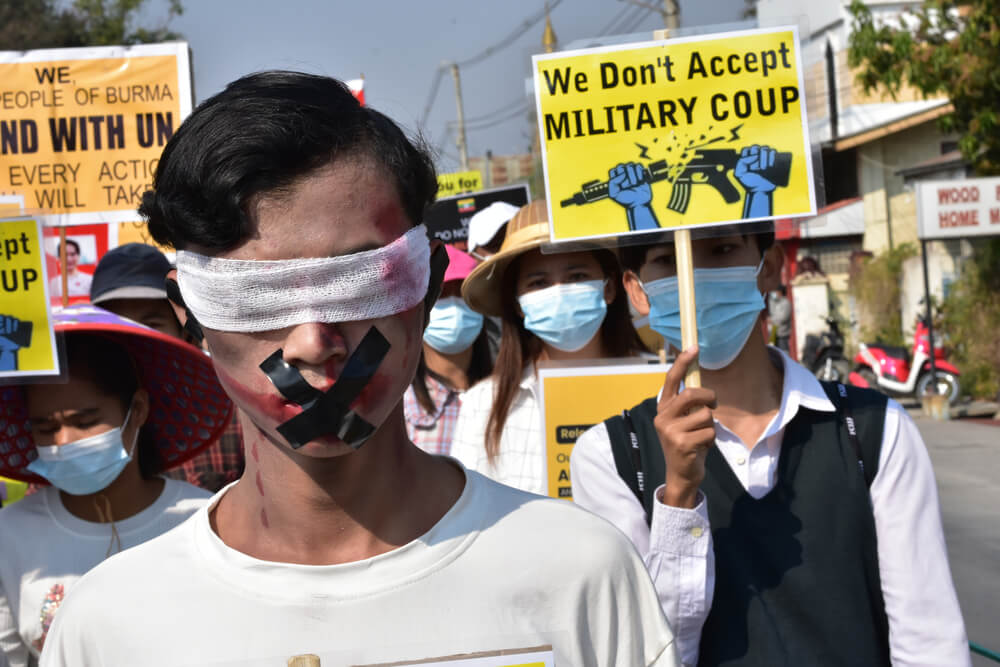 Elections without genuine competition can further deepen distrust between the state and society
For the domestic public, elections without genuine competition can further deepen distrust between the state and society.
For the international community, they will not provide grounds for lifting sanctions or normalising relations.
For the military government, they are an attempt to restore a semblance of institutional order in a country that remains deeply unstable.
This makes Myanmar's elections less a matter of timing and more a matter of purpose.
As long as key political actors are systematically excluded, and security conditions prevent normal political activity in much of the country, the electoral process cannot provide a way out of the crisis.
Under these circumstances, the electoral process merely serves as a formal mechanism to maintain the current order.
