The Kremlin’s failed foreign policy in the South Caucasus is increasingly pushing Vladimir Putin to use open political pressure and threats against Armenia over its move towards European integration.
During a press conference in Moscow, the Russian president stated that Yerevan must decide “as quickly as possible” on its future membership in the European Union, after which a possible “soft divorce” from Russia’s sphere of influence could take place on the basis of a referendum he recommended holding.
At the same time, Putin resorted to direct blackmail, referring to events in Ukraine and claiming that the current war was allegedly the result of “Ukraine’s attempt to join the EU.”
Thus, behind the rhetoric of a “civilised separation” lies a harsh ultimatum: the Kremlin makes it clear that Armenia’s departure from Russia’s sphere of influence will be perceived as an existential threat with corresponding consequences.
By invoking the so-called “Ukrainian scenario,” Moscow is effectively undermining its own statements regarding Yerevan’s right to independently choose its foreign policy course.
Putin placed particular emphasis on the claim that Ukraine’s movement towards the European Union allegedly “led to a coup d’état, the Crimean events, the conflict in the southeast, and military actions.”
Such rhetoric is not only manipulative, but also demonstrates Russia’s readiness to use force against states seeking to pursue an independent policy.
The Kremlin views the European integration of neighbouring countries not as their sovereign right, but as a challenge to its own geopolitical influence.
In reality, however, the cause of the war in Ukraine was not Kyiv’s European aspirations, but Russia’s aggressive actions – the occupation of Crimea and the destabilisation of Donbas.
What does Moscow expect from the elections in Armenia?
Putin’s statements, made on the day of the Victory Parade, carry not only symbolic significance.
The Kremlin realises that if democratic parliamentary elections are held in Armenia on 7 June, the most likely outcome would be a victory for Prime Minister Nikol Pashinyan's ruling party, Civil Contract.
Despite the presence of influential pro-Russian forces in the country, particularly the “Strong Armenia” bloc, their chances of victory are currently considered limited.
It cannot be ruled out that the Kremlin may consider a scenario of forceful intervention similar to the operation in Crimea in 2014
This is precisely why Moscow may seek to act pre-emptively, since after the official confirmation of Pashinyan’s victory it would be significantly more difficult to radically alter the political situation.
It cannot be ruled out that the Kremlin may consider a scenario of forceful intervention similar to the operation in Crimea in 2014.
This could involve the possible use of special operations units and airborne forces.
Given Armenia’s territorial and demographic scale, Russia could theoretically conduct such an operation with a relatively limited contingent of 10,000 to 12,000 troops, who could be airlifted to Erebuni airfield near Yerevan, where Russian military infrastructure and aviation units of the 102nd Russian base in Gyumri are already stationed.
Crimean scenario
Obviously, any such scenario would require maximum secrecy. Similar to the Crimean events, the operation could be organised using the element of surprise – during the final stage of the election campaign and on the eve of voting day.
Potential targets could include strategic facilities such as airports, government institutions, parliament, law enforcement agencies, and security services.
In such a situation, the key factor would be the ability of the Armenian leadership to rapidly mobilise the army and security structures to counter possible interference.
At the same time, the Kremlin could attempt to use pro-Russian political forces within the country to legitimise its actions by creating pseudo-political structures such as “rescue committees” or announcing a change of power.
If state institutions were quickly brought under control, Moscow might seek to ensure that elections were held under the de facto control of Russian forces.
Russia does not share a border with Armenia; therefore, the transfer of troops would require the use of third countries' airspace
In the event of armed resistance, attempts to postpone the elections under the pretext of a “state of emergency” cannot be ruled out.
Particular attention should also be paid to the logistical aspect of a possible intervention.
Russia does not share a border with Armenia; therefore, the transfer of troops would require the use of third countries' airspace.
Azerbaijan would hardly agree to the transit of Russian military aviation. A similar position is expected from Georgia, despite the relatively cautious policy of its current government towards Moscow.
The option of transit through Turkey, as a NATO member state, is also practically unrealistic.
Theoretically, Russia could attempt to use a route via the Caspian Sea and Iranian airspace, making Tehran’s position critically important in the context of potential developments.
Preventive diplomatic response
Under these circumstances, the preventive diplomatic response of the European Union and its partners becomes especially important.
Following the European Political Community summit held in Yerevan on 4–5 May, European leaders reaffirmed their support for Armenia’s European course.
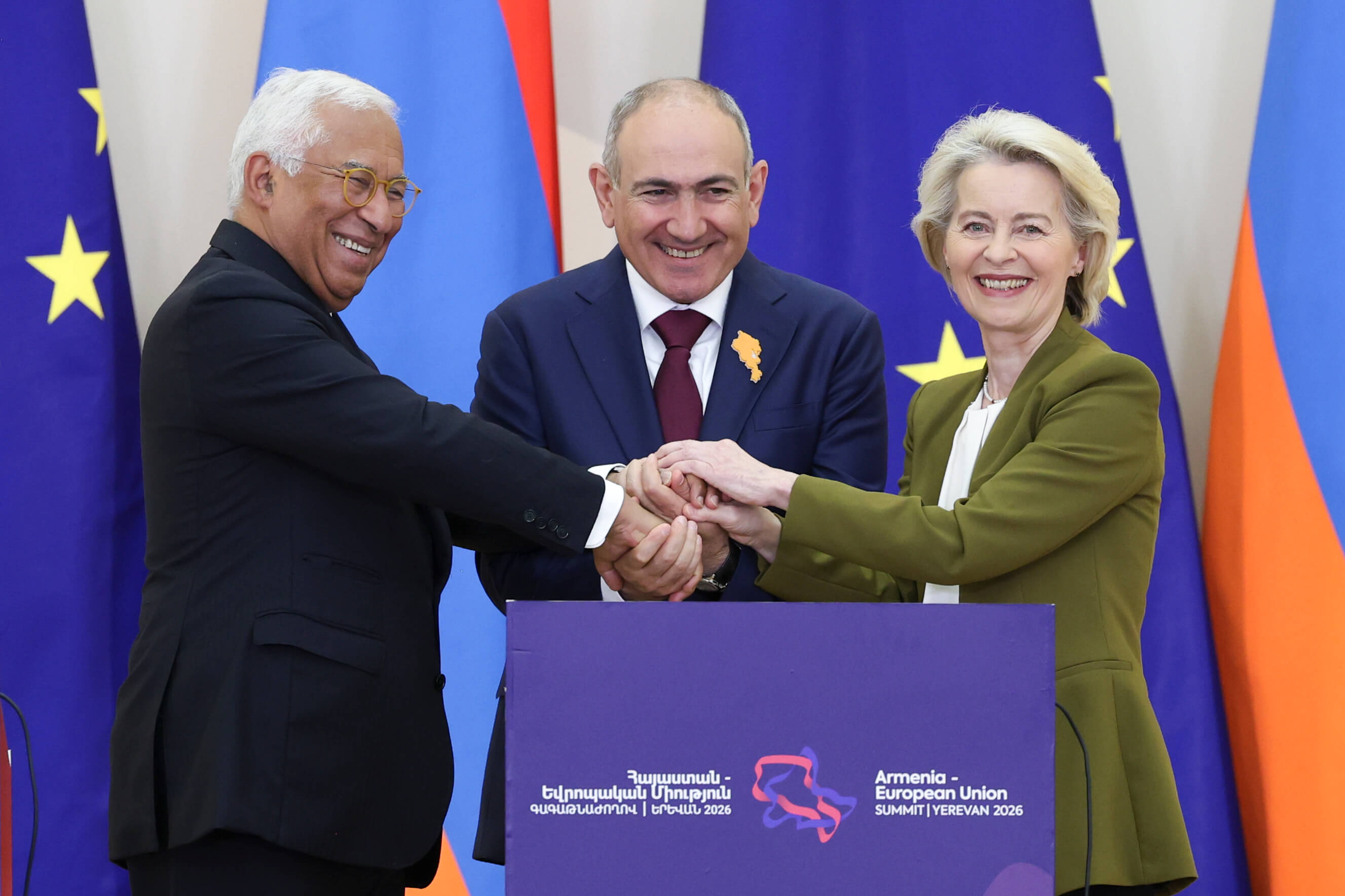 It is critically important to closely monitor Russia’s actions regarding Armenia and to ensure political and diplomatic support for stability in the region - Antonio Costa, Nikol Pashinyan, Ursula Von der Leyen
If the risk of Russian intervention does exist, responding after troops are deployed would be significantly more difficult.
That is why European states should already be working with Georgia and Iran to prevent the use of their airspace for any potential military operation.
It is also important to ensure coordination with the United States and to raise the issue of Armenia’s security at the level of discussions among EU foreign ministers.
The Kremlin traditionally relies on the factor of surprise and informational silence.
However, active international attention to the situation could significantly complicate the implementation of any force-based scenario.
That is why it is critically important to closely monitor Russia’s actions regarding Armenia and to ensure political and diplomatic support for stability in the region.
The parliamentary elections on 7 June must take place in a calm and democratic atmosphere, and the future of Armenia should be determined exclusively by its citizens.
Oleksandr Levchenko, a former Ukrainian diplomat, is a professor at the State University (Kyiv) and a member of the Academy of Geopolitics and Geostrategy (Kyiv).
