A survey of church attendance published last year encouraged Britain’s Christian leaders to proclaim a quiet revival was under way until it recently emerged that the pollsters had got their numbers wrong.
Far from a growing young cohort of the faithful flocking to the pews, as the survey suggested, it turns out formal Christian worship is still in a state of epochal decline.
The Bible Society, which commissioned the poll, retracted its widely cited ‘Quiet Revival’ report after the polling company YouGov acknowledged that suspect data from some respondents had not been weeded out.
The reality check was not only a disappointment for would-be revivalists but also a potential challenge for a range of traditionalists and ethnonationalists who claim the UK’s inherent Christian identity is under threat from alien forces.
Some politicians on the right appear to have rediscovered their religion as they engage in the kind of identity war that they invariably denounce when it is waged by their rivals on the left.
Last month’s kerfuffle over whether a public Muslim prayer meeting in London amounted to an act of Islamic domination was just the latest skirmish in the latest culture war.
At odds with the established Church of England
Ironically, it is conflict in which the right has often found itself at odds with the established Church of England whose bishops it regards as insufferably ‘woke’ when it comes to issues such as immigration.
While Reform UK recently pledged to restore Britain’s Christian heritage, its leader, Nigel Farage, has in the past accused church leaders of being out of touch with their own congregations by defending asylum-seekers.
Britain was losing its Christian values because of the “sheer quantities of people that came to the country in a short period of time”
The party’s Christian heritage pledge was spelled out in February by its home affairs spokesman Zia Yusuf, who said Britain was losing its Christian values because of the “sheer quantities of people that came to the country in a short period of time”.
Yusuf, a practising Muslim, indicated a future Reform government would seek to reverse the cultural trend in part through the mass deportation of illegal migrants and incentives for British expats to return home.
The revivalist rhetoric extends even further to the right, with anti-immigration activist Tommy Robinson launching a Put Christ Back in Christmas campaign after claiming to have found his faith during a prison spell.
A project in the making
The emergence of such self-anointed evangelists on the right prompted the conservative Telegraph to proclaim late last year: “God is back in British politics. That changes everything”.
The accompanying analysis suggested that, with left-wing activists having all but chased Christianity out of their movement, there was political opportunity in advocating for a Christian revival.
The authors pointed to the example of the US, where Christianity had become key to differentiating conservative movements from the progressive left.
In broadly secular Britain it is a project in the making, and the political neophytes do not always get it right.
Robert Jenrick, writing as a Conservative shadow minister before defecting to Reform, lambasted the Labour government last Easter for its belated seasonal greetings to the UK’s Christians.
Robert Jenrick assailed Labour for allegedly being more attentive to other faiths in an example of ‘asymmetrical multiculturalism’
Also writing in The Telegraph, he assailed Labour for allegedly being more attentive to other faiths in an example of ‘asymmetrical multiculturalism’ in which minority cultures were celebrated and promoted while majority traditions and festivals were ignored.
Unfortunately, in the course of his diatribe, Jenrick inadvertently referred to “Psalm” Sunday rather than “Palm”, perhaps betraying an incomplete grasp of the Christian traditions he was seeking to promote.
Last month, a fellow Reform activist, Matt Goodwin, was also lampooned for multiple inaccuracies, including fake quotes allegedly created by AI, in his new book: Suicide of a Nation: Immigration, Islam, Identity.
Goodwin, who reportedly promoted a Christian heritage message to voters in a recent unsuccessful parliamentary by-election bid, maintained he had only used AI to obtain datasets for the book.
Goodwin attacked “left-wing activists who object to a (now bestselling) book that points out clearly… what mass immigration and rapid demographic change is doing to our country.”
A marker of how much has changed
Even if the right succeeds in getting more competently on-message with its identitarian appeals, elevating the centrality of Christian tradition may offer only limited political benefits in an increasingly secular society.
Ahead of the Easter holiday, the enthronement of a new Archbishop of Canterbury was a reminder of the established church’s past and continuing role in the constitution of the modern state.
Yet the appointment of the first woman head of the Anglican Church in its 500-year history was in itself a marker of how much has changed.
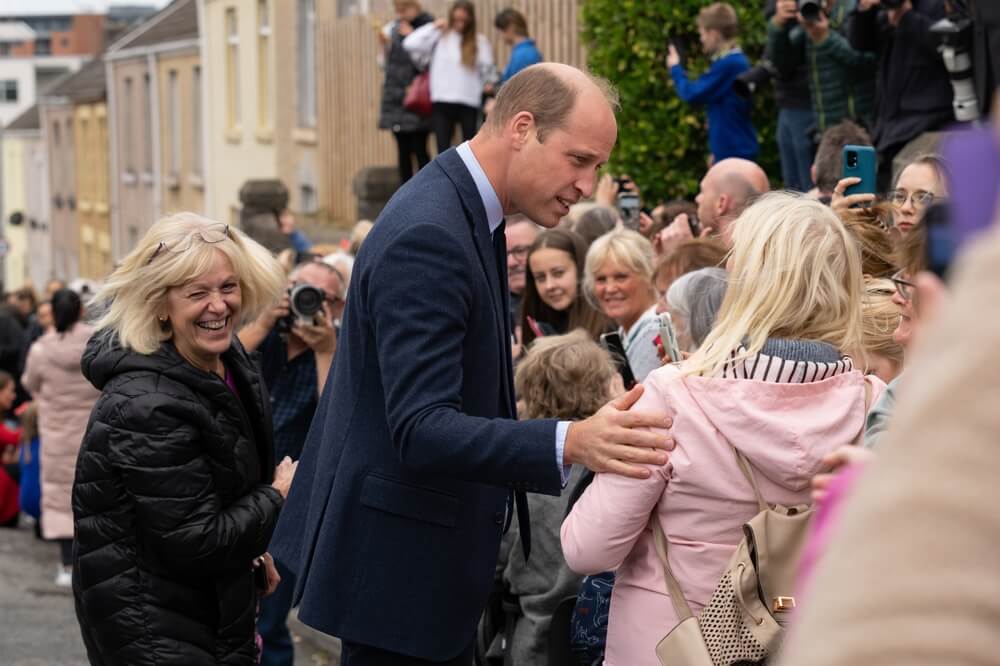 Many Christians might prefer to follow the example of the royal heir Prince William, who appears to have adopted a stance of quiet observance while committing to the Anglican Church
There are persistent differences within the church over issues such as the blessing of same-sex marriages and the role of religion in schools.
In wider society, few believers or non-believers would contest the statement of Sarah Mullally when she was named to the role that “Each one of us deserves to be treated with dignity, compassion and respect”.
Humanists argue that the attitudes of most modern Britons are better reflected in their belief in democracy and equality before the law than in a shared religious faith.
Within what remains a broadly tolerant society, despite the mounting strains, the right might find that few are ready to sign up for its new crusade.
Many Christians, meanwhile, might prefer to follow the example of the royal heir Prince William, a future Defender of the Faith, who appears to have adopted a stance of quiet observance while committing to the Anglican Church.
A close source speaking for the prince said: “His feeling is, ‘I might not be at church every day but I believe in it, I want to support it and this is an important aspect of my role and the next role and I will take it very seriously, in my own way’.”
