On 23 November, the US Department of Commerce added the Singaporean company Megaspeed and six related companies to a list of entities subject to restrictions on the export of US technology.
On the same day, Nvidia, the world’s leading chip company for artificial intelligence systems, announced that its co-founder Jensen Huang would return to the position of chief executive.
Megaspeed leases access to computers with Nvidia chips in data centres in South-East Asia to other companies and, as of June 2024, had purchased advanced Nvidia chips worth more than $4.8 billion, according to a letter from two US senators.
The case shows what US control of chip exports depends on. The government decides on licences, but information about who buys the chips and where they end up is largely obtained from the exporters themselves.
Between Nvidia and the end users in the Megaspeed case stood the manufacturers of servers – the mainframes in which the chips were installed – and the companies that leased the computing power.
A comparison of trade documents indicates that the list Nvidia provided to the government omitted some of the sales made through those intermediaries.
Nvidia announced Huang’s resignation on 12 November, following reports of his extramarital affair with Alice Huang, a former Megaspeed executive. US authorities suspect Alice Huang of working with Chinese intelligence and are investigating whether Megaspeed diverted chips to China in violation of US export regulations.
Megaspeed says it followed regulations, and Beijing rejects the allegation of espionage. Jensen Huang acknowledged the relationship, apologised, and promised to cooperate with the company’s internal investigation.
President Donald Trump says Attorney General Todd Blanche has confirmed to him that the government has no evidence Jensen Huang broke the law.
The end of direct sales left open the question of intermediaries
The Departments of Commerce and Justice announced on 17 November that the investigation into Megaspeed began in 2024.
In May 2025, the Department of Commerce asked Nvidia for information on how many chips it had sold directly to Megaspeed and how many through intermediaries, and Nvidia placed Megaspeed on its no-sell list the following month.
However, Senator Tom Cotton wrote to Commerce Secretary Howard Lutnick in October 2025 that Megaspeed had itself stopped ordering from Nvidia when Malaysia and Singapore stepped up their crackdown on chip smuggling that summer.
According to Singapore’s Ministry of Home Affairs, the US Bureau of Industry and Security, the export control arm of the Department of Commerce, inspected Megaspeed on 24 June 2025 regarding the use of equipment that had already been shipped.
On the same day, Singapore police questioned Alice Huang as part of their investigation into whether incorrect information had been given to the authorities when the server was procured.
In February 2026, the police concluded that there was insufficient evidence to prosecute, but also that Alice Huang had knowingly given false information to investigators to minimise her role, so she was given a stern warning and banned from entering Singapore.
Nvidia stated that the US government had told it that it did not have to stop doing business with Megaspeed
Singapore did not investigate her for espionage, and the investigation into Megaspeed is ongoing. The same ministry said US server maker Supermicro had provided only limited cooperation and that repeated requests to US authorities yielded little information.
According to customs records, Megaspeed imported tens of thousands more chips than Nvidia found in its centres during its inspection. Separately, a comparison of trade documents showed that the list Nvidia submitted to the Bureau by mid-November 2025 did not include 50,000 chips that Megaspeed had purchased through Nvidia’s partners.
In December 2025, Nvidia reported that it had found the equipment in additional warehouses, and in November 2025 it also stated that the US government had told it that it did not have to stop doing business with Megaspeed.
According to the report, which cited people familiar with the investigation, Nvidia’s chief legal officer, Tim Teter, called Jeffrey Kessler, the Commerce Department undersecretary who oversees chip export controls, in late summer 2025 and asked whether his office had played a role in Singaporean authorities keeping Alice Huang in the country during the investigation.
Sources say that the Bureau did not participate in that. Nvidia says Teter was unaware of Jensen and Alice Huang’s relationship at the time, and that the company is speaking with officials to answer their questions, share what it has found with customers, and seek guidance.
The Commerce Department delayed action despite requests from other departments
Treasury Secretary Scott Bessent said on 13 November that his department, the State Department, the Pentagon and the Office of the US Trade Representative had supported Megaspeed’s listing for months, but that the decision had stalled at the Commerce Department, which chairs the multi-departmental committee responsible for the listing.
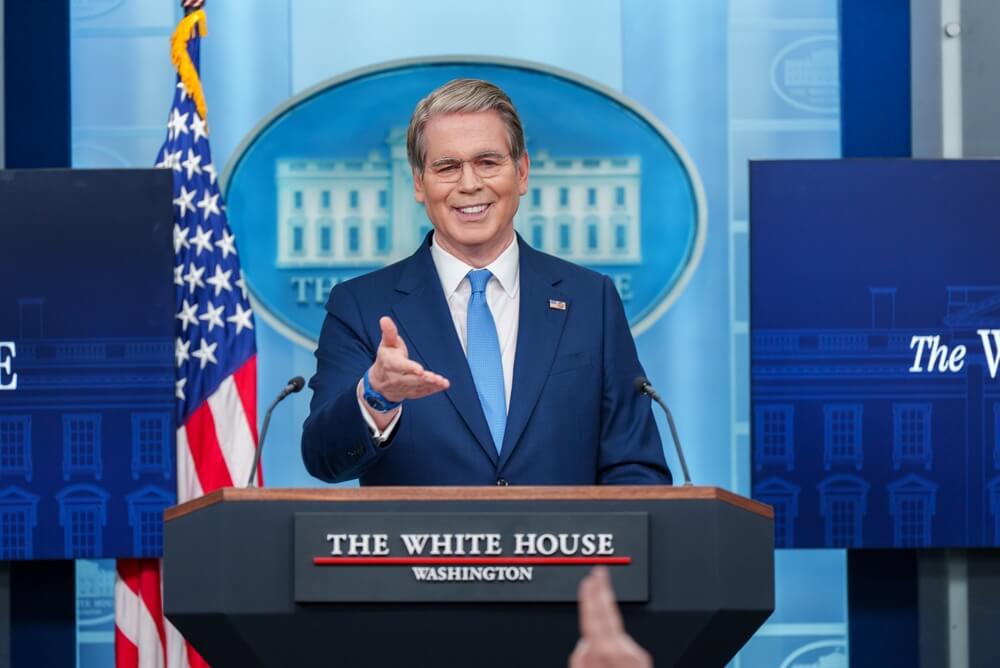 Scott Bessent said that his department, the State Department, the Pentagon and the Office of the US Trade Representative had supported Megaspeed’s listing for months, but that the decision had stalled at the Commerce Department
Megaspeed and other firms from Singapore, Malaysia and Thailand were the first new names on that list as of October 2025. These firms now require a licence to export controlled US goods, and the Commerce Department is considering applications on the assumption that it will reject them.
Apex Enterprise Solutions, the Singapore subsidiary of the Chinese company Alibaba, is also on the list. According to reports on the deal, Apex paid Megaspeed and other firms upfront to lease computing power so that Alibaba could use Nvidia’s chips without buying them. Alibaba denies that Apex diverted the export-restricted chips.
Singapore Prime Minister Lawrence Wong said on 24 November that the chips Megaspeed bought from Nvidia were not intended for Singapore, and that his government was still seeking data from the US on who ultimately used them.
Malaysia’s Ministry of Investment, Trade and Industry and its customs authorities are investigating whether Speedmatrix, Megaspeed’s Malaysian subsidiary, re-exported the imported chips.
The board reversed its decision in five days
Nvidia chairman Harvey Jones told investors on 17 November that Huang would not return because his behaviour was inconsistent with company rules.
However, according to a filing with the Securities and Exchange Commission, on 22 November the same board unanimously restored him to the position of chief executive and to its own ranks.
Trump has confirmed that he pushed for Huang’s return and has reportedly tasked Vice President JD Vance with investigating security concerns and persuading the board. Nvidia says it concluded that Huang’s return does not pose a security risk based on information received from senior US officials.
The new board structure changes who within the company receives export data
The same administration, whose assurances influenced that conclusion, decides, through the Department of Commerce, to whom and under what conditions Nvidia is allowed to export.
Leading Democrats on four House committees asked Trump on 24 November for the administration’s correspondence with Nvidia’s board of directors, and set a deadline of 8 December.
On 17 November, Nvidia established a permanent committee on national security and export controls, chaired by board member Suzanne Nora Johnson. The customer and export vetting functions will report directly to her, and the new compliance officer will report to the nominating and governance committee.
The new board structure changes who within the company receives export data, but the Megaspeed case shows that this data can be incomplete when chips reach customers through other suppliers.
The licence does not reveal who ultimately uses the chips
On 19 November, the House Foreign Affairs Committee released data on export requests for Nvidia’s H200 chip and US rival AMD’s MI325X chip, both used to develop artificial intelligence systems.
By 11 May, requests covered more than 3.4 million chips, and the Department of Commerce had approved 879,868 across 21 requests. Of that total, 150,000 were intended for the Chinese company Tencent and its subsidiaries, and 75,000 for Alibaba.
Since January 2025, the Pentagon has listed Tencent as a Chinese military company, although that designation does not in itself prohibit the export of US chips.
The Department of Commerce approved 150,000 chips for the company, while in the case of Megaspeed it delayed for months a decision that other agencies had requested. Different parts of the same administration, therefore, make different assessments of who can receive US chips.
A table released by the committee, listing each of those approvals, noted that no shipments had been made by 11 May. Nvidia said in November that it later shipped limited quantities of the H200 with approval, and then halted shipments of that model to China.
Apex’s deal with Megaspeed shows how computing power can be leased without buying chips
In all the applications reviewed by the committee, the firms that requested the licences themselves assessed the risk that the chips would end up with an unapproved user as low.
How difficult it is to determine from the documents where the chips end up can be seen in Nvidia’s annual reports. In the financial year that ended in January 2025, customers invoiced in Singapore accounted for 18 per cent of Nvidia’s total revenue, while goods actually shipped to Singapore accounted for less than 2 per cent.
The difference arises because customers in Singapore received invoices for equipment that was almost always shipped to other countries. From the next financial year, Nvidia will report revenue according to the customer’s headquarters, so Singapore will no longer be listed separately.
The regulation that took effect on 19 November also requires permission when a foreign data-processing centre, after buying chips, gives firms with headquarters or parent companies in China, Macau or any other country under a US arms-export embargo access to enough computing power to develop advanced artificial-intelligence systems.
Systems that recommend products or content to customers, such as those used by online stores and social networks, are excluded. Such a centre can switch customers without a new order from Nvidia, and Apex’s deal with Megaspeed shows how computing power can be leased without buying chips.
Teter’s testimony puts Nvidia’s audits before Congress
Huang speaks to House committees on 1 December, Teter a day later, and on 3 December Huang testifies at a public hearing before the Senate Banking Committee.
 Senators Elizabeth Warren and Chris Coons have asked the Commerce Department, the State Department and the White House to preserve documents on the export of advanced chips
 and to inform members of Congress about the security risks of the alleged intelligence operation.
The most specific question for Teter will be whether the June decision not to sell Nvidia chips to Megaspeed also applied to purchases through Nvidia’s partners or only to direct orders, which public data does not clarify.
The answer would show what Nvidia and Washington meant by business interruption, and whether the Bureau was able to distinguish earlier orders from deals made after June 2025 on the resulting list.
The November regulation shows how dependent Washington still is on exporters’ own records. It introduces licences for certain shipments to Indonesia, Malaysia, Singapore, Thailand and Brazil, and exempts buyers and users that are, or belong to, US companies, provided that the exporter or other supplier reports the final destination, user and quantity to the Bureau and submits monthly reports on those transactions.
The completeness of those reports depends on whether they also include deliveries through intermediaries, and it was precisely such deliveries that were missing from the list that Nvidia submitted to the Bureau in Megaspeed’s case.
