A recent global flurry of high-level talks, meetings and agreements is pointing in one direction: leaders everywhere are doubling down on the showbiz side of politics while avoiding the hard choices needed to address underlying discontent.
The failed COP31 climate meeting in Antalya, the bizarre and seemingly pointless three-way summit between Trump, Xi and Putin in Shenzhen and even the EU-UK reset signed by the British prime minister, Andy Burnham, appear higher on showmanship than on actual content.
To be fair, both COP31 and the EU-UK reset contain actual achievements, as opposed to the Shenzhen tripartite summit.
But what they all have in common is the overselling of their importance and the danger that they feed into the low trust and expectations that the public seems to have of politics.
An ever-higher fever
Take COP as an annually returning reminder of how the world is failing to deal with climate change.
Despite this going on for more than three decades, and countless so-called agreements being concluded on how to tackle global warming, the world keeps running an ever-higher fever.
The aim of limiting global warming to 1.5 degrees Celsius set out in the famed Paris climate agreement, adopted at COP21 in 2015, will be missed in the next couple of years. Even the absolute limit of 2 degrees is almost certainly no longer realistic.
In fact, just last month, the European Commission directed EU member states to prepare for 3 degrees of global warming by 2100.
Climate pressure is contributing to social and political unrest across the globe, with younger generations in particular both anxious and angry at the world they’re inheriting.
There is no realistic way forward towards a UN or other truly global climate mechanism that will take more effective action and that can be enforced
The youth protests still roiling France are partly fuelled by the lack of air conditioning and insufferable summer temperatures in overcrowded classrooms.
Set against this, the annual COP meetings, however well-intentioned, start looking like a meaningless and even cynical exercise, whether they succeed or not.
While some leaders and advocates have welcomed the COP31 failure as a ‘necessary wake-up call’, there is no realistic way forward towards a UN or other truly global climate mechanism that will take more effective action and that can be enforced.
It is counter-intuitive for such a world-spanning problem, but global climate talks, particularly COP, can only have a limited function and should not be treated as a panacea for more efficient climate action.
Many politicians and leaders like to shift responsibility to larger, supranational forums where effective action will be diluted and the illusion of progress can be maintained, but real change will have to come at home and from like-minded coalitions, and carry a cost.
Compelling vision or empty gestures?
The high-profile EU-UK reset is of a different order, being much more limited in scope, but still has a highly symbolic meaning.
The British vote to leave the EU in 2016 can be seen as the clearest starting shot for the remarkably illiberal moment Western democracies have been going through since then.
It is a huge overstatement, though, to cast the reset deal signed by Burnham in Brussels last week as signalling at least the beginning of the end of that era. Even the term ‘reset’ is widely off the mark, as the real reset started under the Conservative Rishi Sunak.
Burnham has done what he does best: take a deal that was largely already cooked up by his predecessor, Keir Starmer, and attach new significance to it through a number of optimistic, sometimes contradictory, statements.
Compelling and impassioned pro-EU leadership is exactly what was missing during the 2016 Brexit referendum campaign
That’s not to say that there is no value in Burnham’s approach. At least he acknowledges the need for what George H. W. Bush called ‘the vision thing’. And restarting the Brexit debate in the UK is no mean achievement in itself.
Yet, he too is in danger of getting the balance wrong between offering a compelling vision and going to bat for it, on the one hand, and ending up selling hot air and being caught up in endless political manoeuvring, on the other.
It is unclear for now what ideas he’s bringing to the concept of closer ties with the EU and what his final goal is likely to be, let alone how he’s going to get there.
As the EU debate heats up again in the UK and old battle lines are re-established, the issue is likely to become as toxic as before. While there is support for moving closer to the EU, there’s still no appetite for many of the consequences.
Compelling and impassioned pro-EU leadership is exactly what was missing during the 2016 Brexit referendum campaign. For now, Burnham has only made relatively empty gestures in that direction, while not committing to actually making the jump.
High on pomp and symbolism
The tripartite Trump-Xi-Putin summit in Shenzhen was on a different plane in several ways: it brought the world’s most powerful countries around the table, it was intentionally and glaringly high on pomp and symbolism, and it was almost totally devoid of content.
Xi and Putin are autocrats, if not outright dictators, and Trump sits atop a democratic system that, just before the summit, started reasserting itself in a remarkable set of midterms results.
Even so, for the casual observer, here were the powerful of the earth trying to address several issues that are playing havoc with our daily lives, particularly the wars in Ukraine and Iran with all their attendant economic and energy disruptions.
On nuclear arms control, at least a worthy effort, Trump only managed to get a vaguely worded statement that a dialogue would be maintained
But the root causes were not even on the agenda. Energy supplies were addressed through a vague and probably empty production pledge. Most of the other items were even more clearly meaningless and self-serving.
On nuclear arms control, at least a worthy effort, Trump only managed to get a vaguely worded statement that a dialogue would be maintained.
While highly emotive warnings of a second Yalta, where a new dispensation would be foisted on Europe and the world, fortunately turned out to be overstated, the spectacle was another blow to Western unity and the international rules-based order.
Spectacle over substance
Of the three recent international political showpieces – Shenzhen, COP31 and the EU-UK reset, the Shenzhen summit was most specifically built around the idea of the politics of performativity.
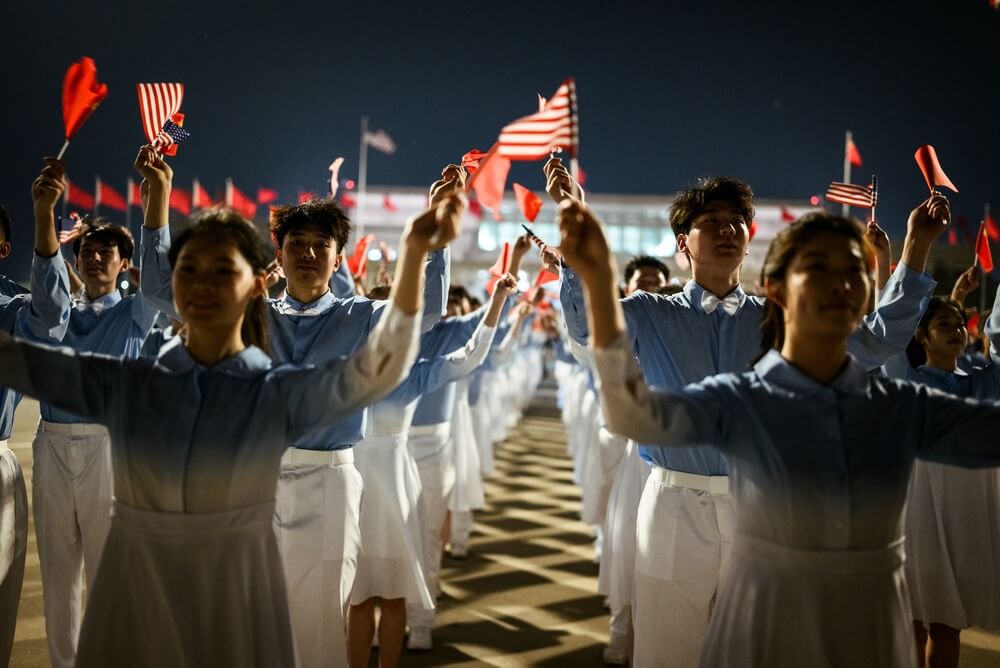 The Shenzhen summit was most specifically built around the idea of the politics of performativity
The shadow play of Trump calling Putin and Xi his friends and the emphasis on the welcome he received at the airport were the whole point of the summit. In fact, in its emptiness, it might have been a more honest political exercise than the other two events.
Both COP and the EU-UK reset pretend to be much more about the content and less about the spectacle and because of that pretence, their failure to deliver might be worse than the mostly vacuous and symbolism-centred Shenzhen meeting.
It’s clearly pointless to ask politicians to stop playing politics. Performance and spectacle are part of the toolkit. But when these become the main focus and very little progress is made on the substance, trust will only keep eroding.
