At an academic event in Brussels a few months ago, one of the speakers casually suggested that the next time the group met, the far right could be in power in France, Germany, and the United Kingdom. No one refuted him.
That was in early spring. The European summer that followed was hot for everyone, but especially for the far right.
First, Nigel Farage’s Reform party outperformed in the May British local elections (scandals over dodgy political donations have since dimmed its prospects).
In July, a French court unexpectedly allowed Marine Le Pen to run for president. She now leads in the polls.
Then came the Alternative für Deutschland’s smashing victory in the Saxony-Anhalt state election two weeks ago.
The trend extends beyond Europe. Now that Abelardo de la Espriella, a political clone of El Salvador’s far-right president, Nayib Bukele, has won in Colombia, most of Central and South America is governed by the far right.
In the region’s largest and most populous country, Brazil, the son of the jailed former president and putsch leader Jair Bolsonaro is tied for first place in polls ahead of October’s presidential election.
Faced with these frightening prospects, the response of establishment center-right and center-left parties remains risible.
UK Prime Minister Andy Burnham’s first move from No. 10 Downing Street was to remove value-added tax on household electricity and cut taxes on pubs. Even delivered in a down-to-earth Northern accent, the announcement underwhelmed.
Leftists, in particular, keep insisting that what is behind the far right’s rise is the rise in the price of eggs. Far-right leaders know better.
Their economic policies range from the fiscal and monetary orthodoxy of Javier Milei (who named one of his dogs after Milton Friedman) to the demand by the French National Rally’s Jordan Bardella that the European Central Bank finance the French Treasury, and from the preposterous protectionism of US President Donald Trump to the free-trade enthusiasm of Spain’s Vox (also surging in the polls thanks to the recent migration crisis in Ceuta). Yet they keep winning.
Law and order and restrictive immigration
Their secret sauce is not economic, but political. It combines two ingredients many voters want: law and order and restrictive immigration.
In some countries the two become one, if foreigners can be blamed for rising crime: think Albanian and Middle Eastern gangs in Sweden, or Venezuelan gangs in Chile and Peru.
Confronted with this reality, most reasonable, centrist, reformist governments are left struggling for words.
Successful responses are few and far between (Sweden’s effort to curb gang violence is one of them).
The problem is not a dearth of policy alternatives, but rather a deficit of conceptual understanding.
Most liberal and centrist politicians underestimate the need for political order
Most liberal and centrist politicians underestimate the need for political order, and carry no philosophy in their heads that can help them craft a workable immigration policy.
In the wake of the English Civil War, Thomas Hobbes understood that without a state monopoly over the legitimate use of violence, life is nasty, brutish, and short. So did Max Weber a century ago.
Yet liberals often forget that lesson. Because violent crime falls most heavily on the poor, it has taken middle-class intellectuals far too long to appreciate the deep-seated demand for law and order.
The grandmother whose handbag is snatched as she boards a train or the shopkeeper whose windows are vandalized by violent protesters need no reminders.
That is why calls to defund the police (or, in my native Chile, to “refound” the police) flopped so spectacularly.
Now that, in the words of Alexandria Ocasio-Cortez, “Woke 1 was crazy” has become the commonplace conclusion in the United States, maybe that lesson is being learned.
Common-sense immigration policy
The next order of business is to craft a liberal conceptual foundation for a common-sense immigration policy.
Fortunately, several liberal thinkers—Oxford political theorist David Miller among them—have done the philosophical heavy lifting for us.
There is no such thing as an unfettered right to migrate to country A to enjoy the social benefits it offers its own people
The starting point is to recognize that the fundamental liberal claim that all human beings, regardless of nationality, are entitled to equal dignity and respect does not entail equal obligations.
Citizens of country A are obliged to pay taxes so that their fellow citizens can get schooling and health care, but the same obligation does not extend toward citizens of other countries.
There is no such thing as an unfettered right to migrate to country A to enjoy the social benefits it offers its own people.
The security of the community
The other crucial point is that democratic nation-states are not accidental agglomerations of people living within accidentally drawn borders.
They are, in John Rawls’ phrase, “fair systems of cooperation.”
One of the things citizens can cooperatively agree on is the rules for membership: who gets to join the nation and under what conditions.
This is not an ethical concession but an ethical achievement, following as it does from people’s commitment to self-determination.
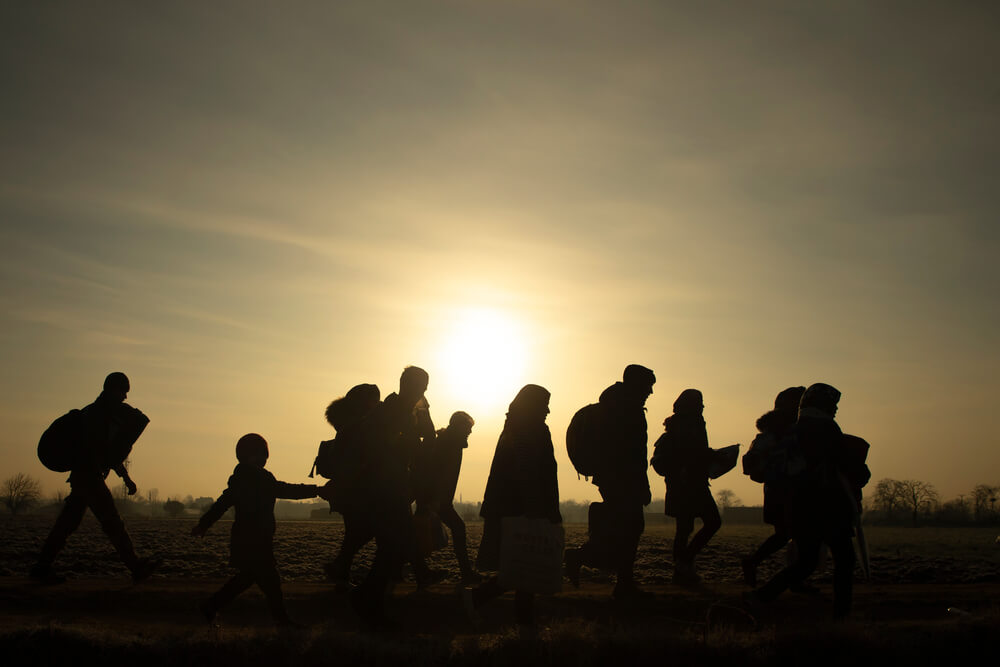 What is at stake is no less than the future of liberal democracy. To save it, liberals need to craft policies that ensure the security of the community and its borders
What immigration policies follow from these principles will differ from country to country.
Aging societies in need of young laborers and taxpayers may choose to relax the rules for membership.
Societies wishing to preserve a particular cultural heritage may choose stricter rules.
The point is that there is nothing illiberal in securing borders and creating hurdles to inward migration.
Nor is it illiberal to expect migrants to learn the local language, partake in the local culture (and eventually contribute to it), and embrace the core political principles of their adopted home.
I say that as someone who has migrated several times, and who lives and works in a country that is not my own.
What is at stake is no less than the future of liberal democracy. To save it, liberals need to craft policies that ensure the security of the community and its borders.
If they fail to do so, far-right forces will secure power in more and more places—and the policies that follow will be anything but decent and liberal.
Andrés Velasco, a former finance minister of Chile, is Professor of Public Policy at the London School of Economics and Political Science.
