Germany is in deep trouble, so goes the by now accepted narrative, economically and also, or hence, politically.
State-level elections in early September in Saxony-Anhalt and a few weeks later in Mecklenburg-West Pomerania, both in the East of the country, are expected to bring new victories for the far-right Alternative for Germany, AfD, if not an outright breakthrough.
The far-right and other populist parties, such as the ostensibly left-wing Bündnis Sahra Wagenknecht, BSW, thrive on the widespread emphasis, both in Germany and outside it, placed on the country’s apparent economic woes.
It’s not that these parties offer realistic paths to better economic performance. They channel the unease and fear into resentment against migrants, anti-woke mobilisation and pro-Russian, anti-EU and anti-NATO sentiment.
The AfD’s message, much more than the BSW’s, is resonating increasingly across Germany, not merely in the Länder of the former DDR.
The party has been leading in national polls now for months and is at the time of writing close to 7% ahead of the ruling centre-right CDU/CSU of Chancellor Friedrich Merz.
The extent of the AfD’s meteoric rise can be gauged from its surging support in Germany’s core industrial heartland, the Ruhr area.
One has but to look at the dilapidated state of many of its cities, the number of rough sleepers, the extent of the drug problems to get an idea of what reservoirs the AfD has tapped to more than triple its support this decade in North Rhine-Westphalia, a former left-of-centre SPD stronghold.
Still, it’s in eastern Germany that the AfD might in September break through and for the first time gain an absolute majority in a state parliament and thus gain regional power.
Fanning the flames of panic
For those who see the rise of the AfD as merely a function of Germany’s declining economy and the East’s traditionally disadvantaged status since reunification, there are some incongruous factors to ponder.
Indeed, the economy is sluggish at best, with GDP growth this year expected to remain below 1%. A poorly performing automotive industry, once the jewel in the crown, drags the country down and is seeing job losses in the tens of thousands.
Still, Germany’s famous export-led economy is nowhere near down and out. While exports to the US and China are under pressure for well-known reasons, trade with Europe has picked up, and overall exports saw strong growth in the first half of this year.
The country’s finances remain incredibly robust, despite the huge increase in borrowing, mainly for infrastructure investment and defence. These are also expected in turn to boost economic growth down the line.
While welfare, social security, health and other regular budgets are under pressure, Germany is still in a much better place fiscally than most other EU countries, as well as the UK and US.
It is still held back on these issues by its much-debated, self-imposed debt brake, the Schuldenbremse, although it’s been slightly loosened for the Länder.
When looking specifically at Saxony-Anhalt, where the AfD has the biggest chance of an outright win and forming a government, it’s true that the state still faces a stubbornly high level of poverty compared to western Germany.
The importance that outside figures attach to the narrative surrounding Germany is most clearly seen in Elon Musk’s interventions in favour of the AfD
On the other hand, its GDP per capita is slowly converging with the rest of the country, with even larger advances in disposable income, partly due to the low cost of living.
It might sound like splitting hairs to argue about whether Germany is facing economic disaster or only managing a relative, possibly temporary, decline. And whether the former East Germany is still mired in problems or slowly catching up.
Yet this is one of the main thematic battlegrounds in the election campaigns, with the mainstream parties, including the now out-of-power Greens, comparatively projecting more confidence in the economy, while the populist parties fan the flames of panic.
In fact, Germany’s economy minister just this week warned that rising support for the AfD would be bad for the German economy as it might discourage investors.
The narrative tension is also evident in the paradoxical way in which Donald Trump is treating Germany. On the one hand, he sees the country’s export economy as a threat to the US and imposes tariffs, on the other hand, he calls Germany a “broken country”.
The importance that outside figures attach to the narrative surrounding Germany is most clearly seen in Elon Musk’s interventions in favour of the AfD, at one point stating that “only AfD can save Germany”.
He recently said that he got too involved in politics and has for now refrained from further comment on Germany, but his frequent boosting of anti-migration posts still sends a message.
Promoting a fearmongering narrative
While economic anxiety underlies much of the success of the populist far-right and -left, the spearhead of their attacks on the establishment is migration, in Germany as much as in France, the UK and the US and elsewhere.
To take Saxony-Anhalt again, the proportion of foreign-born residents has increased dramatically over the past decade or so. But this is from a very low base, and the state still has one of the lowest proportions of migrants in Germany.
It seems to confirm the adage that anti-migration sentiment is often fiercest in places with the fewest migrants.
Like the economy, migration is weaponised through promoting a fearmongering narrative
Of course, whenever there’s an attack carried out by migrants or people with a migrant background, this immediately boosts the AfD’s chances.
This was the case after the recent deadly attack on the Berlin Pride parade, even though the AfD is far from positive about gay rights in its programme.
Like the economy, migration is weaponised through promoting a fearmongering narrative. What can be seen as a legitimate security concern is made into an existential threat in order to score political points.
The "confirmed extremist" label
The AfD itself is on the federal level still regarded by Germany’s security services as a “suspected extremist organisation” that might pose a threat to the constitution and the state.
This is the state of play after a court earlier this year ordered the domestic security service BfV to change the classification back from “confirmed extremist”, pending further investigation.
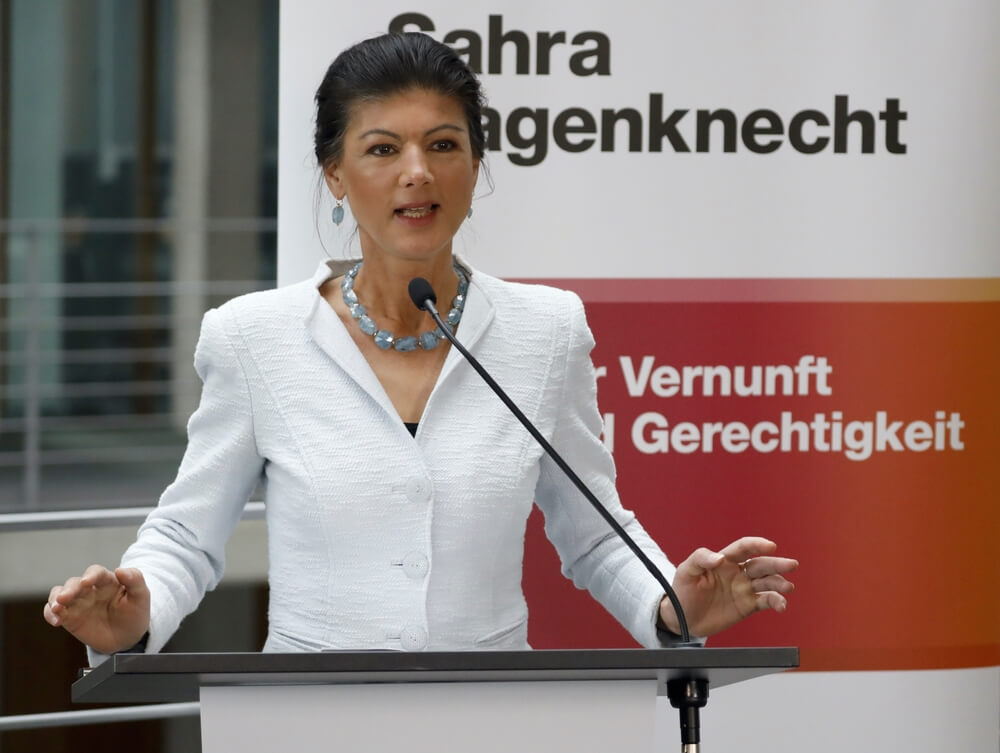 As support for the AfD is growing, it’s not surprising that support for maintaining the firewall is declining - Sahra Wagenknecht
What has escaped the attention of many observers and voters appears to be that several state-level AfD sections do already merit the “confirmed extremist” label, including the one in Saxony-Anhalt.
The extremism label is important, also in the debate among other parties over maintaining a firewall, Brandmauer, to keep the AfD out of power.
As support for the AfD is growing, it’s not surprising that support for maintaining the firewall is declining.
Especially the populist, or authoritarian, left-wing BSW is now publicly saying it will abandon the Brandmauer, with its leader, Sahra Wagenknecht, pitching for an AfD-BSW coalition in Saxony-Anhalt.
Complex electoral arithmetic
This is all part of a complex electoral arithmetic that the BSW is seeking to exploit. Since Wagenknecht’s remark, her party is edging closer to passing the electoral threshold.
An outright AfD majority could actually come about in Saxony-Anhalt if the party gains just over 40% of the vote and if BSW as well as the mainstream Greens and Social Democrats, SPD, don’t manage to cross the 5% electoral threshold.
A lively tactical voting debate has therefore sprung up, but it is one that also highlights the precarious position of the two major left-of-centre parties in this Eastern state and their decline nationwide.
Dissatisfaction with the political establishment is another narrative that helps the AfD and other populists mobilise their voters
While the mainstream left, like in many other European countries, is bearing the brunt of it, dissatisfaction with the political establishment is another narrative that helps the AfD and other populists mobilise their voters.
After the short-lived SPD chancellor Olaf Scholz gave up, Merz very quickly saw his popularity decline as well. There’s now even talk within his CDU of finding a replacement, just as Labour did with Keir Starmer in the UK.
As with the other crisis narratives, there’s ample justification for criticising the lack of leadership and vision in modern-day politics.
Yet here too, the facts are not as dire as the populists want to paint them, and their solutions are often not merely objectionable but also unconstitutional.
