Whatever one thinks of the US National Security Strategy published late last year, at least it clearly set out what President Donald Trump’s second administration sees as America’s strategic priorities.
But no sooner was the NSS released than US “strategic” decision-making abandoned it.
True, the new NSS’s emphasis on the Western Hemisphere was no mere rhetorical shift. The capture of Venezuela’s dictator, Nicolás Maduro, and the growing pressure campaign against Cuba both clearly fit the new strategic framework.
The new NSS also emphasized the importance of countering China, reflecting the broader shift in US strategic priorities over the past decade.
Although its language was less bellicose than other pronouncements have been, the document still considers it a strategic priority to prevent China from challenging the United States, not only in East Asia but globally.
At the same time, the Middle East, the region that has dragged the US into one “forever war” after another, was downgraded even more decisively than in previous administrations’ strategies.
The US may lose by not winning
Trump’s NSS proclaims that “the days in which the Middle East dominated American foreign policy in both long-term planning and day-to-day execution are thankfully over.”
But barely three months later, US strategy has become unhinged. Trump has leapt feet first into a major new Middle East war with ever-changing objectives.
As the conflict escalates, the endgame scenarios are growing increasingly bleak and complicated. The US may lose by not winning; and Iran may win by not losing. It is a slow-motion strategic disaster.
Perhaps Trump believed that he could deliver another fait accompli in a matter of days
Perhaps Trump, intoxicated with US hard power after last year’s 12-day war with Iran and the tactically brilliant Venezuela operation in January, believed that he could deliver another fait accompli in a matter of days.
The ancient Greeks called this cast of mind hubris, and they warned that it almost always ends in tears.
Or perhaps Trump was dragged into the conflict by Israeli Prime Minister Benjamin Netanyahu, who has been seeking a US-backed war with Iran for many years.
Netanyahu knew that Israel, for all its impressive military capabilities, could not sustain and win a full-fledged war with the Islamic Republic on its own; and he knew that, in Trump, he finally had a US president whom he could maneuver into an “excursion.” This dynamic also has a name: the tail that wags the dog.
Capricious adventurism
Whatever the case, one thing is clear: Trump’s war of choice flatly contradicts the letter and spirit of the NSS he himself signed last November.
The US could be bogged down in yet another Middle East quagmire. Exactly what this will mean for American power and the rest of the world economy is not clear, but the US role is too central for it simply to walk away from the chaos it has created (unlike Israel, which can rely on the threat of striking other countries in the region at will).
So, Trump’s America First neo-isolationism has now mutated into capricious adventurism, at the expense of America’s ability to achieve the strategic priorities listed in its own NSS.
As the Iran war escalates, the administration has resorted to relocating critical US assets from elsewhere.
Air-defense systems are being shipped from South Korea to the Middle East, and the most important intervention asset in Asia, the Marine Expeditionary Unit in Okinawa, is also on the way.
Europeans are on their own, and they know it
Whereas previous US presidents declared a “pivot to Asia,” Trump is presiding over a pivot to the Middle East. Chinese President Xi Jinping is surely smirking.
Europe, however, is reeling. Most Europeans consider the Iranian regime abhorrent, and would not miss it if it collapsed.
But few believe that the US can achieve regime change and stability in the region simply through bombing.
Worse, Trump has had to loosen sanctions on Russian oil, and weapons intended for Ukraine’s use (which the Europeans have paid for) are being delayed or redirected.
Following Trump’s recent threats against Greenland, transatlantic strategic trust has eroded rapidly. Europeans are on their own, and they know it.
Putin and Trump were both mistaken
Like Xi, Russian President Vladimir Putin is a principal beneficiary of this sordid spectacle.
Once again, America’s attention is being diverted from Europe; its weapons stocks are being depleted; and billions of dollars continue to flow into the Trump family’s coffers, making a mockery of the world’s oldest democracy.
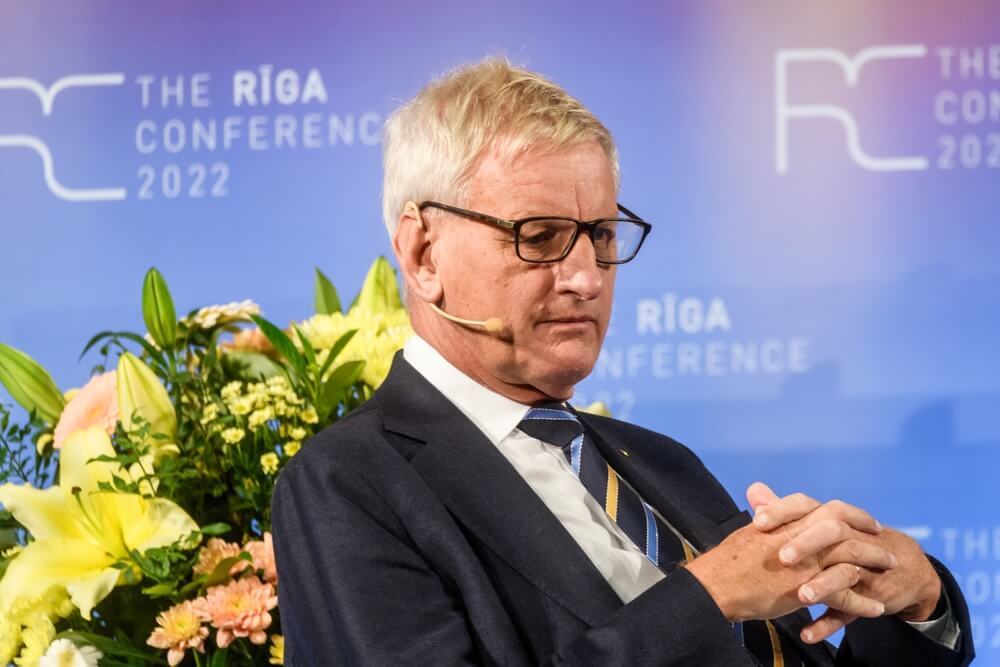 There is an obvious similarity between Putin’s full-scale war of choice against Ukraine and Trump’s war against Iran - Carl Bildt
There is an obvious similarity between Putin’s full-scale war of choice against Ukraine and Trump’s war against Iran.
In both cases, the fateful decision was taken by an autocratic leader who saw no need for careful planning or consultations with experts.
It never occurred to either man that his armed forces would fail to obliterate the enemy in one fell swoop.
But Putin and Trump were both mistaken. Putin’s “special military operation” has turned into a prolonged war with far more than a million Russian casualties, and Trump’s “excursion” has already lasted much longer, and proved far costlier, than he expected.
One is reminded why serious powers create formal strategy documents in the first place.
They focus leaders’ attention on long-term challenges, issues, and possibilities, as well as on scenarios that should be avoided. But they serve that purpose only if leaders bother to read them.
Carl Bildt is a former prime minister and foreign minister of Sweden.
