The visit of then-US House Speaker Nancy Pelosi to Taiwan in 2022 led to one of the biggest crises in Sino-American relations to date.
Another visit, which also includes Taiwan and is currently underway, could, however, raise relations between the two largest global powers to a new and unprecedented level.
The chairwoman of Taiwan's opposition Kuomintang party, Cheng Li-wun, has been on an extended visit to the United States since Monday. Over two weeks, she will stay in Washington and meet US lawmakers and officials, among others.
Although already high-profile enough to attract global attention, the visit of the Taiwanese opposition leader to the United States has become even more intriguing due to Cheng Li-wun's statement that she is "very willing" to meet President Donald Trump.
Beijing responded to these announcements with unusual mildness and tolerance. "Issues concerning the exchanges of China's Taiwan region with foreign countries should be treated in accordance with the one-China principle," was all the Chinese Ministry of Foreign Affairs stated on Tuesday regarding the Taiwanese politician's visit to the United States.
It is not known whether the leader of the Kuomintang, a party that advocates dialogue with Beijing, will meet President Trump over the next two weeks.
However, the mere expression of interest in such a meeting, followed by Beijing's almost indifferent reaction, suggests that Cheng Li-wun's stay in the United States plays a significant role in the broader context of the complex relations between Beijing and Washington.
What has changed since 2022 and Nancy Pelosi's visit to the island that China considers part of its territory, to today, when contacts at the highest political level between Taiwan and the United States have become possible, and perhaps even desirable?
Is Ching Li-wun Xi's emissary?
It is widely believed that the leader of the Taiwanese opposition is coming to America as a bridge between Washington and Beijing in addressing the issue of Taiwan, the largest and most complex of the many unresolved problems between the two superpowers.
Furthermore, there are claims that Ching Li-wun is coming to the US as an "emissary" of Xi Jinping, bringing messages to policymakers in Washington not from Taipei, but from Beijing.
Such speculations should not be dismissed too quickly. The sequence of significant events supports those who view the current visit of the Taiwanese opposition leader to America as a continuation of a process already well under way.
The process aligns with Chinese strategies for island integration
She was in Beijing in April, where she also met Xi Jinping. On that occasion, China announced a series of measures to improve daily connections between the mainland and the island, such as increasing the number of flights and intensifying communication between the Chinese leadership and the Kuomintang leadership.
This rare visit was followed by the Trump-Xi summit in Beijing, where the issue of Taiwan took centre stage.
The impression remains that the process aligns with Chinese strategies for island integration, and that the American president is losing enthusiasm for keeping Taiwan within his sphere of influence.
Beijing will not interfere with the visit
In this context, the arrival of a Taiwanese political leader who prefers compromise to confrontation with Beijing and its strategies should be viewed as a continuation of the dialogue on Taiwan between Beijing and Washington. This time, a leader from Taipei, at least from the opposition, is taking part.
Beijing has no reason to undermine the visit of the Taiwanese opposition leader to the United States
Beijing therefore has no reason to undermine the visit of the Taiwanese opposition leader to the United States.
It is even less likely that, due to her possible high-level talks (how high remains to be seen) with the American establishment, Beijing would initiate strong economic and military pressure on Taiwan, such as followed Nancy Pelosi's visit to Taipei four years ago.
On the contrary, Beijing aims to gradually lay the groundwork for "peaceful reunification", taking into account the possible candidacy of Ching Li-wun for the presidency of Taiwan in 2028.
If she wins in Taipei, Beijing will gain a cooperative and close interlocutor, in contrast to the current government and President Lai Ching-te, who are staunch advocates of the island's independence.
Assembling the consensus triangle
This means that a rare moment has arrived when current interests and medium-term projections in the US–China–Taiwan triangle are aligned.
Beijing is comfortable with Trump's isolationist stance on Taiwan and his clearly expressed restraint regarding US intervention in the event of Chinese escalation.
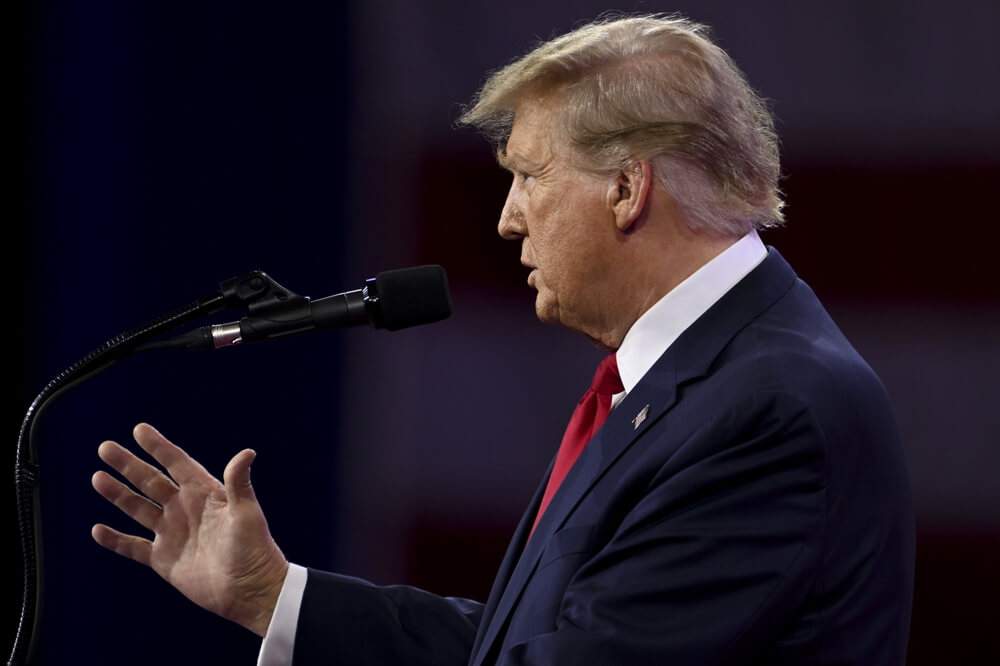 Trump is attempting to remove Taiwan from the top of the unresolved issues with Beijing
Trump is attempting to remove Taiwan from the top of the unresolved issues with Beijing, as his transactional approach to diplomacy focuses more on economic benefits in competition with China.
Ultimately, as a Taiwanese actor, Ching Li-wun benefits from an environment that can easily propel her to the top, as it positions her as a leader who can legitimately claim to have open channels with both opposing sides and thus serves as the guarantor of a peaceful future.
If Ching Li-wun meets Donald Trump in the coming days, even briefly, and Beijing responds with its usual rhetoric about the "one-China principle", this will confirm that the decision-making triangle regarding Taiwan is firmly established, leading to the realisation of the scenario envisaged by Beijing.
