The US-Israeli war on Iran has already destabilized the global economy and the geopolitics of the Middle East.
Even more alarming, recent reporting suggests that US President Donald Trump is considering deploying ground troops, a prospect that immediately evokes memories of past failed interventions – from Vietnam to Iraq – with their high costs in American and especially local lives.
Given the disastrous track record of US foreign interventions, the only “boots on the ground” should belong to inspectors from the International Atomic Energy Agency (IAEA), who urgently need to account for Iran’s stockpile of highly enriched uranium (HEU) before the world ends up stumbling into a nuclear catastrophe.
The current cycle of escalation is already dangerous enough. There is no reason to think that a land intervention by US forces – whether to “secure” the Strait of Hormuz or to seize Iran’s stockpiles of HEU – would help matters.
Using US forces to protect maritime traffic would likely require a large-scale open-ended occupation; and even a more limited operation to seize Iran’s HEU would require putting hundreds of troops – not to mention heavy excavation equipment – on the ground and in the line of fire for an extended period.
All special operations are extremely risky, and this one would be extremely escalatory, too.
Transition to diplomacy
No one is dismissing the seriousness of the risk posed by Iran’s nuclear material.
Yet one of the ironies of this war is that it may end up amplifying the nuclear-proliferation risk that it was supposedly launched to eliminate.
Iran possesses 440 kilograms (970 pounds) of 60% enriched uranium, enough for around ten nuclear weapons.
Its stock is already weapons-usable, and only a short step away from weapons-grade (90%).
The only appropriate body to account for and monitor Iran’s stockpile is the IAEA
The only appropriate body to account for and monitor Iran’s stockpile is the IAEA, which is legally mandated to do so under the Treaty on the Non-Proliferation of Nuclear Weapons.
It is the only authority with the expertise and independence to provide oversight without further escalating the conflict.
It has already played an important monitoring role in Iraq and North Korea, and at the Zaporizhzhia Nuclear Power Plant in Ukraine since 2022.
To be sure, the IAEA’s ability to monitor Iran’s nuclear material has been largely cut off since the Twelve-Day War last June, and IAEA inspectors are unlikely to be able to play a meaningful monitoring role in an active war zone.
But these limitations only underscore the importance of ending the conflict as soon as possible. The goal should be to make the transition to diplomacy, not to pursue further escalation.
The security nightmare
Had Trump agreed to a nuclear deal last month instead of launching this illegal war, we could already be in the early stages of a process to down-blend Iran’s HEU to natural levels.
Instead, we face the security nightmare of loose nuclear material in a war zone.
If the Iranian regime survives the conflict it may well emerge even more determined to develop nuclear weapons
If the Iranian regime survives the conflict – as it has managed to do so far, despite the decapitation of its leadership – it may well emerge even more determined to develop nuclear weapons.
The consequences would be no less dangerous if the regime collapses.
Domestic factions would likely seek possession of this material as a means of asserting control and gaining international leverage.
At the same time, the remains of Iran’s nuclear program would be a coveted starter kit for any would-be terrorist or sub-national group – a prospect that should terrify us all.
Mutual distrust is not a deal-breaker
Either way, Iran’s nuclear program cannot be bombed away, and it is not even clear that regime change would eliminate the threat it represents.
Israel’s rise as a regional military hegemon and its willingness to intervene across the Middle East with impunity only further incentivizes Iran (and others) to obtain nuclear weapons, regardless of what form of government prevails.
Moreover, Iran has previously demonstrated some willingness to negotiate with the IAEA, such as when it accepted an Egyptian-facilitated agreement to restore IAEA access last September (though implementation has been limited so far).
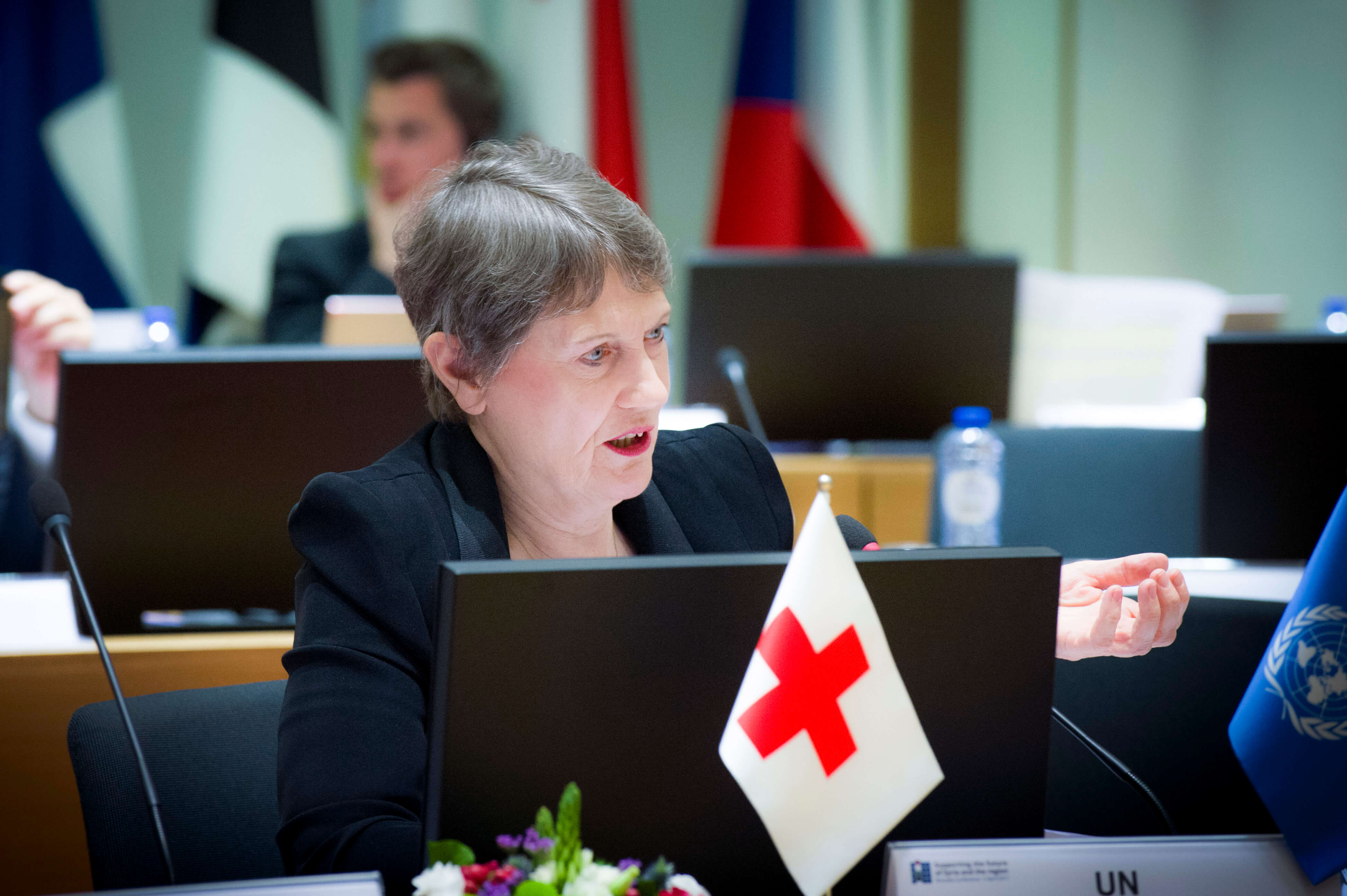 Diplomacy ultimately remains the only sustainable path out of the conflict and away from a fresh wave of nuclear proliferation in the Middle East - Helen Clark
Iran’s foreign minister recently stated that the regime’s HEU stockpile could eventually be retrieved under the supervision of “the agency,” hinting that an IAEA agreement might be negotiable.
This possibility must be fully explored. A preliminary agreement with the IAEA could be the first step toward ending this globally destabilizing conflict.
There is no question that a return to diplomacy will be a difficult sell for Iran, given that it has now been bombed twice by the US and Israel during negotiations.
But while the Iranians have little reason to trust the Trump administration, diplomacy ultimately remains the only sustainable path out of the conflict and away from a fresh wave of nuclear proliferation in the Middle East.
Mutual distrust is not a deal-breaker in arms-control negotiations; it is the norm.
With Trump having just deployed 2,000 troops from the US Army’s 82nd Airborne Division to the region, this is the moment for all parties to find a way out of this dangerous war.
American boots on the ground would make a bad situation far more dangerous.
Helen Clark, a former prime minister of New Zealand and former administrator of the United Nations Development Programme, is Chair of the Extractive Industries Transparency Initiative Board and a member of The Elders.
