Earlier this month, US voters delivered the biggest congressional swing since Watergate.
It’s no great mystery why: Americans are fed up with paying much more for everyday necessities because of President Donald Trump’s tariffs and war in Iran.
For the first time since the 1970s, Americans have acutely and immediately absorbed the economic costs of a president’s foreign adventurism.
By my calculations, Trump’s policies have already cost over $3,000 per household and pushed up mortgage rates by more than a percentage point. According to the Tax Foundation, tariff hikes have cost the average household roughly $1,800 over the past two years, in line with recent figures from the Yale Budget Lab.
The war has cost American households more than $1,250 in higher gas and diesel prices alone, Brown University researchers estimate. Rising jet fuel prices have added to the burden.
At their best, tariffs are a targeted tool to support US competitiveness and ensure that domestic producers get a fair shake against foreign competitors. But the administration’s abuse of the tariff system has shown that the drawbacks of America’s tariff laws far outweigh their potential benefits.
While the Supreme Court struck down Trump’s “Liberation Day” tariffs for exceeding the authority granted by the International Emergency Economic Powers Act, he managed to keep most of them in place using other authorities.
Voters sensed that they were footing the bill for these tariffs, and they were right.
About 90 cents of every dollar the federal government has collected in tariffs has been paid by American consumers and businesses, according to research from the New York Federal Reserve.
The tariffs have also hurt the US manufacturing sector, contributing to a 36% decline in factory investment since the end of 2024.
Congress has a mandate to respond
Congress has a mandate to respond. As tangled as these challenges may seem, there are specific steps lawmakers can take to rein in the president’s tariff and war powers and establish accountability mechanisms to protect households from rising costs.
For starters, Congress should pass a Trade Responsibility Act that would put an expiry date on all broad-based tariff increases implemented over the past two years and require the president to seek congressional approval for proposed tariffs within 60 days.
Reasserting Congress’s authority over tariff policy would be a critical first step toward reestablishing the United States as a trustworthy trading partner
Reasserting Congress’s authority over tariff policy would be a critical first step toward reestablishing the United States as a trustworthy trading partner.
This would likely require 60 votes in the Senate to overcome the filibuster, but it could command bipartisan support.
In April 2025, Republican Senator Chuck Grassley and Democratic Senator Maria Cantwell introduced the Trade Review Act, which would phase out tariffs imposed by the president after 60 days unless Congress approves them. Reversing some of the regressive tax cuts passed last year could help make up for the lost tariff revenue.
Ending the Iran war
Congress should also make government funding contingent on ending the Iran war.
Lawmakers can use their authority under the War Powers Act to send a binding resolution to Trump’s desk, as they nearly did in June and September.
Under the 1973 law, such a measure could legally bar offensive action against Iran, though Trump could veto it.
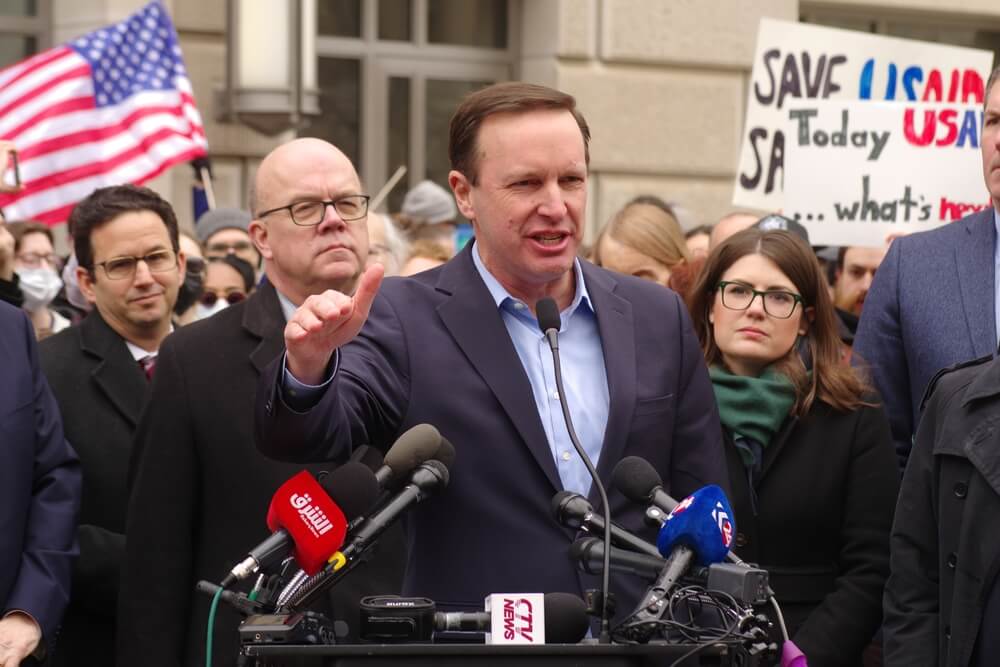 Congress should pass the bipartisan National Security Powers Act which would terminate funding for any unauthorized military action after 20 days - Chris Murphy
Only an end to all US attacks on Iran will deliver the financial relief that American voters demand.
And even if Trump vetoed it, Republican support would increase pressure on the White House to end the conflict.
But ending the current war won’t be enough to prevent the next one. A broader plan is needed to restore America’s commitment to the international order, on which US households’ purchasing power depends.
The War Powers Act, though intended to prevent presidents from launching a major war without congressional approval, always had a central flaw: it gives presidents 60 days to wage war before they have to seek congressional approval and effectively forces lawmakers to muster a two-thirds majority in the Senate and House of Representatives to overcome a presidential veto.
To address this, Congress should pass the bipartisan National Security Powers Act, proposed by Senators Chris Murphy, Mike Lee, and Bernie Sanders, which would terminate funding for any unauthorized military action after 20 days.
Putting the Congressional Budget Office to work
Another way to make the costs of war harder to ignore is to put the Congressional Budget Office to work.
The CBO “scores” the budgetary implications of major bills under consideration.
For legislation authorizing military force, the CBO should be required to assess not only the direct costs to the US government but also the economic costs to American households.
A CBO report prepared before the Iran war would have laid bare its financial risks
A CBO report prepared before the Iran war would have laid bare its financial risks and spelled out what energy analysts have known for years: a major war with Iran would raise energy prices by threatening oil flows through the Strait of Hormuz.
The public debate prompted by such a report would help ensure that the US goes to war only when the American people want it to.
It is long past time that Congress reclaimed its constitutional powers to declare war and set tariff policy.
Every month that the Iran war drags on and Trump’s tariffs remain in place costs Americans roughly $300 per household. There’s no reason to let this continue.
Josh Waldman is a former White House economic policy adviser under President Joe Biden.
