Among Indian Prime Minister Narendra Modi’s most ambitious goals is to transform his country into a developed economy by August 15, 2047 – the centenary of Indian independence.
Given India’s growth record over the past two decades, the speed and scale of its infrastructure development in recent years, and the Modi government’s willingness to enact large-scale economic reforms, India is likely to become one of the few developing countries to avoid the middle-income trap.
Although there is no universally accepted definition of a “developed economy,” the World Bank’s threshold for high-income status serves as a necessary, if insufficient, criterion.
Many characteristics commonly associated with developed-country status are highly correlated with per capita gross national income.
The World Bank sets the threshold for a high-income country at $13,845 in 2023 dollars, and in 2023, India’s per capita GNI in current dollars was $2,580.
If this figure grows by 7.25% annually from 2024 to 2047, India would reach the high-income threshold. But with a population growth rate of 0.6%, the corresponding constant-dollar GNI growth rate would be 7.9%.
Is this feasible? India’s recent growth experience gives us a baseline. From 2003 to 2023, current-dollar GDP grew at an average annual rate of 10.1%, while the US GDP deflator grew at an average annual rate of 2.3%.
Together, these figures imply a constant-dollar GDP growth rate of 7.6%. That is lower than the required 7.9%, but not by much.
The question, then, is whether India can overcome this small difference over the next two and a half decades, or whether, like so many developing countries in Latin America and Southeast Asia, its progress will stall.
Demographic outlook
There are several reasons to be optimistic. First, over the past 79 years, democracy has taken deep root in India.
Despite the noisy politics and occasional chaos, important economic-policy reforms made over the past three decades have been sustained.
True, in exceptional cases, when opposition to a particular reform has mounted, the government has pragmatically retreated.
But over time, the consensus in favor of an outward orientation and market-friendly reforms has strengthened.
India’s demographic outlook over the next two decades is very favorable
Second, India’s demographic outlook over the next two decades is very favorable.
Its large population, with a gross enrollment ratio in higher education at 28.3% in 2021, implies a large workforce of more than 600 million with diverse skills.
Such breadth also yields economies of scale in the provision of public goods, particularly digital platforms.
With more than half of the population under 30 years of age, the worker-to-population ratio is high.
Better still, a high proportion of young people implies a high savings rate, which is essential for maintaining a high level of investment.
Infrastructure projects
Third, over the past decade, India has benefited from a dramatic turnaround in the public sector’s capacity to undertake infrastructure projects quickly and at scale.
The kind of massive projects that have awed visitors to China are now being completed in India in record time. The 21.8-kilometer (13.5-mile) Atal Setu bridge and coastal highway in Mumbai, the parliament building in New Delhi, and Mandapam, a new town in the state of Tamil Nadu, are just a few examples.
Nationwide, India is expanding its road, high-speed rail, and civil aviation networks at a rapid pace
Nationwide, India is expanding its road, high-speed rail, and civil aviation networks at a rapid pace.
Having visited the farthest corners of the country (27 of 28 states) in the past year as part of the 16th Finance Commission’s work, I have seen this connectivity firsthand.
In the state of Sikkim, high in the Himalayas bordering Tibet, we could travel as far as 12,000 feet on the robust roads built by India’s Border Roads Organisation.
Resilience in the face of adversity
Fourth, and more importantly, India has demonstrated surprising resilience in the face of adversity.
It responded decisively to the global economic turmoil caused by Donald Trump’s trade policies.
With US tariffs on Indian goods reaching 50%, it found itself among the countries facing Trump’s highest trade barriers.
Unable to do much on that front, it moved rapidly in other areas, implementing pending domestic reforms and forging free-trade agreements with the European Union and others.
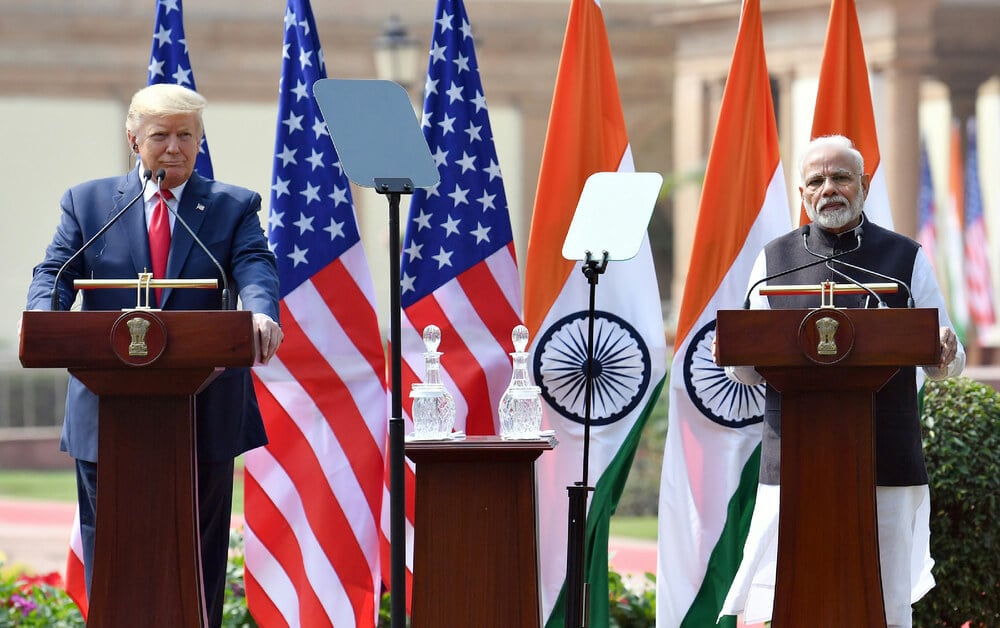 India responded decisively to the global economic turmoil caused by Donald Trump’s trade policies
Domestically, India greatly simplified the personal income-tax system by lowering tax rates, eliminating many exemptions, and replacing multiple indirect tax rates on goods and services with just two levies.
It has also removed many non-tariff barriers and initiated a wholesale reform of the higher-education system.
Moreover, Modi’s government recently implemented what I have called the mother of all reforms by enacting four employment-friendly labor codes to replace 29 highly restrictive and mutually contradictory labor laws (many of which were enacted 50-100 years ago).
The trade agreements with the EU and the United Kingdom seem to have persuaded the United States to stop stalling in its own trade talks with India.
With the broad contours of a new trade framework having now been outlined, a final agreement is expected to be signed by the end of March, when Modi is due in the US.
Owing to these agreements and the liberalization they will bring to India’s markets, India is becoming even more attractive to global investors.
The fifth and final factor likely to enable India to escape the middle-income trap is fierce competition among its 28 states for investment and global market share.
While small countries with limited scope for domestic competition may stagnate for a few years after a spark, 28 states are highly unlikely to come to a grinding halt simultaneously.
The states on India’s western coast and southern peninsula have already sustained robust growth for longer than any country that fell into the middle-income trap ever did.
If they are bellwethers for the rest of the economy, Indians have much to look forward to.
Arvind Panagariya, former chair of the 16th Finance Commission and former chief economist of the Asian Development Bank, is Professor of Indian Political Economy at Columbia University and Director of the Deepak and Neera Raj Center on Indian Economic Policies at the School of International and Public Affairs.
