The Chinese government proposed bans or restrictions on the export of another 40 advanced technologies, including 23 in the field of artificial intelligence, five in biomedicine and 12 in the solar industry.
The measures cover certain large-scale AI models, programmes capable of performing tasks independently and the computer systems on which these models are developed and run, as well as technologies for gene therapy and for manufacturing materials and cells for solar panels.
Of the 40 proposed items, 14 would be banned from export and 26 would require special permits.
The final rules have yet to be adopted, but part of the decision took effect immediately.
As of 16 October, Chinese companies must report to the Ministry of Commerce any transaction that transfers any of the 40 technologies on the proposed list abroad.
Registration is mandatory when the rights to a technology are sold to a foreign firm, when a foreign partner is licensed to use it and when a Chinese company that owns such technology comes under the control of a foreign owner.
At the same time, the ministry receives information about both parties to the transaction, the recipient country, the purpose of the technology and the estimated value of the contract.
For now, it is only a record, but Beijing already knows who is transferring Chinese know-how, to whom, and for how much.
The final catalogue will determine which of these activities will require an export licence in future.
TikTok has shown how valuable an export licence can be
China’s catalogue of prohibited and restricted technologies has existed since 2001, and the political significance of its application became particularly evident in August 2020, when Donald Trump, during his first presidential term, demanded the sale of TikTok’s American business.
Beijing then added to the catalogue technologies for personalised content recommendations, which underpin the way the social network works.
Because of the rule change, the eventual transfer of the relevant algorithm to an American buyer could have required Chinese approval.
The state thus gained the ability to influence negotiations between private companies, even when the subject of the sale was mainly in another market.
In July 2025, the same catalogue was expanded to cover certain technologies for producing cathode materials for batteries and extracting lithium.
These are areas in which Chinese industry has extensive experience and a competitive advantage.
Controlling the production process allows Beijing to monitor the transfer of know-how even when a Chinese manufacturer plans to build a factory in another country
Controlling the production process allows Beijing to monitor the transfer of know-how even when a Chinese manufacturer plans to build a factory in another country.
A finished battery may be sold under different terms from the technology required to produce such a battery independently of a Chinese partner.
An even stronger example emerged through a separate system of export controls.
In October 2025, China tightened rules on the export of certain rare earths and related products.
Following the meeting between Xi Jinping and Donald Trump in South Korea, some of these measures were suspended as part of a trade truce until 10 November 2026, while the earlier restrictions remained in place.
The Chinese–European talks on 8 and 9 October underlined the importance of permits.
European Commissioner Maroš Šefčovič announced an agreement in principle which, according to European Commission projections, would reduce Chinese exports of hybrid cars to the EU by more than half over the next four years compared with the volumes expected without the agreement. The Chinese side did not confirm that figure.
In the same talks, Beijing offered to handle European buyers’ requests for export licences for rare earths and permanent magnets through an expedited procedure, which Chinese authorities call the “green channel”.
European manufacturers of cars, wind turbines and industrial machinery depend on these magnets to power their electric motors.
The permits that Beijing tightened a year earlier have become a subject of negotiation with the European Union.
The service remains available to foreign customers
The Ministry of Commerce maintains that the October change to the catalogue is a routine adjustment of regulations to technological developments and is not directed against any country, region or company.
It warns that artificial intelligence systems can facilitate the writing of malicious programmes, the discovery of security flaws in software and attacks on critical infrastructure.
Those risks are real, but the same document carefully protects the business that Chinese AI companies generate overseas.
The restrictions do not apply to the sale of artificial intelligence as a service. When a foreign user accesses a Chinese model through a website, application or programming interface that connects the model to their software, the model remains on the Chinese supplier’s computers, and the user receives only responses.
Running simplified versions of the model on users’ phones and computers is also outside the scope of control.
Control begins when a Chinese company hands over the technology itself to a foreign partner, so that they can install the model on their own computers and operate it without Chinese involvement
Control begins when a Chinese company hands over the technology itself to a foreign partner, so that they can install the model on their own computers and operate it without Chinese involvement.
Such transfers will be prohibited or require permission, depending on which list the technology is on.
When a Chinese company builds and runs a data centre overseas on its own or deploys a model on its own cloud, the licence is issued automatically, as the technology remains under Chinese control.
The distinction is best illustrated by two banks. One pays a Chinese company to have its AI system process client requests, with the system still running on Chinese computers and under Chinese management.
The other wants to install the same system domestically and to maintain, check and adjust it itself.
The first arrangement is not covered by the controls, whereas the second may fall under them. The same principle applies to biomedicine and the solar industry.
The catalogue does not include the sale of ready-made medicines and solar panels.
Control concerns the knowledge that would allow a foreign company to produce them independently, and it is precisely this knowledge that is a particularly valuable asset of Chinese companies in those sectors.
Washington has already drawn a similar line
On 13 January 2025, a week before the end of his term, Joe Biden’s administration introduced rules limiting the export of the most advanced AI models whose parameters are not public.
Parameters are numerical values that a model acquires during training, and whoever possesses them can run the model on their own computers without the developer’s involvement.
Accessing a model via the internet was not considered an export of parameters, and models whose parameters are publicly available remained outside the scope of these controls.
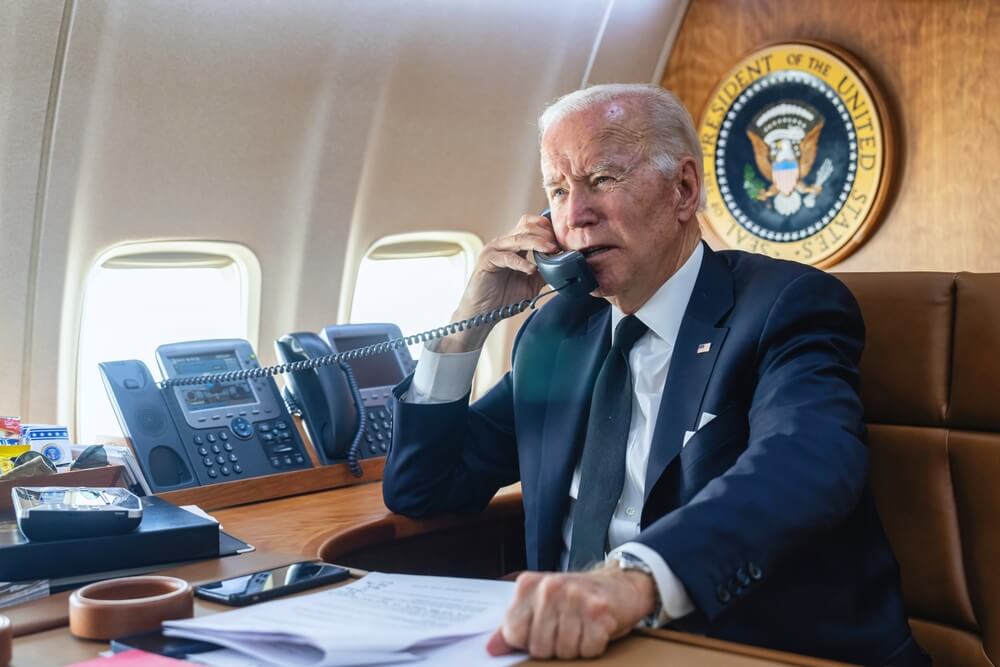 A week before the end of his term, Joe Biden’s administration introduced rules limiting the export of the most advanced AI models whose parameters are not public
The same regulation also introduced restrictions on the sale of advanced chips abroad, making it far broader than the Chinese draft.
On 13 May 2025, two days before most of these obligations were due to take effect, the Trump administration announced the revocation of the regulation and instructed federal agencies not to implement it.
The United States has nevertheless maintained other export controls on chips and sensitive technologies.
Beijing is now incorporating into its own draft the same distinction that Washington first established and then abandoned.
The provision of artificial intelligence as a service remains unrestricted, while the transfer of the model itself to a foreign partner is subject to state supervision.
The state thus controls the outflow of strategically vital know-how, while Chinese companies continue to expand the reach of their services in overseas markets.
China seeks customers and influence over rules
Chinese AI companies are attracting foreign users with lower prices and models that users can customise.
In January 2025, DeepSeek released the R1 model with publicly available parameters under a licence that permits commercial use.
Such models are being adopted at low cost by universities, research institutes and smaller companies around the world, and severely restricting their availability would weaken one of China’s major strengths.
The proposal exempts from control technologies that are already publicly available through open source and scientific papers.
For future releases of open-source models, automatic permission is envisaged, which companies will obtain without difficulty
For future releases of open-source models, automatic permission is envisaged, which companies will obtain without difficulty, but the ministry will keep a record of each such release.
China has also given its technological expansion an institutional framework. On 16 July 2026, an agreement was signed in Shanghai to establish the World Artificial Intelligence Cooperation Organization, headquartered in the city. Among the 29 founding countries are Russia, Pakistan, Indonesia and Kazakhstan, with no European Union or G7 countries among the members.
The Ministry of Commerce is now preparing additional provisions to facilitate the export of technology that members need to strengthen their capacities, exchange technologies and jointly shape rules.
Membership of the Beijing-initiated organisation therefore provides an easier route to Chinese technology, while Beijing retains the final say over the most sensitive transfers.
Europe seeks control even after purchase
China’s proposal comes as the European Union drafts rules on who can manage its digital infrastructure.
On 3 June, the European Commission proposed the Cloud and AI Development Act, which classifies providers into four tiers according to how well they are protected from influence outside the EU.
The third tier requires suppliers to be European-owned and controlled, and the fourth tier requires that no third country can influence their software or supply chain.
Member states will determine the tier required for each public service, and institutions in defence, the judiciary and the police will not be allowed to use the lowest-tier services.
The regulation is only at the start of the legislative procedure, and the European Parliament and the Council of the EU can still amend it.
This is where the two systems collide. When a Chinese company builds and operates a data centre abroad, China offers the most favourable terms, including an automatic export licence.
What Beijing considers the safest form of export, Brussels would regard as the greatest risk
Under the European proposal, a supplier from a non-EU country will be able to work for the public sector only once it reaches the third tier and the Commission recognises the country from which it is managed.
A data centre in Europe operated by a Chinese company would be unlikely to pass such scrutiny. What Beijing considers the safest form of export, Brussels would regard as the greatest risk.
A similar choice awaits countries still building their own capacities. In September, the United Nations Development Programme published an analysis of data centres in Kenya, Malawi, Rwanda, South Africa, Togo and Zambia.
It concludes that computers alone are not enough, and that centres run by local institutions, with usable data and local experts, deliver the greatest benefits.
Chinese rules offer the most favourable terms precisely when management stays with the Chinese company.
Governments in Africa and Asia will therefore have to choose between the ready-made Chinese offer and the slower development of infrastructure that they would manage themselves.
Three November deadlines and a new question for Washington
Companies and experts can submit comments on the draft catalogue until 15 November, after which Chinese ministries will determine the final list.
That deadline coincides with the expiry of two key concessions from last year’s trade truce between China and the US.
In November 2025, Washington suspended the rule under which export bans on companies on the US blacklist are automatically extended to subsidiaries in which they hold at least a 50 per cent stake.
The suspension lasts until 9 November, meaning the rule will apply again from 10 November unless the US administration decides otherwise.
On the same day, China’s suspension of part of the restrictions on the export of rare earths also expires.
The Ministry of Commerce did not link the consultation deadline to negotiations with Washington.
 Buyers who do not wish to depend on a Chinese licence can choose American and European models, such as Meta’s Llama or those from the French firm Mistral
However, Beijing enters these talks with a new point of leverage, ready at the exact moment when both sides must decide whether to extend the truce.
Following the consultation period, China is likely to retain most of the proposed restrictions and relax only those that would make it harder for its AI companies to operate abroad.
The speed and terms on which it issues permits will give Beijing more leverage than the list itself, because it can adjust them without new legislation; the outcome of the truce negotiations will therefore influence how the catalogue is applied more than its formal adoption.
Foreign users accessing Chinese models over the internet will notice little change.
Companies and governments seeking to deploy a Chinese model and manage it themselves will be affected, because in addition to a commercial contract, they will also require approval from the Chinese state.
Beijing would apply the same pressure to AI that it has already applied to TikTok, batteries and rare earths.
This time its leverage may prove weaker, because buyers who do not wish to depend on a Chinese licence can choose American and European models with publicly available parameters, such as Meta’s Llama or those from the French firm Mistral.
