On 19 September, the French Ministry of Finance published new public finance estimates for 2026 and 2027.
Public debt is expected to reach 119.3 per cent of GDP this year and 121.7 per cent next year.
The government led by Sébastien Lecornu is seeking to reduce the deficit from 5.4 per cent of GDP to around 5 per cent through a fiscal adjustment of approximately €54 billion.
At the same time, the yield spread between 10-year French and German government bonds surpassed 100 basis points for the first time since the eurozone debt crisis of 2012.
Investors are therefore already demanding a higher premium to hold France’s debt.
France cannot be compared with Greece in the period 2010–2012 in terms of the size of its economy, the government debt market, its position in the eurozone or the nature of its current fiscal risk.
High debt and more expensive refinancing are reducing the government's room for manoeuvre at a time when Paris plans to spend more on the military, nuclear deterrence, energy, technology and industrial policy, while simultaneously trying to preserve a social system in which deeper cuts would be politically very difficult.
The Banque de France expects growth of only 0.4 per cent this year and 0.9 per cent in 2027, so stronger economic growth cannot for now absorb most of the fiscal adjustment.
Interest is taking an ever-larger share of the budget
In July, the French government estimated that interest expenses would rise from €64.8 billion in 2026 to €74.2 billion in 2027.
For that same year, Emmanuel Macron set a target for the military budget to reach €64 billion, twice as much as in 2017.
If current estimates remain broadly unchanged, next year the state will spend about €10 billion more on interest than on the entire armed forces.
These two amounts are not directly interchangeable budget items, but they clearly show how rapidly expenses are growing and how difficult they are for the government to reduce.
The military programme can remain on track, but its budgetary space will have to be preserved at the expense of other priorities
Debt servicing is an obligation, while an increase in military spending is already embedded in France’s planning and based on the assessment that security pressures on Europe will persist.
In August, an additional €36 billion was confirmed for the period 2026–2030, intended, among other things, for cyber capabilities, unmanned systems, anti-missile defence and long-range strike capabilities.
In July 2025, Macron stated that additional armaments should not be financed through new debt and linked military independence to financial independence. That intention is now far more expensive to implement.
France is borrowing at higher rates than before, existing debt is gradually being refinanced on less favourable terms, and economic growth is too weak to significantly increase tax revenues.
The military programme can remain on track, but its budgetary space will have to be preserved at the expense of other priorities.
Defence remains a protected priority
There is currently no serious indication in Paris that the military programme could be scaled back because of fiscal pressures.
France is assuming more of Europe’s military responsibilities, increasing its presence on NATO’s eastern flank and seeking to give its nuclear force a greater role in European security.
At the NATO summit in Ankara, Macron called for greater European responsibility in areas where US involvement is declining.
France’s military planning is based on the assumption that the country’s commitments will increase in the coming years.
Lecornu is preparing the 2027 budget, in which the government must find approximately €54 billion of savings as interest rates rise, defence remains a political priority and large tax increases or severe cuts in social benefits carry high risks ahead of the presidential election.
Without new measures the deficit could exceed 6.5 per cent of GDP
According to government estimates, without new measures the deficit could exceed 6.5 per cent of GDP.
Most savings will have to come from social programmes, local government expenditure, subsidies and other items that can be adjusted through the annual budget.
Military expenditure is not the only rival to these demands. France also wants greater investment in nuclear energy, artificial intelligence, industrial policy and infrastructure, precisely in the areas where Paris has warned for years that Europe is lagging behind the United States and China.
Higher borrowing costs increase the expense of these programmes and limit how many large projects the state can run at once without further increasing the deficit.
Weak growth complicates fiscal consolidation
The Banque de France projects growth of 0.4 per cent in 2026. At such a low rate, tax revenue growth will remain limited and the debt-to-GDP ratio will be difficult to stabilise without cutting the deficit.
For 2027, the central bank expects growth of 0.9 per cent, while warning that less favourable energy prices could keep it at 0.4 per cent and that a more severe external shock could lead to a slight contraction in the economy.
Implementing fiscal consolidation in such an environment entails higher political costs.
Debt begins to constrain government policy long before it becomes seriously difficult or too expensive for the government to borrow
Reducing expenditure affects domestic demand more directly, while increasing taxes can further weaken private consumption and investment. At the same time, bonds issued during periods of very low interest rates are replaced, at maturity, by new debt at a higher cost.
Debt begins to constrain government policy long before it becomes seriously difficult or too expensive for the government to borrow.
It is sufficient for interest expenditure to grow faster than revenue and to take an increasing share of the budget from year to year.
The price of France’s debt matters for all of Europe
Europe has entered a period of significantly greater security obligations. NATO has set a target of total allocations of 5 per cent of GDP by 2035, of which at least 3.5 per cent is for core defence needs.
The European Union has granted some members additional fiscal flexibility for defence, but these rules do not affect the yield the market demands on their government bonds.
France is currently not even using the national derogation clause that has been activated for 18 member states
France is currently not even using the national derogation clause that has been activated for 18 member states, and its case shows the limits of that mechanism, since the prospect of higher expenditure does not guarantee cheaper financing.
France is particularly important for European defence because it is the only nuclear power in the European Union, has a large domestic defence industry, holds a permanent seat on the UN Security Council and has the political ambition to take a leading role in developing European military capabilities.
If higher debt costs constrain Paris’s room for manoeuvre, the same pressure will be even more pronounced in other highly indebted members that have increased their defence commitments in recent years and do not share France’s financial and industrial base.
Paris will push harder for European funding
In April, Macron advocated common European borrowing to invest in defence, space and artificial intelligence.
With debt above 120 per cent of GDP and rising interest expenditure, France has an even stronger interest in ensuring that projects of common European importance are not financed exclusively from national budgets.
Every programme financed at European Union level reduces the amount that Paris has to find within its own budget.
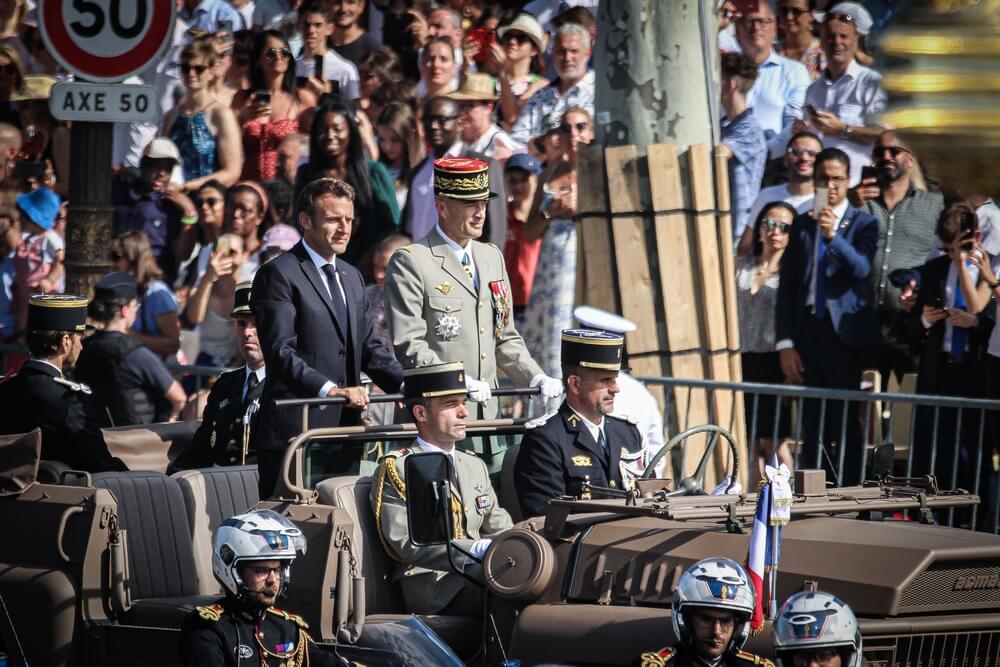 In 2027, the French government will probably continue to defend the planned increase in the military budget
In 2027, the French government will probably continue to defend the planned increase in the military budget, while seeking to implement most of the fiscal adjustment through other spending.
Weak growth and higher interest rates will make this task more difficult, especially if the gap between French and German yields remains wide.
Any delay in reducing the deficit would increase interest expenditure in future budgets and further strengthen France’s argument that part of Europe’s security and technology investments should be jointly financed.
France has sufficient economic and financial capacity to continue its planned military build-up, but financing defence, energy, technology and social programmes will become increasingly difficult if debt and interest rates continue to rise at their current pace.
The 2027 budget will show which expenditures the government is genuinely willing to cut to protect the military programme and stabilise the deficit. If defence is spared major cuts,
Paris will have strong grounds to argue within the European Union for joint financing of part of the costs arising from new European security obligations.
