The nuclear question has returned to the center of global politics. While the specter of nuclear proliferation never disappeared, it was obscured for decades by a functioning and predictable global order, underpinned by a hegemonic United States, a strong NATO, and credible arms-control regimes.
But this order is now under unprecedented strain, with the US-Israeli war on Iran just the latest evidence. How can we preserve nuclear restraint in a world in which the architecture of restraint is crumbling?
The dawn of the nuclear age led to an inversion of strategic thinking. Until then, military power had been measured by the capacity to win wars, which was tested on the battlefield. But nuclear weapons’ purpose was deterrence, not victory.
Nuclear weapons did not abolish conflict. The Cold War remained violent, dangerous, and morally depraved. Proxy wars raged, and people lived in fear.
What nuclear weapons did was raise the stakes of conflict, with mutual assured destruction helping to prevent direct war between the superpowers.
Deterrence worked not because it made leaders virtuous, but because it made escalation suicidal.
Nuclear order is multipolar
That grim logic remains relevant, but its context has changed. Whereas the Cold War was fundamentally bipolar, today’s nuclear order is multipolar. China is joining the US and Russia as a major nuclear power.
Though China’s arsenal remains smaller, the US Department of Defense projects that it could exceed 1,000 operational nuclear warheads by 2030.
The result will not simply be an expanded version of the Cold War. Trilateral deterrence is more unstable than bilateral deterrence.
Each major power must calculate not only its balance with adversaries, but also how moves against one affect the other
Each major power must calculate not only its balance with adversaries, but also how moves against one affect the other. Arms control becomes more ambiguous, and crisis management more complex.
Confounding matters further are several other nuclear states—Britain, France, India, Israel, North Korea, and Pakistan—each with its own nuclear doctrine, geography, fears, and political compulsions. Their arsenals are smaller, but the danger they represent is not.
A nuclear exchange on the Korean Peninsula or between India and Pakistan would not only be a major regional tragedy; it would affect broader alliances, disrupt global markets and supply chains, and reshape great-power calculations.
The war in Iran
But perhaps the most dangerous factor in the emerging nuclear order are threshold states.
The risk is not only that more states build large arsenals; it is that some acquire just enough nuclear capability to believe that they can intimidate neighbors, deter foreign intervention, or survive conventional defeat.
Just a few nuclear weapons may be enough to transform a regional crisis into a global one
Just a few nuclear weapons may be enough to transform a regional crisis into a global one. This raises the stakes of negotiations to end the war in Iran.
A deal that delivers an immediate military de-escalation and reopens the Strait of Hormuz might be diplomatically useful.
But if it does not include a clear agreement on Iran’s nuclear program, the lesson drawn—not just in Iran, but also in Turkey, Saudi Arabia, South Korea, and Japan—could be that proliferation is sound strategy.
The American security guarantee
Europe is also paying attention. NATO’s collective-defense clause remains the cornerstone of European security, but it is not an automatic trigger; it must be activated through political decisions.
The more NATO’s European countries doubt that the US will fulfill its commitment to come to their defense, the more they will hedge, through strengthened national capabilities, special bilateral guarantees, and alternative nuclear deterrents.
This is not a hypothetical prospect. While former Polish President Andrzej Duda called for the deployment of US nuclear weapons on Polish soil—a bid for greater assurance that the US nuclear umbrella can be counted on—Prime Minister Donald Tusk has emphasized the importance of autonomy in nuclear deterrence.
Moreover, German Chancellor Friedrich Merz has encouraged discussion about a shared European nuclear umbrella, underpinned largely by France and the United Kingdom.
There is no substitute for the American security guarantee
France certainly seems to be on board with the idea. In March, French President Emmanuel Macron described an “advanced deterrence” doctrine, which would cover the country’s European allies.
Belgium, Denmark, Germany, the Netherlands, Greece, Poland, Sweden, Norway, and the UK have already agreed to participate in the strategy, supporting France’s nuclear deterrent with their conventional forces.
But France’s so-called nuclear parapluie is fundamentally limited—selective, sovereign, and reversible. It does not cover all European Union member states; it leaves countries (such as Spain) outside the inner circle; and it keeps nuclear decision-making entirely in France’s hands.
Macron’s rhetoric suggests not the emergence of a true European nuclear deterrent, but an effort to dress up the redistribution of burdens in the language of strategic autonomy.
Ultimately, there is no substitute for the American security guarantee. But Europe must do its part to keep that guarantee politically sustainable.
Reducing proliferation pressure
To that end, instead of heading to the upcoming NATO summit in Ankara with more anxiety disguised as indignation, European leaders should arrive with a pledge to strengthen the alliance’s European pillar.
This means expanding their conventional capacity, enhancing their air and missile defenses, deepening their weapons stocks, improving their intelligence and surveillance capabilities, and increasing their contribution to deterrence below the nuclear threshold.
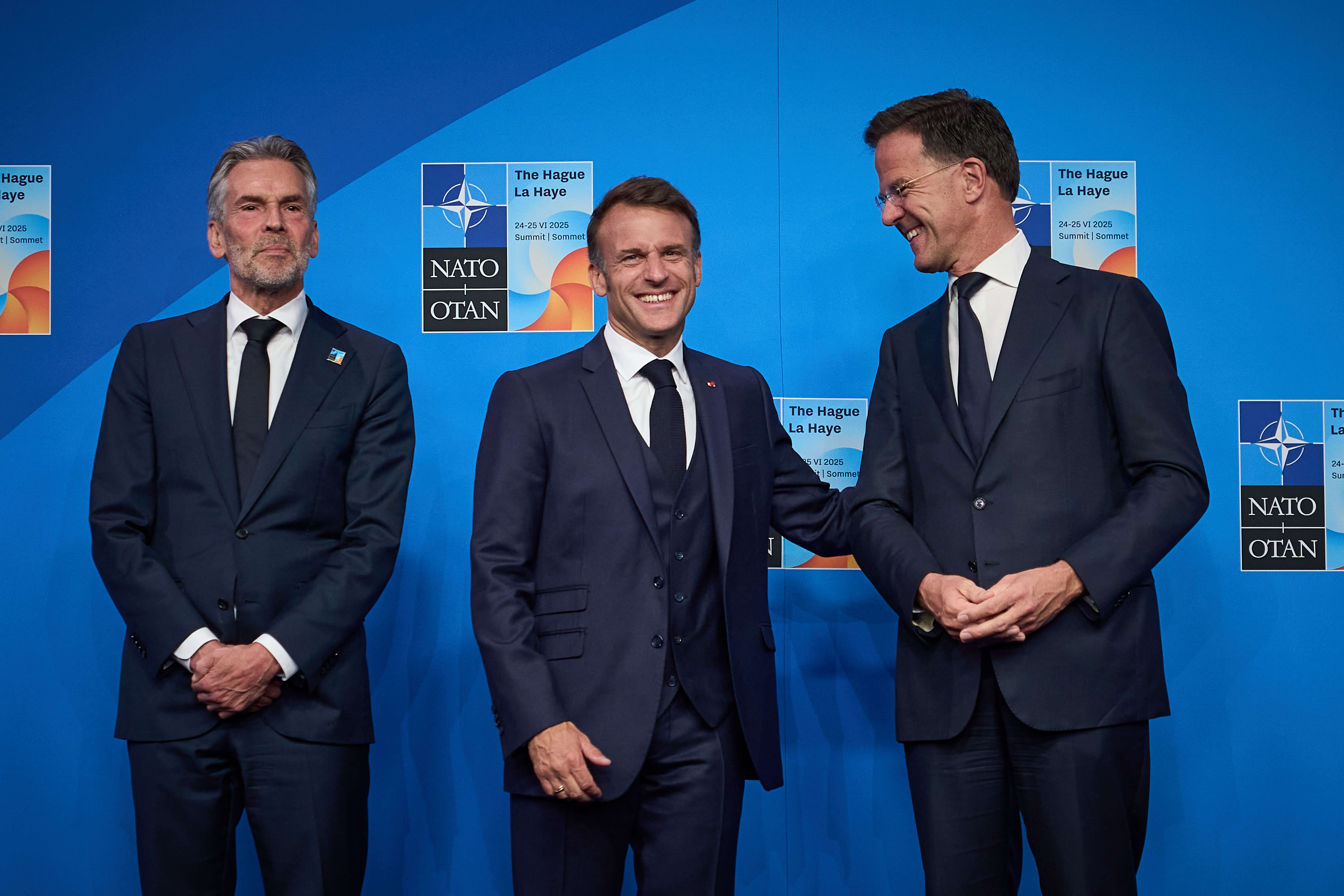 The greater Europe’s conventional capabilities, the less outcomes will depend on America’s willingness to risk nuclear escalation
The greater Europe’s conventional capabilities, the less outcomes will depend on America’s willingness to risk nuclear escalation.
Crucially, this approach would also reduce proliferation pressure, which would be good news for the US.
The last thing the country wants is a world in which every anxious ally or regional power concludes that only nuclear weapons can guarantee its security. American ambiguity may be useful at the margin; American abandonment would be destabilizing at the core.
The nuclear age began with the realization that victory could mean catastrophe.
That risk remains as potent as ever, but the institutional framework that mitigated it has been severely eroded.
The task now is to prevent the quest for deterrence from giving way to proliferation.
For Europe, this means keeping the US engaged, building conventional capacity, preserving NATO’s credibility, and upholding strategic restraint.
Ana Palacio, a former minister of foreign affairs of Spain and former senior vice president and general counsel of the World Bank Group, is a visiting lecturer at Georgetown University.
