A nasty row between Ukraine and Poland over a WWII massacre of ethnic Polish civilians is a timely reminder of Europe’s dark past and the enormous obstacles the continent has to overcome if it is to work together effectively.
Lest we forget, every European country without exception has in the past at some point been involved in a conflict with a neighbour. Most countries have a history of centuries of bloodletting.
Almost all have also carried out atrocities against minorities or been involved in their oppression.
This, in addition to centuries of colonial outrages in which many Europeans were involved, even ones not citizens of colonial powers.
The historical grievances between Poland and Ukraine are thus not the exception but the rule. They share some of the same ultra-nationalist markers that fan the current Russian war of aggression on Ukraine.
Old resentments linger
The European Union, through economic integration and until recently under a Pax Americana, was largely meant to take the sting out of such issues, but even there, old resentments linger.
With the current right-wing nationalist turn in most countries, these frictions have, if anything, increased.
Nobody knows what will happen if the far-right gains power in Germany or France and if the EU in its current form will even be able to survive.
Ultra-nationalism has already played a role in ripping a vital part out of the EU: the UK after Brexit
In a way, ultra-nationalism has already played a role in ripping a vital part out of the EU: the UK after Brexit. Whatever spin pro-Leave forces might try to put on it, the vote was heavily affected by the ultra-nationalist triad of anti-migration sentiment, anti-European feelings and empire nostalgia.
The EU is reacting in several ways to the ultra-nationalist wave, emphasising the rule of law, using money as leverage to enforce compliance with common rules and reconsidering unanimity requirements, especially in the wake of the experience with Viktor Orbán in Hungary.
But it has very little power to force countries, once they’re members, to adjust their historical narratives and stop revering a murderous past, even if that involved the slaughter of current allies.
No place in a modern Europe
Poland is not wrong to demand that Ukraine refrain from celebrating the WWII Ukraine Insurgent Army, UPA, which was among other things responsible for the massacre and ethnic cleansing of up to some 100,000 ethnic Polish civilians in the Volhynia region.
It is understandably upset by Ukraine’s president Volodymyr Zelensky’s decision to name an elite army unit after the UPA.
Many Ukrainians, especially in their struggle against Russia and prior to that against the Soviet Union, see the UPA as a symbol of national resistance.
As is often the case, especially when a country is involved in ongoing conflict, the darker side of such national symbols is ignored.
Zelensky’s decision to officially embrace the UPA legacy might be partly tied to morale issues in his army and recruitment pool and could possibly be aimed at defusing a looming discipline issue surrounding the use of UPA symbols.
The far-right president, Karol Nawrocki, is escalating the issue while the centre-right Prime Minister, Donald Tusk is attempting to resolve the row
Yet, it does institutionalise a part of Ukrainian history that has no place in a modern Europe.
The UPA is a particularly difficult case, because, besides fighting the Germans, it also at times cooperated with them. It and its members were involved in killing Jews and other ethnic minorities, including Poles, and prioritised the fight against the Soviets.
Polish insistence on this being addressed is understandable, but the way in which it has been pushed also has to do with that country’s own right-wing nationalist politics.
The far-right president, Karol Nawrocki, is escalating the issue while the centre-right Prime Minister, Donald Tusk is attempting to resolve the row.
Poland’s ultra-nationalists, when in power, were themselves guilty of trying to whitewash parts of the country’s WWII past with a punitive Holocaust history law.
The role that ultra-nationalism plays
One of the questions raised by the episode, though, is the role that ultra-nationalism plays in Ukraine.
This is not only an issue because Russia keeps referring to the ‘fascist Kyiv’ regime as one of the justifications for its war.
It is also an issue for Ukraine’s ongoing and now accelerated accession talks with the EU. Several Polish politicians have already threatened to block accession if the Volhynia issue is not resolved.
A parallel, though not completely equivalent, situation emerged when Croatia sought membership of the EU.
The EU addressed some of this during Croatia’s accession process in the 2000s
That country had, mostly unofficially, used its WWII Nazi-collaborationist Ustase movement and regime as a national symbol during its independence struggle from Yugoslavia and the Balkan wars in the early 1990s.
The EU addressed some of this during Croatia’s accession process in the 2000s. Yet, a measure of backsliding has been reported since Croatia became an EU member in 2013.
Because, as noted, once a country is a member, the EU leverage over such issues declines, which might partly explain Poland’s current emphasis on Ukraine’s behaviour.
One important caveat, thus far, is that even Poland’s far-right ‘mainstream’ is not calling into question support for Ukraine’s fight against Russia.
On the other hand, new, even further-right factions have emerged that are now doing so, and they have rapidly become the third-most popular political grouping in the country.
Tensions between EU members
Such ultra-nationalist currents are by no means limited to Ukraine, Poland and Croatia. In most cases, for now, they focus on anti-immigrant sentiment rather than on neighbours. But the immigration issue, too, has led to some tensions between EU members.
Germany’s AfD, classified as ‘suspected of right-wing extremism’ by the country’s intelligence agencies, is now leading in the polls nationwide and could come to power later this year in one or more German regional state governments.
The party is not just extremely anti-immigrant and anti-Muslim, it’s also overtly and deeply pro-Russian.
The old fears of a radicalised, powerful Germany at the centre of Europe are being revived
While an AfD takeover of the German federal government doesn’t look likely right now, the party’s rapid growth is a sign that nothing can be excluded.
Even now, as the largest opposition party, concerns of spying or leaking information to Russia complicate the German Bundestag’s proceedings.
At a time when Germany is investing more in its armed forces than any other European country, the old fears of a radicalised, powerful Germany at the centre of Europe are being revived. Even though ostensibly, Europe needs the German defence effort in order to counter Russia.
The recent failure of pan-European defence projects, particularly the German-French FCAS fighter aircraft programme, illustrates the distrust and the difficulties for even two such pivotal EU countries to work together.
An existential threat to a united Europe
The French situation is slightly different from Germany’s, but there too, candidates of the far-right’s Rassemblement National are leading in the polls for next year’s presidential elections.
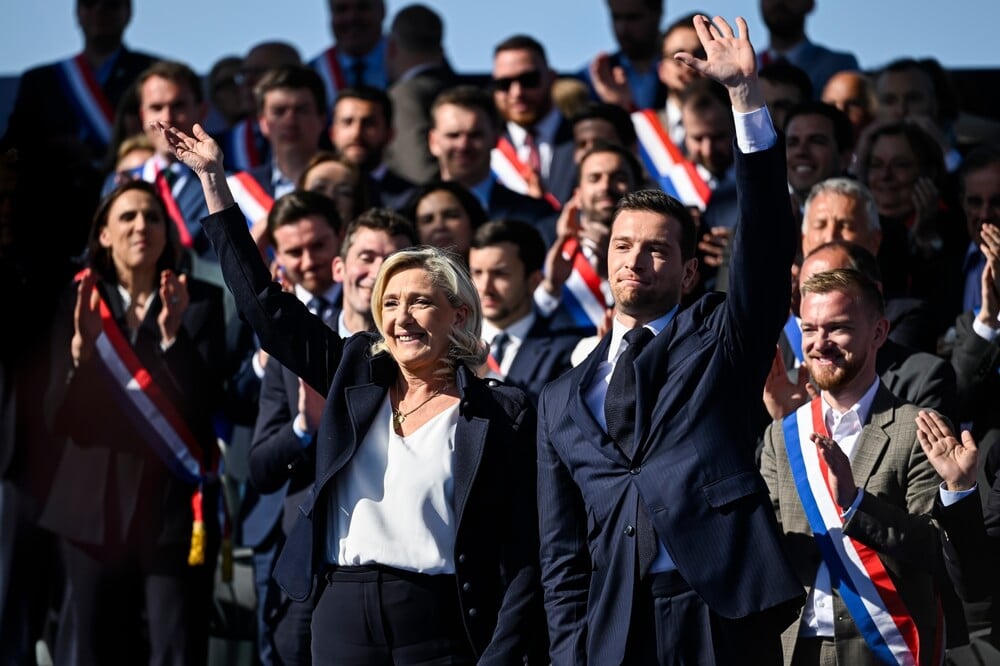 The RN has moderated its pro-Russian, anti-EU stance and is trying to pass itself off as an old-style Gaullist, but nobody knows how it will behave once in power
The RN has moderated its pro-Russian, anti-EU stance and is trying to pass itself off as an old-style Gaullist, French-nationalist party, but nobody knows how it will behave once in power.
Having either the AfD or the RN at the core of the EU’s power structure is likely to have far-reaching consequences for European cooperation and support for Ukraine.
At the very least it is likely to further undermine the EU’s current effort to stand up its own defence and tech capacities, which would in turn make a united Europe ever less effective and thus attractive to its members.
If war among major European countries seems impossible right now, except for Russia, that’s because of the success of the European Union.
But if the old violently nationalistic habits are widely celebrated and allowed to flourish once more, there’s no guarantee that Europe’s future will not be just as bloody as its past.
We only have to look just outside the EU’s eastern borders to see this already happening.
