On 8 June 2026, France and Germany officially abandoned the development of a joint next-generation combat aircraft under the Future Combat Air System (FCAS) programme.
Chancellor Friedrich Merz and President Emmanuel Macron concluded that Airbus and Dassault Aviation had been unable to resolve years of disputes over project leadership, division of labour, and intellectual property rights.
This effectively ended the core part of the initiative, which was intended to become a symbol of European defence integration in the coming decades.
FCAS was launched in 2017 with the aim of replacing the German and Spanish Eurofighters as well as the French Rafale aircraft by around 2040.
Estimates indicated that the total value of the system, which included unmanned platforms and a digital network for data exchange in addition to the piloted aircraft, could reach 100 billion euros.
From the outset, the project was plagued by industrial rivalry, but the political leadership in Berlin and Paris insisted for years that the differences would be resolved.
Today, it is clear that political support was insufficient to overcome the conflict of interests between the two leading European defence companies.
Industrial interests took precedence over political ambitions
The withdrawal was not due to a lack of political will, but to the inability to reconcile the demands of Dassault Aviation and Airbus.
The French manufacturer insisted on a leading role in the development of the aircraft, citing experience gained from the Rafale programme.
Airbus, representing German and Spanish interests, sought a more equitable distribution of jobs and greater access to key technologies.
Disputes affected nearly all elements of the project. Discussions addressed technical specifications, programme management, ownership of intellectual property, and operational priorities.
France insisted on capabilities suited to aircraft carrier operations, while Germany emphasised interoperability within NATO structures.
Without the aircraft as the central element, the project loses its original purpose and political significance
The problems did not arise overnight. The programme had been delayed for years, and attempts to mediate between industrial partners had not produced results.
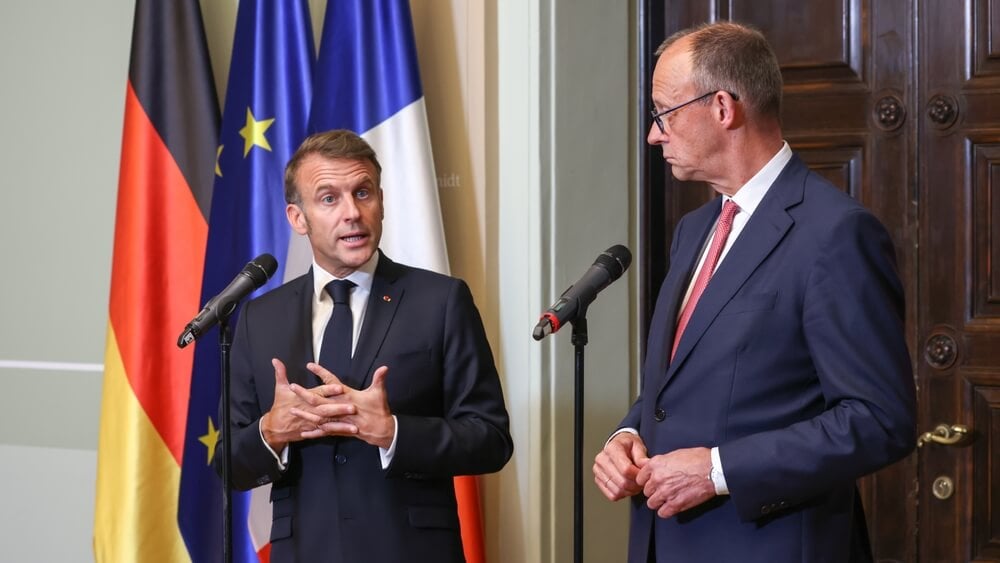
The last serious attempt at a political agreement was made by Merz and Macron at the end of May, on the sidelines of the summit in Montenegro.
When no progress was made, the decision was taken to suspend development of the fighter jet.
It is important to understand the scale of this decision. Not all of FCAS was abolished. Certain elements, primarily the digital infrastructure for data exchange and parts of the programme related to unmanned systems, may remain under the existing cooperation framework.
However, without the aircraft as the central element, the project loses its original purpose and political significance.
Germany is seeking an alternative
Berlin did not wait long to signal its next steps. Airbus, together with seven leading German companies from the defence and aerospace sectors, has formed the "Team Gen 6" group, aiming to develop a future sixth-generation fighter jet.
German industry believes that some of the technologies developed within FCAS can be used in the new programme.
At the same time, the possibility of Germany joining the British Global Combat Air Programme (GCAP), in which the United Kingdom, Italy, and Japan are already participating, is attracting increasing attention.
Although no official decision has been made, the fact that this option is being seriously considered demonstrates Berlin's willingness to seek solutions outside the traditional Franco-German framework.
Both sides are expected to identify new areas of cooperation
France is much more reserved in its public statements. Paris is trying to preserve at least some technological cooperation with Germany and avoid giving the impression of a complete break.
At the meeting of the Franco-German Ministerial Council, scheduled for July 2026, both sides are expected to identify new areas of cooperation that are politically viable and industrially feasible.
Such a formulation in fact acknowledges that the model of comprehensive integration is no longer realistic.
The limits of European defence integration
The collapse of FCAS extends well beyond the fate of a single programme. It exposes the structural weaknesses of European defence cooperation.
For years, European institutions have promoted the concept of strategic autonomy and the need to reduce dependence on American technology.
However, when projects reach the stage of work distribution, access to technologies, and determination of political influence, national priorities once again come to the forefront.
FCAS is not the first project to encounter such problems, but it is the most ambitious. That is precisely why its failure would have wider consequences.
The collapse of FCAS demonstrates how difficult it is to turn political statements about European autonomy into concrete technological capabilities
Europe is under pressure to rapidly increase its own defence capabilities, while Washington is increasingly openly expecting European allies to take on more of the burden for their security.
The collapse of FCAS demonstrates how difficult it is to turn political statements about European autonomy into concrete technological capabilities.
For Germany, the situation is particularly complex. Berlin does not have a national sixth-generation fighter jet programme to replace the Eurofighter within the planned timeframe.
The acquisition of American F-35 jet, which has already begun, therefore takes on additional strategic importance.
At the same time, the German leadership is clearly not prepared to accept long-term arrangements in which it believes it does not have an equal position with France.
From grand visions to limited partnerships
European cooperation in military aviation is likely entering a new phase. Instead of large integrated projects involving numerous countries and companies, smaller formats based on clearly defined interests and precise allocation of responsibilities now appear more realistic.
Germany will continue to consider cooperation with the United Kingdom and other partners. France will aim to preserve national technological capabilities and selectively choose areas where international cooperation is beneficial.
Certain elements of FCAS may survive in a modified form, but the development of European aviation capabilities will almost certainly proceed more slowly and with less coordination than anticipated just a few years ago.
 FCAS demonstrates that European strategic autonomy cannot rely on the assumption that industrial interests will automatically align with political objectives
FCAS demonstrates that European strategic autonomy cannot rely on the assumption that industrial interests will automatically align with political objectives.
As long as the largest defence companies retain the power to block projects that do not suit their business interests, large integrated programmes will remain exposed to the same risks.
Thus, the collapse of FCAS does not mark the end of European defence cooperation; it marks the end of one way of thinking about such cooperation.
Europe will continue to pursue the development of common military capabilities. However, future projects are likely to be more modest in scope, more precisely defined, and based on pre-agreed interests.
In European politics, it is often assumed that common interests will eventually lead to joint action. FCAS has shown that this process can also work in reverse.
When national priorities clash, neither years of negotiations, billions of euros, nor political symbolism guarantees success.
