The Council of the European Union imposed sanctions on Xenia Fedorova, the former president and director of the RT France news programme, for participating in Russian foreign information manipulation and interference activities (Foreign Information Manipulation and Interference – FIMI).
Her assets in the EU have been frozen, European citizens and companies are prohibited from making funds and economic resources available to her, and she is subject to a travel ban across the Union.
The sanctions regime for Russian destabilising activities now applies to 81 individuals and 20 organisations.
In its explanation, the Council cites Fedorova’s former leading role at RT France, as well as her subsequent appearances in the French media.
Among the messages it accuses her of spreading are claims that Western aid is prolonging the war in Ukraine, that Russia wants peace while Europe seeks conflict, challenges to established facts about the unlawful transfer and deportation of Ukrainian children and portrayals of NATO and the EU as a threat to European security.
The French authorities had already treated her as a security risk, adopted a measure to expel her and frozen her assets for six months.
The case is significant because of Fedorova, but above all because of the instrument the EU is currently expanding.
Brussels is increasingly using individual sanctions against people whose activities take place primarily in the information space.
Consequently, the European response to foreign influence operations is shifting from media regulation and the banning of certain channels to a much more serious zone: asset freezes, travel bans and restrictions on business relations with specific individuals.
Such measures require a clearer answer to the question of where political speech ends and participation in the operations of a foreign state begins.
Not every pro-Russian message is part of a foreign operation
The European External Action Service does not define FIMI as another term for disinformation.
According to its definition, it is a deliberate, manipulative and coordinated pattern of behaviour that can threaten political processes, institutions or social values, even though the behaviour itself is often not unlawful.
This distinction is important because the focus shifts from the content of individual messages to the way they are produced, disseminated and linked to other activities.
A false claim on its own is not evidence of a foreign operation, nor is a political position that aligns with Moscow’s interests
A false claim on its own is not evidence of a foreign operation, nor is a political position that aligns with Moscow’s interests.
In an open society, people may, for ideological, political, financial or other reasons, hold positions that coincide with those of a foreign government without being part of its operation.
The same applies to propaganda: it can be false, manipulative and politically harmful, but in legal terms it is not the same as coordinated activity attributable to a foreign state.
That is why the European 2024 framework is concerned not only with content, but also with the people and organisations that plan, carry out, support or facilitate the coordinated manipulation of information linked to Russian government policy.
This criterion is necessary. A sanction against a natural person cannot rest solely on the fact that they say the same thing as the Kremlin; there must be a sufficiently strong connection between their behaviour and the wider operation.
The sanction must be based on a connection with the operation
In Fedorova’s case, there are facts that make this doubt substantial. She has held senior positions at RT for years, including heading RT France and the former video agency Ruptly.
In 2022, the General Court of the EU held that RT France was not only a media outlet with a controversial editorial policy, but also an organisation financed by the Russian state which actively supported Russia’s policy of destabilisation and aggression against Ukraine.
In 2026, France went beyond evaluating her media work and treated Fedorova’s activities as a matter of national security.
The Ministry of the Interior issued an expulsion order, and a separate decision froze her assets. The EU refers to these procedures in its own statement of reasons.
However, the publicly released decision of the Council describes in more detail what Fedorova said than how her current activity is connected to the Russian state.
Sanctions decisions often rely on data that are not fully public
In the public part of the statement of reasons, there is no detailed account of funding, instructions, coordination or other operational links that would clearly show how the Council moved from her repeating Russian narratives to the conclusion that this formed part of a wider Russian operation.
This does not mean that such evidence does not exist; sanctions decisions often rely on data that are not fully public.
But it is precisely the strength of that connection that will be decisive if the measure is challenged in court.
This is a crucial issue because asset freezes and travel bans are not the same as publicly labelling someone a propagandist.
When a state or international organisation responds with such measures to activity that consists mainly of speech and media appearances, it must be able to demonstrate why it is punishing participation in an operation rather than a political position.
RT France is an important precedent, but it is not enough
The judgment in the RT France case showed that, in exceptional circumstances, the EU can restrict the work of media linked to a foreign state.
In 2022, the Court concluded that the Council had sufficiently concrete and mutually consistent evidence that RT France actively supported Russia’s aggressive policy and, when assessing proportionality, it also took into account that the measure was not permanent and could subsequently be repealed. Fedorova’s case is legally more complex.
What must be demonstrated is not only the continuity of the propaganda, but also the continuity of its connection with the operation the EU attributes to the Russian state
RT France was a media outlet controlled and financed by the Russian state. Fedorova is a natural person who, after the closure of that channel in the EU, also appears in French media that are not part of the Russian state system.
Therefore, the judgment against RT France cannot simply be applied to every person who previously worked for that outlet or who now holds similar views.
What must be demonstrated is not only the continuity of the propaganda, but also the continuity of its connection with the operation the EU attributes to the Russian state.
Without that element, the line between a security measure and the punishment of political content becomes too vague.
Courts will determine how far this sanctions regime can extend
That limit is no longer theoretical. Nathalie Yamb, sanctioned in 2025 under the same regime for activities the EU links to Russia, has initiated proceedings before the General Court.
In her claim, she challenges the breadth of the criteria for imposing sanctions, the requirement for a sufficiently precise statement of reasons for the measures, their proportionality and the factual basis on which the Council concluded that there is a connection with Russia.
The court will have to clarify how much evidence the Council must present when a sanction is not based on war financing, cyberattacks or traditional intelligence activity, but on an individual’s role in the information space
In particular, she maintains that her direct or indirect connection with the Russian state has not been proven.
These are allegations by the applicant, not established facts; the court has yet to rule on them.
The significance of these proceedings goes beyond a single person. The court will have to clarify how much evidence the Council must present when a sanction is not based on war financing, cyberattacks or traditional intelligence activity, but on an individual’s role in the information space.
This is where it will be determined how broadly the EU can apply the new regime while maintaining a clear distinction between legitimate defence against foreign interference and the punishment of speech that is politically unacceptable but not, in itself, evidence of an operational connection with a foreign state.
The response to Russian operations
For years, European institutions have been documenting Russian campaigns targeting elections, political processes and public trust, using state media, covert networks, local intermediaries, fake accounts and other channels.
The EU treats such activity as a security problem and has developed legal and political instruments to respond to it.
Yet precisely because the threat is real, the response must be legally precise. Sanctions are most effective when they are based on proven coordination, funding, instruction, concealment of the origin of content or other operational links with a foreign state.
They are much weaker when the justification mainly cites political positions, even when those positions are clearly pro-Russian, manipulative or factually incorrect.
The EU has already decided to treat FIMI as part of hybrid threats and to use sanctions as one of its response instruments.
That policy will continue because Russian influence operations will not end with the Fedorova case.
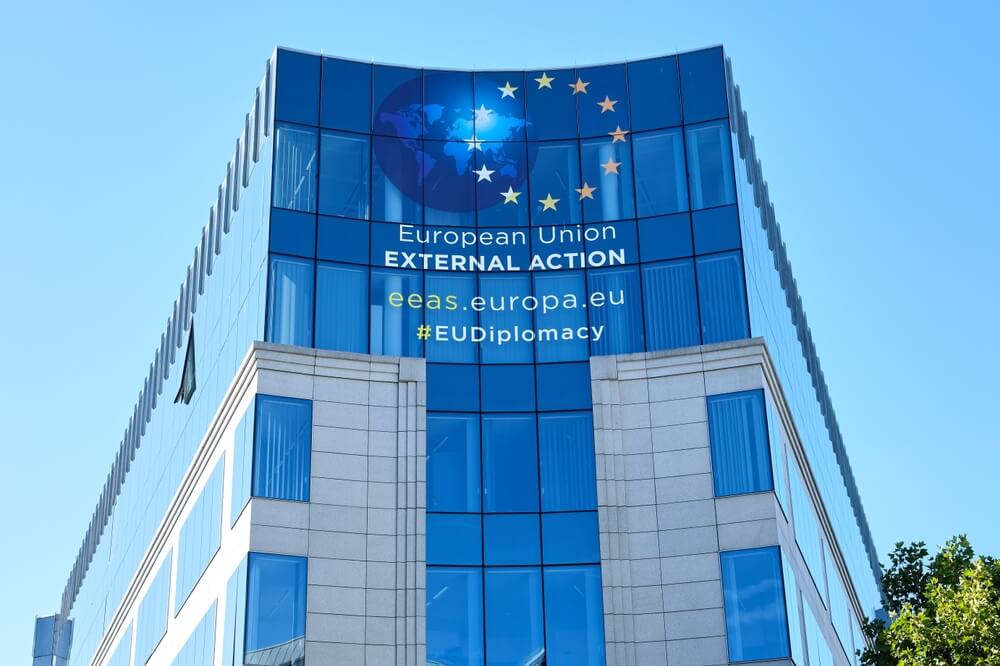 The EEAS documented Russian operations targeting electoral processes in several European countries
However, the more this regime expands to include individuals whose primary business is public speaking, the more important the standard of proof will become compared with the political decision to designate someone.
Cases such as Yamb v Council will therefore have long-term significance. They will determine how far the Council can rely on public appearances, a history of professional ties and congruent narratives, and how far it will have to demonstrate concrete coordination with the Russian state or its proxies.
The outcome of these disputes will not determine whether Europe can combat foreign information operations; it will determine how strong the evidence must be before an individual loses access to property and freedom of movement in the EU because of such activity.
Europe’s sanctions regime will be more legally robust if it is based on provable conduct rather than on an assessments of the appropriateness of a person’s political speech.
Such a standard does not diminish the EU’s ability to respond to Russian information operations; it more precisely distinguishes propaganda from operational participation and clarifies when individual sanctions rest on a sufficiently solid factual basis.
However, this must not become an excuse for European passivity. For years, Russia has used state media, covert networks, local intermediaries, fake accounts and coordinated campaigns to influence elections, undermine trust in democratic institutions and erode support for Ukraine.
During the most recent reporting period alone, the EEAS documented Russian operations targeting electoral processes in several European countries, while the Council described these activities as part of a long-term, coordinated hybrid campaign.
The European response cannot be limited to monitoring propaganda and then refuting falsehoods.
When there is reliable evidence that an individual or organisation is knowingly participating in operations of the Russian state, the EU should use sanctions, financial measures and other available instruments before such a network achieves the political impact for which it was created.
A strong standard of proof is not an obstacle to such a policy; it gives it the legitimacy to be more decisive.
