Canadian Prime Minister Mark Carney’s widely acclaimed speech at Davos earlier this year remains the talk of diplomats worldwide.
Carney argued that middle powers must act together to avoid becoming victims of predatory superpowers, and he has lived by his words, duly standing with his European allies as US President Donald Trump threatened to invade Greenland, a Danish territory.
Carney’s government has also continued to provide military and financial aid to war-torn Ukraine.
And in addition to being a member of NATO, a military alliance largely designed to protect Europe from Russian aggression, Canada has also joined SAFE (Security Action for Europe), the European Union’s new common defense-procurement instrument.
Yet now that Trump has launched another rapidly escalating trade war against Canada, traditionally the United States’ closest economic partner, European leaders have been conspicuously silent. They are making a big mistake. Solidarity must be a two-way street.
In addition to threatening European sovereignty, Trump has repeatedly asserted that Canada ought to become the 51st US state.
Short of annexation, he wants to force important industries that span the two countries to relocate fully to the US.
That is why he has threatened 50% tariffs on car, truck, and auto parts imports from Canada (from January 1) and imposed additional punitive duties on Canadian exports worth $20 billion.
Worse, Trump wants to make Canada an economic vassal by limiting its ability to strike alternative deals with other partners such as the EU, and he is threatening ever-escalating tariffs to achieve his ends.
An attractive alternative
Canada cannot afford to lose this fight. Just as Europe is vulnerable to Trump’s military blackmail, Canada is highly exposed to his economic extortion, with around 70% of its exported goods going to the US.
With the stakes so high, the EU should muster the courage to offer Canada a much deeper economic, political, and strategic partnership, presenting itself as an attractive alternative to what America has become.
Consider the powerful message that the EU could send if it offered Canada an enhanced zero-tariff trade deal
Consider the powerful message that the EU could send if it offered Canada an enhanced zero-tariff trade deal.
Think of all the ways that Canada and Europe could collaborate more closely on Arctic security, energy, and critical minerals.
Canada would eventually provide a valuable alternative to US supplies of liquefied natural gas and Chinese rare earths—essential inputs for many manufacturing industries.
Cowardice
One obstacle to bold EU action is cowardice. Despite ample evidence that Trump does not respect appeasers, European leaders are still wary of sticking their necks out.
Yet when countries stand up to Trump’s bullying, he tends to back down. If middle powers can come together, they will have more options and greater leverage to negotiate with superpowers.
The EU could easily be Trump’s next target
At the very least, a generous offer from the EU would strengthen Canada’s current position vis-à-vis the Trump administration.
The EU could easily be Trump’s next target, whether his focus swings back to Greenland, technology regulation, trade, the Iran war, or some other issue. Does Europe want to endure more bullying alone?
Arrogance
Another hurdle, conversely, is arrogance. In the pre-Trump era, when the US-led rules-based international order was still intact, the EU considered itself a superpower, at least in economic terms.
It negotiated trade terms with the US as an equal partner and regulated US tech giants at will.
The EU must acknowledge that for now it lacks the political unity, military muscle, geopolitical leverage, economic dynamism, and technological prowess to rival the US or China
But in the new world of might makes right, the EU must acknowledge that for now it lacks the political unity, military muscle, geopolitical leverage, economic dynamism, and technological prowess to rival the US or China. It is more like Canada than it thinks.
In fact, the EU is the biggest of the middle powers. It is not, like the US and China, an apex predator, which means that it is potential prey.
Once European policymakers accept this reality, perhaps they will be more open to collaborating with like-minded powers to address their shared vulnerabilities.
Institutional rigidity
A third obstacle is institutional rigidity. As the largest of the middle powers, the EU has the most to gain from closer collaboration with a wide range of partners; indeed, it could be the anchor for overlapping “coalitions of the willing.”
But to play that role, it needs to move beyond its overly rigid and trade-centric model of cooperation, where deep economic integration is reserved for countries that aspire to join the EU or agree to follow its rules wholesale.
Europe should instead embrace more flexible and wide-ranging forms of cooperation that are better suited to a messy, disordered world.
These could involve varying combinations of deeper economic integration, closer political cooperation, and broader strategic alliances.
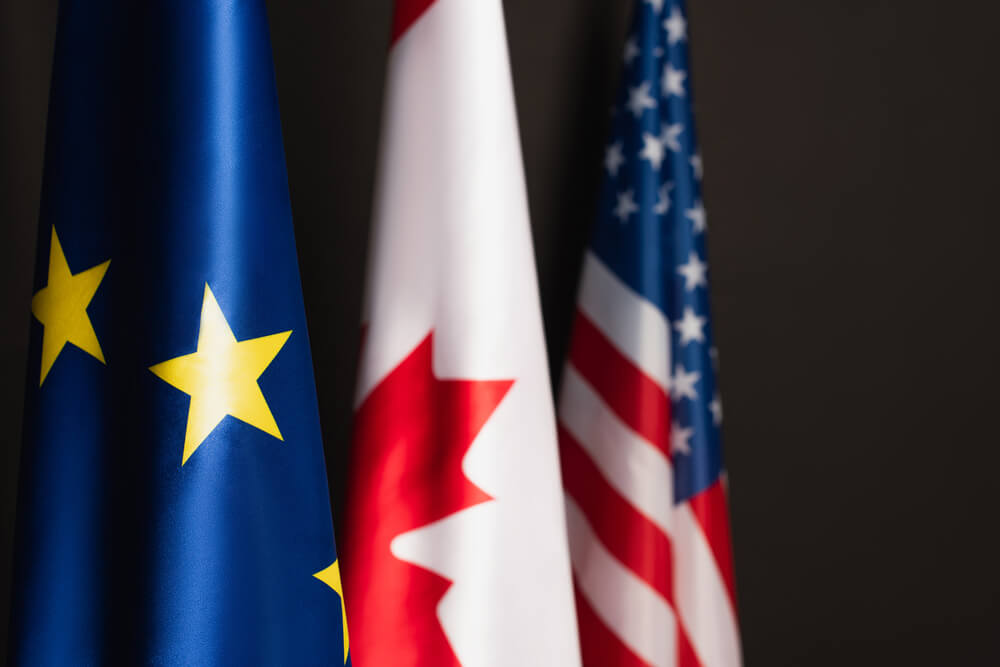 Europe should embrace more flexible and wide-ranging forms of cooperation that are better suited to a messy, disordered world
For Ukraine and several Balkan countries, deep cooperation—call it associate EU membership—could be a step toward EU accession.
For the likes of Canada, and potentially also the United Kingdom (for now), it could involve closer cooperation without that end goal.
More broadly, European Commission President Ursula von der Leyen has floated the idea of the EU linking up with the Comprehensive and Progressive Agreement for Trans-Pacific Partnership, the 12-member trade bloc that includes Canada, Japan, Australia, and the UK.
Together, the EU and CPTPP account for nearly one-third of the world economy, a greater share than that of the US or China.
Talks have already begun on a digital trade deal, with parties pledging not to impose protectionist tariffs on one another; but progress remains slow.
As Carney rightly put it earlier this year, “In a world of great power rivalry, the countries in between have a choice—compete with each other for favor, or combine to create a third path with impact.” Canada has made its choice. This is the moment for the EU to support it.
Philippe Legrain, a former economic adviser to the president of the European Commission, is Visiting Senior Fellow at the London School of Economics’ European Institute.
