On 23 April, the European Union adopted its 20th package of sanctions against Russia. About 120 new individual measures are included, with additional restrictions in energy, finance and trade, as well as expanded supervision of financial flows, including digital assets.
The essence of this package lies not in its scope, but in its structure. Previous measures primarily targeted Russian banks, companies, and exports.
The new package goes further: it focuses on the networks used to circumvent these restrictions. These include intermediary firms, logistics routes, and financial channels operating outside Russia but linked to its trade and procurement.
Thus, the sanctions no longer serve solely as direct pressure on the Russian economy; they are becoming an instrument attempting to control the flows that enable the economy to function despite the restrictions.
Directly targeting channels of circumvention
This package changes the way the EU conducts its sanctions policy. The previous approach focused on directly limiting Russian revenues, exports and the financial system.
In practice, this proved insufficient, as parallel channels were developed to circumvent these measures.
For the first time, the EU is directly intervening in trade flows outside Russia
That is why restrictions are now being introduced to target those channels directly. A concrete example is the decision to ban the export of certain high-tech machines and telecommunications equipment to Kyrgyzstan, on the grounds that these goods are subsequently diverted to Russia.
For the first time, the EU is directly intervening in trade flows outside Russia to close the routes through which sanctions lose their effect.
Financial circumvention is no longer a side issue
The package also affects the financial sector. Reuters cited a ban on transactions with a further 20 Russian banks and third-country lenders linked to sanctions circumvention in Kyrgyzstan, Laos, and Azerbaijan.
This is an important signal: the EU no longer regards financial circumvention as a side issue, but as one of the main mechanisms of Russia's resilience.
Digital assets are no longer viewed solely under financial market regulation, but also as a channel for sanctions circumvention
A significant part of the package concerns financial flows that do not pass through the traditional banking system. The European Commission has clarified that the measures also cover crypto transactions.
This means that digital assets are no longer viewed solely under financial market regulation, but also as a channel for sanctions circumvention, and are therefore included in the operational framework of the measures.
From bilateral pressure to trade context
The energy segment is equally concrete. Entities across the entire chain, from extraction to processing and transportation of oil, have been added to the list.
At the same time, the list of ships associated with the so-called shadow fleet, used to export Russian oil beyond the restrictions, has been expanded.
With these additions, the total number of such vessels under EU measures now exceeds six hundred. They are subject to bans on port access and the provision of services, which directly affects export logistics.
This is an attempt to reduce the opportunities for Russian oil to find buyers despite the restrictions. The EU is now also introducing measures for the sale of tankers from the Union, including mandatory end-use verification and a "no Russia" clause in contracts.
The EU is no longer restricting measures to Russian entities but is also targeting locations through which goods are physically diverted
The aim is to ensure that European vessels, capital, and services do not end up in the Russian shadow fleet through intermediary arrangements.
The Karimun Oil Terminal in Indonesia is also included in the list because of its involvement in transporting Russian oil beyond the price cap.
This is a concrete action with a clear message: the EU is no longer restricting measures to Russian entities but is also targeting locations through which goods are physically diverted.
This moves the sanctions from a framework of bilateral pressure to the broader context in which trade takes place.
Extending sanctions to global actors
The lists also include companies from outside Russia that participate in operations related to oil exports and financial flows under sanctions. These include companies registered in the United Arab Emirates, as well as entities involved in trade and logistics in Asia, including Hong Kong.
There is a particular focus on companies involved in the operational support of the so-called shadow fleet, including ship management, transport organisation, and supporting services.
This targets sanctions at specific actors who enable Russian oil to be transported beyond existing restrictions, rather than only at formal owners or exporters.
The risk is no longer limited to Russian partners
The EU does not formally impose sanctions on states, but on specific companies and financial entities involved in business related to Russian exports and financing. However, the impact of these decisions extends beyond individual companies.
When companies from Asia, the Gulf, or Central Asia are listed, it directly affects how banks, insurers, and logistics firms operate in those countries. The risk is no longer limited to Russian partners.
Any transaction, transport, or contract with a point of contact in these networks enters a zone of increased surveillance and caution. This alters business decision-making even in countries not formally part of the sanctions regime. That is the essence of the new package.
Implementation challenges and global impact
Sanctions no longer function solely as prohibitions; they are becoming a system for monitoring entire flows of goods, capital, and services.
European companies will need to inspect partners, end users, and routes more thoroughly. Banks will need to assess more rigorously the risk of transactions passing through jurisdictions associated with re-exports to Russia.
Insurers and logistics firms must recognise that doing business with a formally legal partner can become problematic if there is a connection to Russian circumvention.
For Moscow, this is a serious blow, but not a shutdown of the system. In recent years, Russia has demonstrated the ability to build parallel supply, financing, and transport networks. Sanctions increase its costs, lengthen routes, and reduce efficiency, but do not automatically halt its activities.
Companies from third countries will face a choice between doing business with Russia and accessing the European market
This is why the European shift towards third countries is logical. If pressure is applied only to the Russian side, Moscow uses intermediaries. If the pressure extends to intermediaries, the cost of circumvention rises.
The risk for the EU lies in the breadth of the new approach. The more global networks are affected by sanctions, the harder it becomes to maintain legal precision and political support. Countries outside the European sanctions regime could interpret the new measures as extraterritorial pressure.
Companies from third countries will face a choice between doing business with Russia and accessing the European market, European banks, and European services. It is a powerful instrument, but it requires discipline and consistency.
Maintaining stability for Ukraine
This package accompanies the EU's decision to approve financial support for Ukraine amounting to approximately 90 billion euros, following a delay caused by Hungary blocking the agreement. Thus, the two policies – sanctions and financing – are now effectively harmonised.
The sanctions aim to limit Russian revenues and logistics, while financial support enables Ukraine to continue operating and maintain its capabilities. Together, these measures attempt to increase pressure on Russia while maintaining stability for Ukraine.
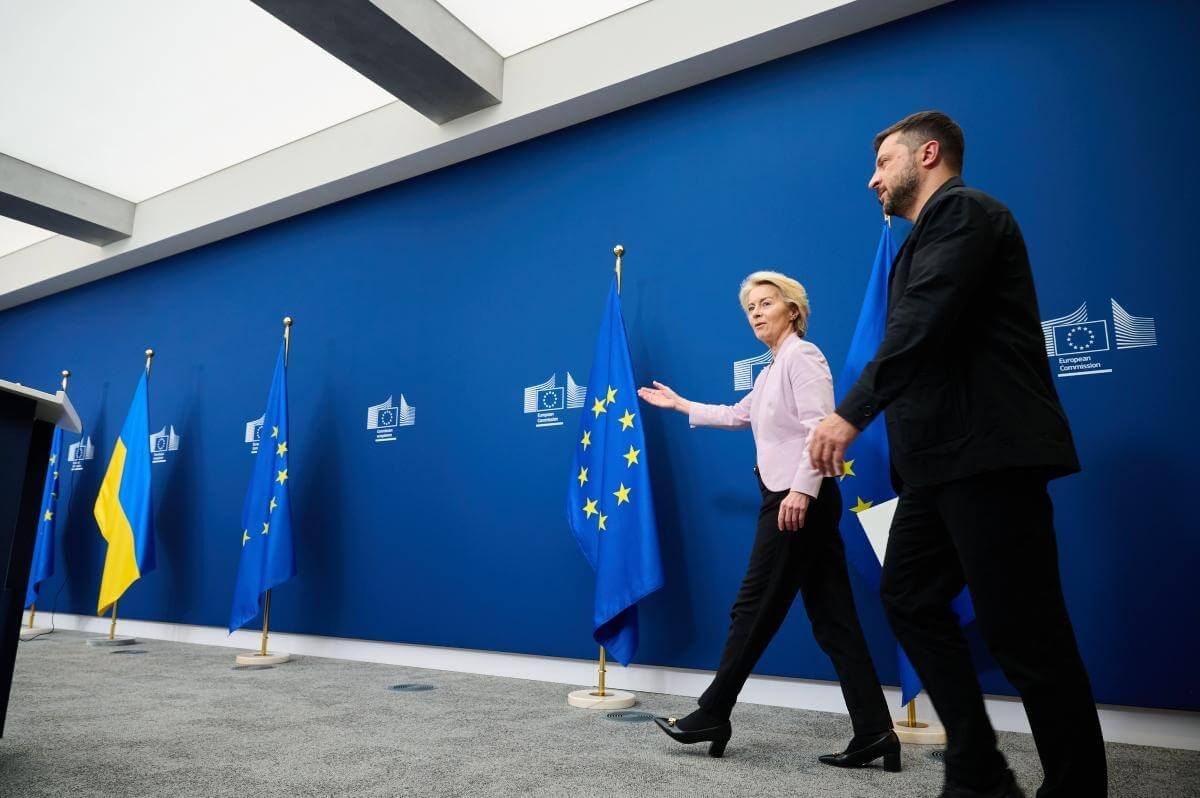 The package accompanies the EU's decision to approve financial support for Ukraine amounting to approximately 90 billion euros, following a delay caused by Hungary blocking the agreement
The most significant assessment is that sanctions are now entering the implementation phase, rather than a phase of automatic expansion. Previous packages have exhausted many obvious targets.
The new focus is on networks, intermediaries, ports, tankers, crypto-transactions, and banks that facilitate circumvention. This is more technically demanding and politically sensitive, but it is probably the only way for the regime to remain relevant.
The EU must now demonstrate that it can implement what it has adopted. If the package remains only a list, its effect will be limited. If enforcement is carried out through banks, ports, insurance, export controls, and end-user investigations, the pressure on the Russian war economy will be more severe.
The key change is clear: sanctions against Russia are no longer just a matter of relations between Brussels and Moscow. They are now entering global flows of trade, finance, and technology.
This increases pressure on Russia, but also draws the EU into a much more complex environment. In this context, every measure must be precise, demonstrable, and applicable. Otherwise, sanctions will generate more political resistance than strategic effect.
