There’s a famous quip about European inability to act on the world stage, attributed, probably wrongly, to Henry Kissinger: Who do I call if I want to talk to Europe?
The European Union, being mainly an economic power, is still hard to reach when it comes to geopolitics. What is less easy to comprehend is that it also still lacks a firm economic and financial core.
This is at the root of the recurrent performative and angst-ridden drama surrounding the bloc’s multi-year budget negotiations that are now gathering steam.
Rich, frugal, austerity-minded, ‘responsible’ – take your pick – member states fight tooth and nail to limit their exposure to centralised EU finances.
The discussions reveal the contradictions at the heart of the EU: It seeks to boost its defences as well as rebuild its competitiveness and its industrial and technological base.
For that, it seeks, among other things, to streamline regulation, unify its capital markets and boost spending. Yet it remains committed to rudimentary centralised EU finances and a tiny budget.
The multi-year financial framework
While the next 7-year budget, called the multi-year financial framework, or MFF, will only run from 2028, discussions have already started to become fraught.
That’s in the wake of the European Parliament last month proposing to modestly raise the European Commission’s own proposal, which itself was a modest increase from the current MFF.
EU ministers met this week in Brussels in part to prepare for a European Council meeting in Cyprus in June where concrete spending proposals will for the first time be discussed.
The parliament wants to bring the total to over €2 trillion for 2028-2035
Before and during the meeting, a coalition of Southern and Eastern member states made clear their opposition to reductions in things such as agricultural subsidies and regional ‘cohesion’ funds.
They also oppose budgetary red lines, promulgated by Germany with the support of countries such as the Netherlands, Austria and Sweden.
There’s a lot of juggling with figures, indexation, baselines and debt repayment, but what it comes down to is the European Commission proposing to raise the MFF from the current 7-year total of €1.2 trillion to €1.76 trillion. The parliament wants to bring the total to over €2 trillion for 2028-2035.
An AI hallucination
In terms of Gross National Income, the Commission proposed increase looks modest and is actually non-existent. It would rise from 1.12 - 1.14 percent of the GNI up to 1.26 percent.
Yet almost this whole gain is then obliterated by debt repayment for the Covid recovery NextGenerationEU fund.
In fact, the more than €420 billion NextGenerationEU fund should also be added to EU spending over the current period, even further undermining the case that the budget is actually set to increase from 2028.
If all of this is taken into account, the EU’s budget both in real terms and as a percentage of the GNI is actually set to shrink in the coming period, making talk of an increase sound more like an AI hallucination.
Southern and Eastern member states are not only arguing for more money and looser budget rules
How this can be reconciled with the bloc’s ambition to revitalise its economy with, for example, a more than €400 billion European Competitiveness Fund, is part of what’s causing the heated discussions.
Southern and Eastern member states are not only arguing for more money and looser budget rules, such as spreading the debt repayments, because they support the EU’s investment in competitiveness.
Their main concern is that money is going to be taken away from agricultural subsidies and regional support funds in order to balance the books.
The Commission’s proposals do go some way in this direction, pointing among other things at reducing payments under the bloc’s Common Agricultural Policy that had long been desired by some of the net-contributing member states.
"Europe must make do with the money we have"
Yet, to put it into perspective, and as mentioned before, the EU’s budget is tiny by all standards: it is dwarfed by the member states’ own budgets.
For example, Germany’s budget alone over the same next 7-year period is expected to be some 7 times that of the EU’s.
While it’s difficult to make a direct international comparison, the EU centralised budget is also tiny compared to the US and other large economies.
While much of the spending is taking place on the level of the member states, this still matters when addressing large structural challenges such as defence, competitiveness and unifying capital markets.
Friedrich Merz, the German Chancellor, opposes extra contributions and new common debt
It’s ironic that many of the EU countries pushing hardest for stepping up the bloc’s competitiveness oppose putting more money into a centralised budget that could be instrumental in making that happen.
Friedrich Merz, the German Chancellor, has said that "Europe must make do with the money we have." He opposes extra contributions and new common debt.
Like many other net contributors, Germany is facing its own economic and political troubles. Sending more money to the EU could be highly unpopular at a time when domestic programmes are being cut.
Yet, the small amounts involved and the huge net gains that national economies get from the bloc’s membership should help the argument for an increase.
An avalanche of ideological technobabble
In practice, EU contributions appear to be easy fodder for populists, as the UK witnessed during the Brexit debate, with huge misleading numbers posted on the side of a bus.
Apart from the height of the contribution, there’s also the trope of the money then being spent by ‘faceless Brussels bureaucrats’. In practice, it’s the member states’ governments that decide the spending priorities.
As usual, the political hot potato of how to boost defence, stimulate growth and re-energise Europe’s competitiveness without breaking the bank is being buried under an avalanche of ideological technobabble.
You cannot have a unified capital market, for example, without stronger central oversight
Both the Commission and the ‘frugal’ member states hammer away at so-called ‘simplification’, i.e., rolling back what is seen as over-regulation and red tape as if that were a cure-all.
Even they recognise this is not enough, so now there’s also increased emphasis on deepening or ‘completing’ the bloc’s single market.
First of all, the above two principles could well clash on many fronts, as more EU-wide regulation would have to accompany deepening the single market. You cannot have a unified capital market, for example, without stronger central oversight.
And for more central oversight and supplying it with the instruments it needs, you very likely need more centralised finances.
Whatever it takes
To go back to the claim that Europe lacks a phone number in case of an economic emergency, we only need to go back to the financial crisis at the end of the 2000s.
When it looked like nobody was able to come up with a fix, only a promise by the head of the European Central Bank, Mario Draghi, to do ‘whatever it takes’ to stabilise the Eurozone’s finances calmed the situation.
That meant quantitative easing. While later judged ‘a monetary policy instrument’, it did in effect mean shared liability for European taxpayers, exactly what Germany and others had opposed.
It worked but was problematic on many levels. Mainly, Draghi was not an elected official and had no political authority. If a decision on common borrowing is going to be made, it should be on the political level.
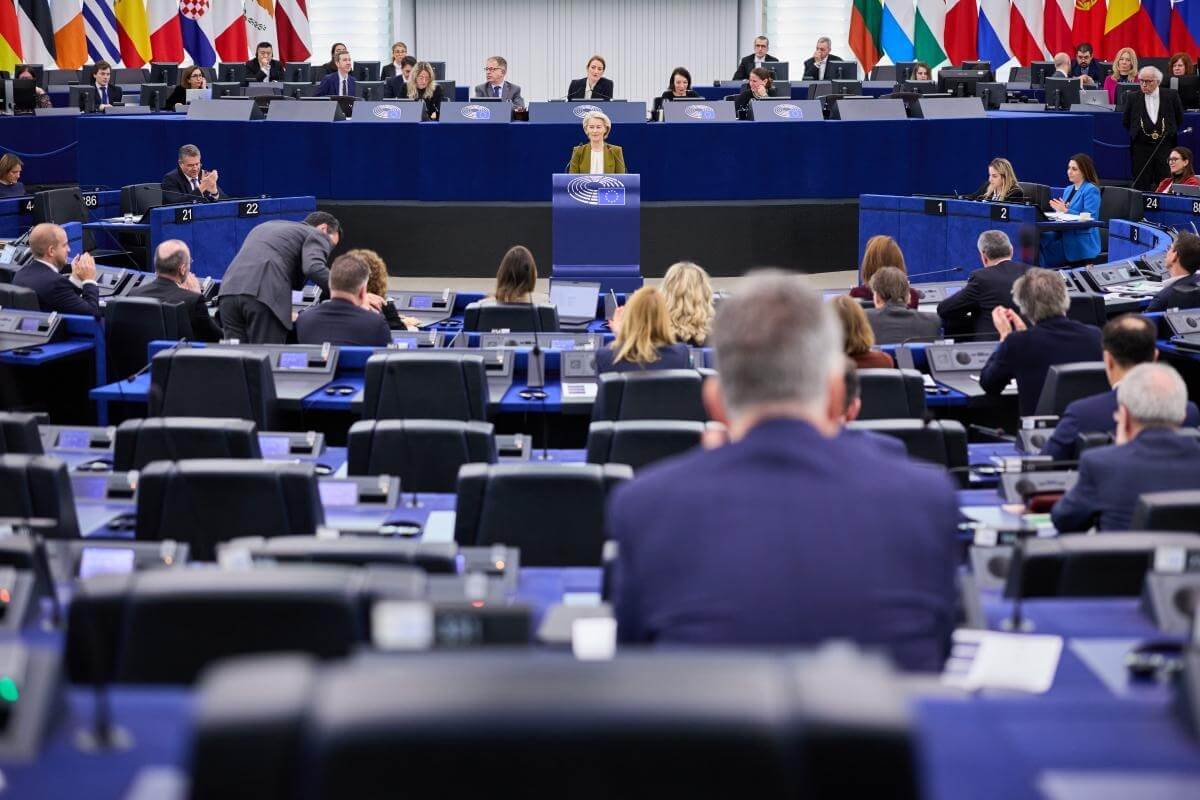 Maintaining that delicate balance between national sovereignty and interests versus the need for common action is going to become ever more difficult - European Parliament
The EU’s problems with centralising its economic power closely mirror those with streamlining its geopolitical power. Nobody wants to relinquish national control over what are seen as core issues.
Just as we might wonder whether we want, for example, a Middle East policy dictated by Germany or, for that matter, by Spain, we can wonder if we want economic – and things such as welfare – policy dictated by the Netherlands or France.
Finding consensus, on the other hand, as in foreign policy, often is a recipe for inaction.
For a long time, the EU was able to pretend it could be a mere trade bloc, have the loosest of unions and not invest in irksome burdens such as common defence or centralised finances.
Both the economic and, probably as a consequence, also the geopolitical circumstances have changed and now force the bloc to make fateful choices.
Maintaining that delicate balance between national sovereignty and interests versus the need for common action is going to become ever more difficult.
