When the German soccer player Deniz Undav scored two late-game goals to clinch a 2-1 victory for his team over Ivory Coast, you would have been hard-pressed to find many German fans who did not see him as a national hero.
Few cared that the Turkish-Syrian son of Kurdish Yazidi parents did not look classically German. He delivered an exhilarating triumph for the German side, demonstrating why the beautiful game commands a wider global viewership than any other sport.
Undav also represents a rebuke to the obsessions of both the hard right and the hard left.
He and the rest of the German squad are living proof that people with very different origins and appearances can be woven into a shared enterprise that becomes a source of collective pride.
They show that loving one’s country (something that is often caricatured or seen as unfashionable on the left) and welcoming newcomers (which the far right abhors) are not incompatible impulses.
That lesson is hardly confined to the German team. The World Cup, even when it is not being jointly hosted by three countries, consistently puts ethnically mixed squads in front of billions of fans.
Every serious contender is fielding some players whose families arrived only a generation or two ago, and almost every one of them is inspiring an outpouring of joyful patriotism.
The combination of diversity and national pride is precisely what the political extremes insist is impossible.
Anxieties about the arrival of ethnically different peoples
Across much of the industrialized world, mainstream politics has become consumed by anxieties about the arrival of culturally and ethnically different peoples and the supposed discord such immigration brings.
Ideas once confined to dark corners of the internet—such as the “Great Replacement” theory and calls for “remigration”—are now being aired and debated in respectable forums.
A recent YouGov poll finds that 45% of Britons, 50% of Danes, 51% of the French, 53% of Germans, 51% of Italians, 52% of Poles, and 46% of Spaniards would support a scenario in which immigration is stopped, and many recent migrants depart.
To be sure, there is no evidence that the harshest hypothetical scenario, in which immigrants are forcibly expelled through a process resembling ethnic cleansing, would have much support, and the wording of the question may be inflating softer concerns.
There has been a striking reversal from a decade ago, when the public in many of the same countries welcomed those fleeing war in the Middle East
But even with such caveats, there has been a striking reversal from a decade ago, when the public in many of the same countries welcomed those fleeing war in the Middle East.
Much of the left, meanwhile, has traveled in a different but still troubling direction by looking at every issue through the lens of oppressor and oppressed.
Under these crude terms, Western countries are always the villains, and patriotism is viewed with suspicion or disdain.
National pride
This shift is reflected in polling data. According to Gallup, the share of US Democrats reporting “extreme pride” in being American fell from more than 60% in the early 2000s to just 22% in 2019 (though it has recovered somewhat since then).
Much of this collapse coincided with Donald Trump’s first presidency, suggesting that it may reflect disaffection with those in power rather than a principled rejection of the US.
Talk of national pride has become deeply embarrassing—if not enraging—to many on the left
Yet the deeper trend is unmistakable. It is no secret that talk of national pride has become deeply embarrassing—if not enraging—to many on the left.
This is a troubling trend because without the buttress of shared identity, national politics are less likely to coalesce around policies designed to support those who are losing out.
That includes workers without a four-year college degree, an ethnically diverse cohort that has been struggling against downward mobility for several decades throughout the industrialized world.
Ethnic integration and patriotic pride coexist
Of course, professional athletics is not a perfect mirror of society. A national squad is a small, lavishly resourced, intensely managed group united by a single unambiguous goal.
Creating a winning team is not the same as integrating large populations into housing, schools, and labor markets.
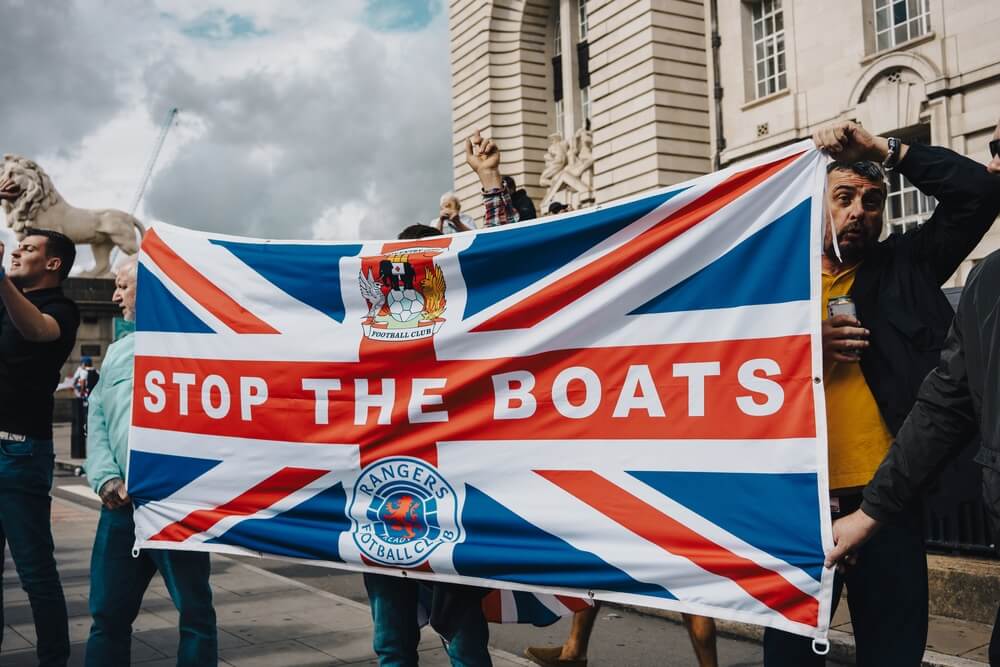 Integration may be celebrated by the many, but the retrograde minority is loud and disproportionately influential in an era of algorithmically powerful extremism
Nor is integration in sports as frictionless as the cheering suggests. England’s Black players were deluged with racist abuse after losing the Euro 2020 final; France’s “Bleus” are perennially dragged into arguments about who counts as truly French; and the US has an ugly history of racism in many sports.
Integration may be celebrated by the many, but the retrograde minority is loud and disproportionately influential in an era of algorithmically powerful extremism. In that sense, sports replicate the pattern we see in society.
The World Cup does not prove that integration is easy. But it does confirm what the extremists want to deny: ethnic integration and patriotic pride routinely coexist.
Most fans who are watching their multiethnic team carry the national flag are experiencing both without giving it a second thought.
If activists on the hard right and the hard left could climb down from their high horses long enough to watch a few matches, they might rediscover what the rest of us already know: when integration and national pride go hand in hand, the outcome, more often than not, is a winning combination.
Daron Acemoglu is a 2024 Nobel laureate in economics and an Institute Professor of Economics at MIT.
