Paris Saint-Germain’s second consecutive UEFA Champions League title has confirmed what has been clear for years: France is no longer just one of football’s great nations. It has become the world’s most productive football talent factory.
Most explanations focus on coaching methods, academy structures, scouting networks, or financial resources. All matter. Yet none fully explain why France continues to produce elite footballers at a rate unmatched elsewhere in Europe, nor why the French national team seems able to replace world-class players with other world-class players almost indefinitely.
The answer lies at the intersection of France’s imperial history, demographic transformation, urban development, and a football infrastructure developed over generations.
Modern French football is one of the most successful unintended consequences of the French Empire.
Throughout the twentieth century, millions of people from former French territories in North Africa, West Africa, Central Africa, the Caribbean, and the Indian Ocean migrated to metropolitan France. Many settled in Paris, Marseille, Lyon, and other major cities.
Over time, changing urban policies, industrial restructuring, and rising housing costs pushed many lower-income communities into the suburbs surrounding these cities.
These banlieues became home to large populations with roots in Algeria, Morocco, Tunisia, Senegal, Mali, Cameroon, Congo, Guadeloupe, Martinique, and numerous other territories historically linked to France.
The deepest football talent pool
What emerged was not merely a demographic shift; it was the creation of perhaps the deepest football talent pool ever assembled within a single country.
Football became the common language of these communities. Children played in schoolyards, housing estates, municipal pitches, and neighbourhood parks.
Local authorities invested in sports facilities. Volunteers organised clubs and youth competitions. Football became both recreation and a pathway to social mobility.
The crucial factor was organisation. France did not simply produce talented footballers; it created a system capable of identifying them.
At the base are over ten thousand local clubs spread across the banlieues and provincial towns.
Each level scouts the one below and feeds into the one above
Above them are stronger regional clubs. Above these are the academies of professional teams. Above them is the development structure of the French Football Federation and Clairefontaine, the national training centre that bridges grassroots football and the national team. Each level scouts the one below and feeds into the one above.
A gifted twelve-year-old in Bondy, Saint-Denis, Sarcelles, Marseille or Lyon does not need to be discovered directly by Paris Saint-Germain or Olympique Lyonnais.
He only needs to be noticed by a local coach. Once identified, the system moves him through progressively stronger environments.
Development compensation mechanisms ensure that clubs involved in a player’s progression receive financial rewards when the player signs professional contracts or is transferred.
This encourages cooperation rather than competition and turns thousands of local coaches into the first layer of a nationwide scouting network.
The scale of the system
The scale of the system is extraordinary. The French Football Federation reported a record 2.38 million registered licences during the 2023–24 season, including more than two million active players, making it one of the largest football participation systems relative to its population base in the world.
More than fifteen national elite academies feed directly into the French development structure, with Clairefontaine as its most prominent apex institution.
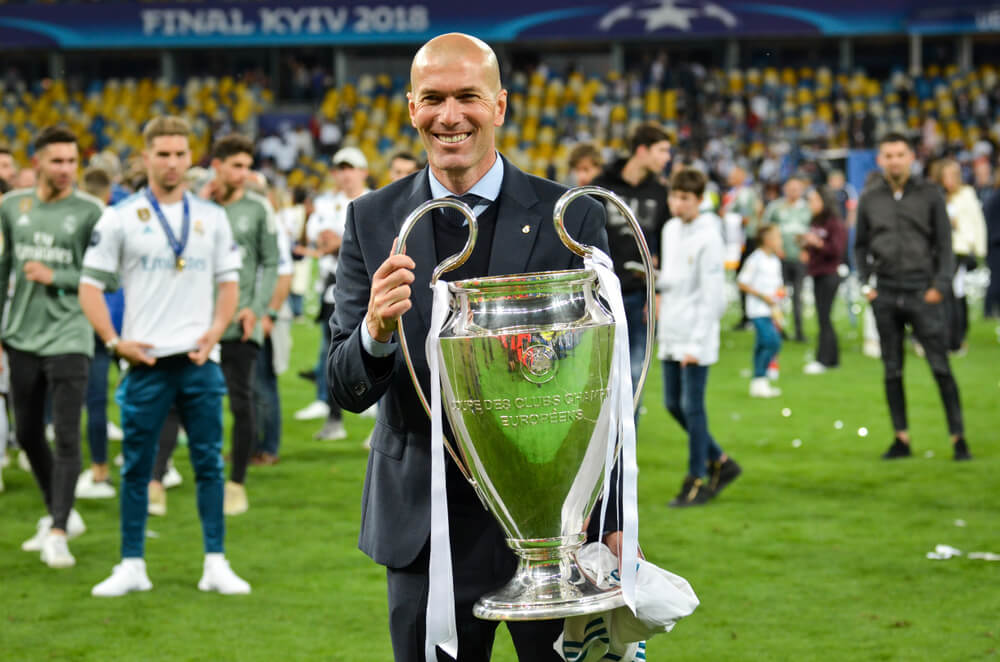 Zinedine Zidane, the son of Algerian immigrants, emerged from the Marseille football ecosystem
The effectiveness of the model can be measured by the players it has produced.
Zinedine Zidane, the son of Algerian immigrants, emerged from the Marseille football ecosystem. Karim Benzema developed through Lyon’s academy structure. Thierry Henry came from the Paris football system. Patrick Vieira emerged from the suburbs of Paris. Kylian Mbappé was developed in Bondy before progressing through the national structure. Ousmane Dembélé, Bradley Barcola, Warren Zaïre-Emery and Désiré Doué represent the latest generation of players produced by the same machinery.
The Paris region alone has produced Thierry Henry, Nicolas Anelka, Kylian Mbappé, Paul Pogba, N’Golo Kanté, Blaise Matuidi, Riyad Mahrez, William Saliba, Mike Maignan and Kingsley Coman among many others.
Widely regarded as the richest football-producing area in Europe, the Île-de-France region contains thousands of football clubs and enough elite footballers to form a team capable of competing at World Cup level on its own.
The rise of Paris Saint-Germain
The results speak for themselves. Over a twenty-four-year period, France won two World Cups, reached four World Cup finals, and lost two finals only on penalties.
It won the tournament in 1998, returned to the final in 2006 before losing on penalties to Italy, lifted the trophy again in 2018 and then became the first team since Brazil to reach consecutive World Cup finals, returning in 2022, where it again lost on penalties after arguably the greatest World Cup final ever played, against Lionel Messi’s Argentina.
No national team has combined that level of sustained success with such extraordinary depth of talent over such a prolonged period.
Much of the talent it sought abroad already existed within the football ecosystem around Paris
That same depth explains the rise of Paris Saint-Germain. For years, PSG tried to buy European dominance by importing superstars.
The arrivals of Lionel Messi, Neymar and others attracted global attention but did not establish lasting supremacy in Europe.
The breakthrough came when the club accepted a simple reality: much of the talent it sought abroad already existed within the football ecosystem around Paris.
Qatar’s investment provided the facilities, resources and academy infrastructure necessary to retain more of that talent, while Luís Campos and Luis Enrique shifted the club towards a younger model rooted in French player development.
Elite international-level players
France’s depth extends beyond its own national team. Numerous players developed within the French football system have ultimately chosen to represent other national teams, as opportunities in the French senior setup were limited by the sheer level of competition.
Among those expected to appear at the 2026 FIFA World Cup are Aymeric Laporte with Spain, Kalidou Koulibaly and Youssouf Sabaly with Senegal, Riyad Mahrez, Yacine Brahimi and Aïssa Mandi with Algeria, Wahbi Khazri with Tunisia and Sofiane Boufal with Morocco.
All were either born in France or developed within the French football system before choosing to represent the countries of their family origins.
The symbolism is difficult to ignore. Laporte, developed in France, is expected to be one of the leading defenders for Spain, widely considered France’s principal rival for the 2026 World Cup.
In effect, France’s football ecosystem produces more elite international-level players than the French national team can absorb.
Only six French players currently competing in the Premier League were selected for the national squad
The same reality can be seen in club football. France is the largest exporter of football talent to Europe’s major leagues and the largest supplier of foreign players to the English Premier League, widely regarded as the strongest domestic competition in world football.
Yet for the 2026 World Cup only six French players currently competing in the Premier League were selected for the national squad, with only two expected to be regular starters.
The overwhelming majority of elite performers in the world’s most competitive league nevertheless found themselves unable to secure places in the French team because competition for selection remains so intense.
The depth extends beyond the senior squad. A recent French B side easily defeated Colombia’s senior national team 3-1, a country that has qualified for the 2026 FIFA World Cup and is widely regarded as one of Latin America’s strongest football nations.
The result served as a reminder that France’s reserve talent pool would be competitive against many established international sides.
The difference lies in organisation
France’s success is not simply the result of immigration, nor is it an inevitable consequence of its former imperial history. Britain, Spain, and other European powers have comparable histories.
The difference lies in organisation. France succeeded in integrating its demographic diversity into a nationwide football development structure that links neighbourhood clubs, professional academies, and the national team.
Other countries possess elements of that model, but none have assembled it on the same scale.
England perhaps comes closest. Like France, it benefits from an increasingly diverse population and a football culture deeply embedded in local communities.
However, England’s system remains more fragmented and less centralised than its French counterpart.
The gap has narrowed considerably over the past decade, but France retains a significant advantage in the breadth and depth of its talent production network.
Spain built perhaps the greatest academy in football history, while France built arguably the greatest football ecosystem in history
The only meaningful comparison is Spain, yet Spain’s success rests upon a fundamentally different model.
Spain’s current generation owes much to the extraordinary legacy of FC Barcelona’s La Masia academy, arguably the greatest club football academy ever established.
Eight members of Spain’s current World Cup squad are Barcelona players, demonstrating the academy’s remarkable influence on Spanish football.
France’s model is different. Spain built perhaps the greatest academy in football history, while France built arguably the greatest football ecosystem in history.
Spain’s success flows primarily from one institution whose influence spread outward.
France’s success rests on a nationwide structure stretching from the banlieues of Paris to the suburbs of Lyon, from Marseille’s neighbourhood clubs to Clairefontaine, and from thousands of amateur pitches to the country’s largest professional academies.
Football is never decided by logic alone
The explanation for France’s success is, therefore, surprisingly simple. The empire established the demographic foundations. The banlieues concentrated the talent. Thousands of local clubs identified it. Clairefontaine, the Federation, and professional academies developed it. Paris Saint-Germain eventually learned how to retain more of it.
 If one were asked to identify the nation best positioned to lift the trophy in the United States, the evidence increasingly points to France
Together, they created what is arguably the most effective football talent-production ecosystem the sport has ever seen.
If football outcomes were determined purely by the depth, breadth, and sustainability of a nation’s talent-production system, logic would suggest that France should win the 2026 FIFA World Cup.
No other country enters the tournament with a comparable combination of proven success, squad depth, player development infrastructure, and generational renewal.
Football, of course, is never decided by logic alone. Yet, if one were asked to identify the nation best positioned to lift the trophy in the United States, the evidence increasingly points to France.
Whether France ultimately wins the 2026 World Cup remains uncertain. What is certain is that no country enters the tournament with a deeper reservoir of football talent.
Dr Nawaf Obaid is a Senior Research Fellow at the Department of War Studies, King’s College London.
