Many commentators, including those on the right, have dubbed US President Donald Trump’s “Operation Epic Fury” against Iran “Operation Epic Fail”: an extravagant waste of money, military hardware, and lives in the service of an ill-conceived war with ever-changing objectives.
Meanwhile, most legal observers consider the operation an illegal act that violates the United Nations Charter’s prohibition on the use of military force except for self-defense or in armed interventions authorized by the Security Council.
But debates about the war’s efficacy and legality overlook a deeper issue: whether Epic Fury constitutes a crime of aggression.
In an interview with the BBC, Luis Moreno Ocampo, the first prosecutor of the International Criminal Court (ICC) and one of the most prominent jurists in the field of international criminal law, explicitly characterized it as such.
Much turns on the distinction between an illegal war and a criminal one. An illegal war may warrant placing sanctions on the aggressor.
For example, Spain refused to allow the United States to use military bases on Spanish territory for operations linked to Iran, and Spanish airspace was closed to military overflights.
By contrast, a criminal war potentially authorizes the prosecution of leaders responsible for planning and launching it.
The meaning and scope of criminalized aggression
Assessing whether Trump’s war on Iran can be considered criminal raises difficult questions, largely because of ongoing uncertainties about the meaning and scope of criminalized aggression.
After all, planning and launching a war of aggression was recognized as an international crime only relatively recently, during the post-World War II Nuremberg trials of the Nazi leadership.
For long periods of Western history, the decision to wage war was a sovereign prerogative.
The Nuremberg tribunal sought to puncture the shield of sovereignty. With “crimes against peace” as the gravamen of the case against the 22 Nazi functionaries on trial, the tribunal sought to establish aggressive war as the “supreme” crime in international law.
As I argue in my new book, The Criminal State: War, Atrocity, and the Dream of International Justice, that effort failed.
The Nuremberg Charter offered precise definitions of war crimes and crimes against humanity, but failed to do the same for crimes against peace
The seeds of that failure were planted in the Nuremberg Charter, which offered precise definitions of war crimes and crimes against humanity (the other charges brought against the Nazi defendants), but failed to do the same for “crimes against peace.”
The jurists who drafted the Charter could punt the issue because Nazi aggression, especially on the Eastern Front, blurred the distinction between acts of war and acts of mass atrocity.
They reasonably concluded that such actions would be seen as criminal, regardless of the definition.
Should wars of aggression always be considered criminal?
This left a central question unanswered. Should wars of aggression always be considered criminal, even those that do not involve atrocities?
All other serious international crimes, such as crimes against humanity and genocide, seek to respond to harm inflicted on individuals and groups, while aggression seems more focused on violations of a state’s territorial integrity or political independence.
Why should such violations constitute an international crime? In other words, is the crime of aggression meant to serve as a check on state sovereignty or as simply another bulwark of it?
Such questions vexed jurists and diplomats in the postwar period. The UN sought to build on the Nuremberg precedent, but as Cold War tensions escalated, experts frittered away decades trying to frame a workable and acceptable definition of the crime of aggression (some of that time was wasted on debating whether one was even necessary or realistic).
A definition was finally agreed at the 2010 Review Conference of the Rome Statute, but it was not until 2017 that the ICC gained jurisdiction over the crime of aggression.
According to the ICC, not all illegal acts of aggression constitute the crime of aggression
Still, the current definition fails to answer the central question left unresolved at Nuremberg. According to the ICC, not all illegal acts of aggression constitute the crime of aggression.
Only those aggressive acts whose “character, gravity, and scale” represent a “manifest” violation of the UN Charter rise to the level of the criminal.
What does this vague and elusive language mean? The most plausible interpretation is the one implied by the jurists at Nuremberg: aggressive war becomes criminal only when waged in a deformed manner, marked by the commission of systematic atrocities.
Putin’s war in Ukraine is criminal
Seen in this light, Russian President Vladimir Putin’s ongoing war in Ukraine is clearly criminal.
The brazenness of the invasion, the mendacity of the proffered justification, and the brutal and indiscriminate attacks on civilians provide a textbook example of the crime of aggression.
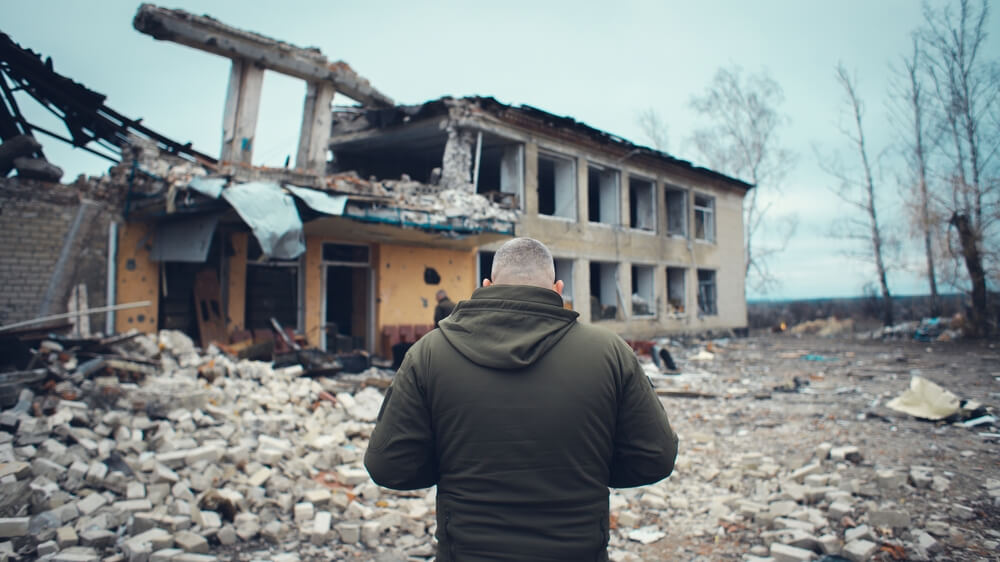 Vladimir Putin’s ongoing war in Ukraine is clearly criminal - Kharkiv
Trump’s war in Iran presents a more complex case. One could argue that the bombing of 13,000 targets (including a primary school filled with children), coupled with Secretary of Defense Pete Hegseth’s reckless remarks about dispensing with the “stupid rules of engagement,” suggest that US aggression has turned criminal.
On the other hand, unlike Russia, the US has not deliberately targeted civilians.
Unfortunately, the argument remains academic. The ICC’s authority to try state leaders for the crime of aggression is so hedged with limitations that even if Putin magically materialized in The Hague, the court would lack jurisdiction to prosecute him for this crime.
Together, the US and Russia were the driving force behind the Nuremberg trial and the effort to make state aggression the supreme international crime.
The irony is that they have now taken a leading role in undermining the system they sought to erect.
Lawrence Douglas is a Professor of Law, Jurisprudence, and Social Thought at Amherst College.
