“What changed?” is the most common reaction in the heated discussion on social media about the sudden decision of the International Olympic Committee (IOC) to lift the suspension of Russia and pave the way for its athletes to participate in the next Olympics in Los Angeles in 2028.
And indeed, what has changed in the overall circumstances that have kept Russian athletes out of international sports competitions, including the Olympics, for the past decade?
Almost nothing. Russia continues to wage an aggressive war against Ukraine, violating the fundamental documents of the international order, of which the Olympic Movement is a part.
Russian athletes continue to have strong ties to state institutions, including the military, and serve as part of a propaganda system that justifies an aggressive war against another UN and IOC member state.
Russia remains an unreliable player in the fight against doping in sport; moreover, its state system is the main stronghold of systematic doping of athletes, which is why Russia was initially excluded from international sport in 2016.
The IOC Executive Board, however, claims that something has changed. It says that the Russian Olympic Committee “no longer includes, as its members, any regional sports organisations in territories falling under the jurisdiction of the National Olympic Committee of Ukraine”.
The IOC bases this conclusion on the “analysis” of its Legal Affairs Commission and considers it sufficient to justify a decision that marks a major shift from its previously firm stance on Russia.
Russian renunciation of four Ukrainian regions
This moment goes far beyond sport and the Olympic framework and directly concerns global politics, including its most complex aspects, from which the IOC traditionally seeks to distance itself.
If the inputs on which the IOC Legal Affairs Commission based its analysis are correct, this means the Kremlin has abandoned its aggressive policy towards Ukraine, even in one “small” aspect regarding sport.
This means that Moscow has abandoned part of what it calls the “sovereign territory of Russia”, namely the four areas of Ukraine that it has occupied during the war since 2022.
The Kremlin has not denied the IOC Executive Board’s statement that it has renounced sports associations in the Ukrainian regions
The Kremlin has not denied the IOC Executive Board’s statement that it has renounced sports associations in the Ukrainian regions of Donetsk, Kherson, Luhansk and Zaporizhzhia, which it first attacked militarily and then, in September 2022, unilaterally declared to be an integral part of Russia.
Russia has also not denied the IOC’s statement that the Russian Olympic Committee will not carry out any activities in those occupied territories.
The IOC helps the Russian strategy
It is therefore almost certain that, before the IOC, Moscow abandoned one of its most important war aims in Ukraine – achieving full sovereignty over the eastern regions of the country.
It is therefore understandable that the Kremlin wants to keep such a move hidden from the international public, even more than from its own, because it shows that it is still willing to negotiate over the “spoils of war” and to give up some of them, while officially refusing any compromise.
Just a week ago, in a televised interview, Vladimir Putin said that his army wanted to establish full control over four Ukrainian regions even before any peace talks begin. While he was saying this, the Russian Olympic Committee, clearly under Putin’s control, was sending the IOC completely opposite messages.
Hoping the concession to the IOC will remain low profile, Moscow expects a much greater reward in return
Bearing in mind the increasingly difficult military and economic situation in which Russia finds itself in the fifth year of its invasion of Ukraine, Putin’s “giving in” to the IOC assumes the importance of a major political manoeuvre, a concession forced on him by military and economic defeats.
The Kremlin’s approach is cautious but pragmatic. Hoping the concession to the IOC will remain low profile, Moscow expects a much greater reward in return: the lifting of the embargo on its athletes’ participation in the Los Angeles Olympics in two years’ time. The IOC has accommodated this strategy.
The role of Trump
Given the controversial turn taken by the IOC leadership, it is difficult to dismiss the possible role of Washington, perhaps even that of President Trump himself.
As he will have the opportunity to host the Olympics a few months before the end of his term, Trump views the Games in Los Angeles as one of his legacies.
His urge to take personal ownership of every high-profile international event, and there are few more important than the Olympics, suggests that Washington may also have had a hand in the major relaxation regarding athletes from Russia.
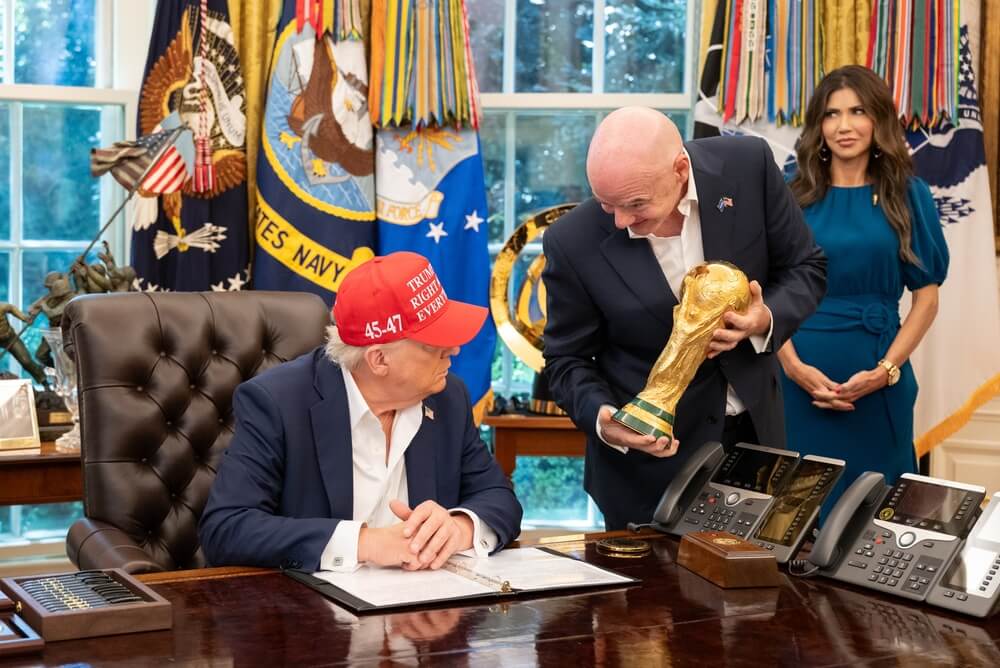 Just like the ongoing FIFA World Cup, the Los Angeles Olympics will face challenges, threats of boycotts and entanglement in political deals
In recent days, Trump has demonstrated that he is prepared to personally breach the supposed “impunity” of the world’s biggest sporting competitions, through his undeniable influence on FIFA’s decision to absolve the sanctioned American football player at the World Cup.
Speculation that Trump promised Putin to lift the Olympic embargo during their 90-minute phone call on 4 July, as the nation celebrated its 250th birthday, may be overblown.
However, bearing in mind Trump’s episode with FIFA, it is impossible to rule out the possibility of explicit or tacit American consent to pave the way for Russian athletes to participate in the Los Angeles Olympic Games.
In any case, the Olympics in America in two years’ time are already tainted by strong political impulses and interests tied to addressing some of the most difficult global crises, such as Russian aggression against Ukraine.
Just like the ongoing FIFA World Cup, which has yet to feel the reactions regarding Trump’s interference in sporting rules, the Los Angeles Olympics will face challenges, threats of boycotts and entanglement in political deals.
