Emirati diplomat Lana Nusseibeh has injected a degree of excitement into the race to become the next secretary-general of the United Nations after the term of António Guterres ends on 31 December.
Nusseibeh, who comes from a prominent Palestinian family, has gained backing from the Gulf Cooperation Council as well as in Israel, while other countries, such as the UK, are reportedly leaning towards her.
But she has drawn sharp opposition from human rights groups because of her role in defending the UAE’s role in Sudan’s brutal civil war.
Liberals are in a tricky position when deciding whether to back her given that Nusseibeh did help to secure the delivery of humanitarian aid to Gaza.
But as the UAE’s ambassador to the UN, she repeatedly rejected allegations of UAE backing for a Sudanese armed group accused of genocide.
Hopelessly deadlocked: the contest to head the UN
The contest to head the UN has played out this year amid much hand-wringing by analysts about the death of multilateralism.
Divisions among the five permanent members of the UN Security Council – the US, China, Russia, the UK and France – have led many to conclude that the international body is hopelessly deadlocked and unable to act on the world’s most intractable conflicts.
The five permanent members have veto power, unlike the other 10 rotating members of the Security Council, which has the final vote on which candidate is recommended to the UN’s 193-member General Assembly.
Should the General Assembly reject the recommendation, the selection process is stalled while the Security Council seeks agreement on another candidate.
Reports are circulating that the US will propose Viktor Orbán, the former Hungarian prime minister, who would also likely win backing from Russia and China
No candidate has yet emerged as a clear frontrunner. Rebecca Grynspan of Costa Rica did receive nine votes in the Security Council’s last straw poll, but two permanent members cast “discourage” votes against her in the informal ballot held on October 16, before Nusseibeh entered the race on October 21.
In addition to Nusseibeh, reports are circulating that the US will propose Viktor Orbán, the former Hungarian prime minister, who would also likely win backing from Russia and China.
Other candidates include Carolyn Rodrigues Birkett of Guyana and Rafael Grossi of Argentina. In the straw poll, they each received eight votes of encouragement and two negative votes from permanent members of the Security Council. Also standing are Uganda’s Olara Otunnu and Ecuador’s María Fernanda Espinosa.
While a victory for Nusseibeh would fulfil calls for the next UN chief to be a woman, it would upset Latin American and Caribbean governments who feel it is their turn to lead the global body.
“The litmus test of the success of an incoming secretary-general”
Sharp questions are also being asked about Nusseibeh’s record. Hours before she took part in a General Assembly dialogue to defend her record on October 27, she came under attack at a virtual gathering held by the advocacy group Avaz.
The UAE is accused of supplying financial and military support to Sudan’s Rapid Support Forces (RSF) during its war with the government’s army, the Sudanese Armed Forces. Leaders from both sides stand accused of genocidal crimes.
“We cannot afford to have the UN led by somebody who is a genocide denier,” said Kenneth Roth, a former executive director of Human Rights Watch.
Nusseibeh, who has stood down from her post as a minister of the UAE while she campaigns to head the UN, was asked in the General Assembly dialogue about UN evidence of the UAE providing support “instrumental to sustaining RSF atrocities,” reported the digital news platform Pass Blue.
“I think the horrific conflict in Sudan will be the litmus test of the success of an incoming secretary-general,” she said and referred further questions about Sudan to the UAE.
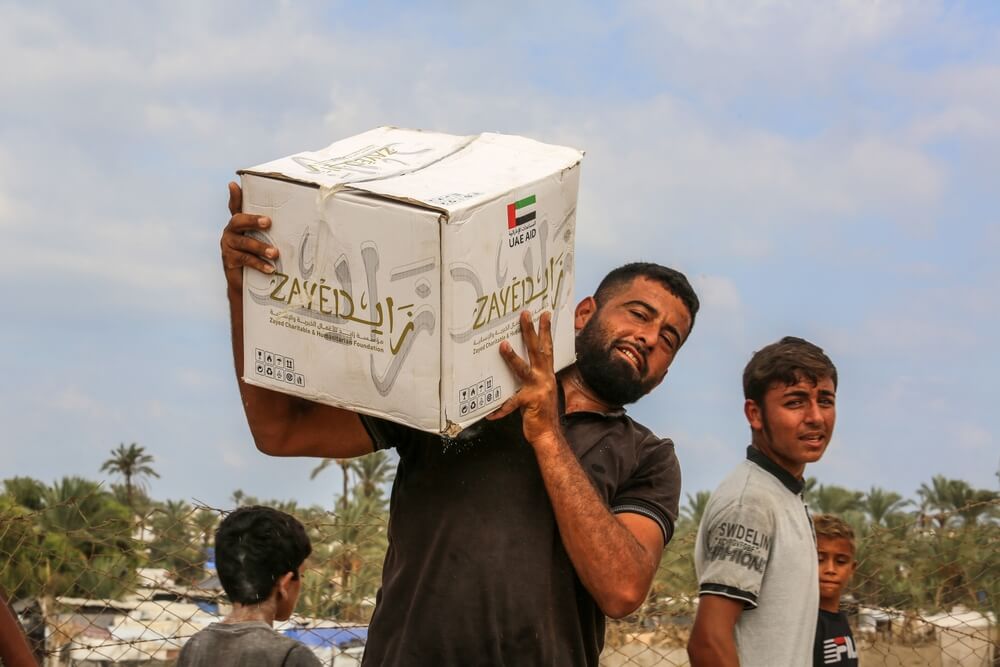 Nusseibeh’s defenders point to her work on Gaza and her global connections
But the controversy is unlikely to die down soon. “For years, Lana Nusseibeh has used her position to vehemently deny and divert attention from the UAE’s war crimes in Yemen and support for the abusive Rapid Support Forces in Sudan,” said Bruno Stagno Ugarte of Human Rights Watch in a statement issued this week.
Nusseibeh’s defenders point to her work on Gaza and her global connections. Her uncle, Sari Nusseibeh, is a well-known Palestinian scholar while she was educated at Cambridge and has a master’s in Israeli and Jewish Diaspora Studies.
“How did UAE become the largest global provider of humanitarian aid to Gaza, according to UN data?” Brett McGurk, former White House envoy, said on X. “Because of Lana Nusseibeh – a diplomat who knows everyone and works with them to [get stuff done].”
The UK is leaning towards supporting her candidacy, according to Middle East Eye, which notes that such backing may help Andy Burnham, prime minister. He is seen as close to Manchester City football club, which is owned by Emirati vice-president Sheikh Mansour bin Zayed Al Nayhan and is accused of financial improprieties.
But only this week, the UK announced sanctions on 15 RSF commanders for “suspected atrocities, including conflict-related sexual violence.”
Nonetheless, Nusseibeh’s Palestinian background many trump misgivings over Sudan, allowing her to win a “high identity-politics jackpot,” wrote The Guardian.
“At a time of big regional wars, multipolarity, energy crises and fraying norms, who better to become a global anchor than a country that is offering value-free transactional politics, is backed with sovereign wealth, and is expert in the opulent backroom gangsterism of the new world order,” it said.
