Recent state elections in Germany have been portrayed as momentous, since the far right finished first in two and may well come to power in one.
Yet future historians may focus on another, largely overlooked outcome: For the first time in the post-World War II period, Germany’s Christian Democrats (CDU) failed to pass the 5% electoral threshold.
Worse, this disastrous result occurred in the largely rural state of Mecklenburg-Vorpommern, where former Chancellor Angela Merkel chaired the CDU’s state branch for close to seven years.
Can the CDU avoid the kind of wholesale collapse that other center-right parties have suffered in Western Europe in recent years? History offers some clues.
Christian Democracy originated in 19th-century Europe as a movement to protect Catholics from what were perceived as overbearing secular states.
Taking their cues from Pope Leo XIII’s Catholic social doctrine, which acknowledged the ills of capitalism while decrying class warfare, the parties associated with the movement were distinguished by their reformist approach to addressing the inequality and immiseration caused by the Industrial Revolution.
But, unlike some of their socialist contemporaries, the early Christian Democrats did not see class warfare as the answer.
Instead, they believed that a harmonious balance between labor and capital could be found by doing justice to the interests of different groups in society.
Vision of social harmony
The Christian Democratic parties that emerged in Western Europe after 1945 were both fiercely anti-communist and largely committed to the creation of welfare states.
In Germany, Italy, and France, their vision of social harmony often centered on conventional conceptions of the family.
Moreover, in contrast to the traditional right, which had been discredited by open alliances with fascists, Christian Democrats harbored deep suspicions about nationalism.
They well remembered how the newly unified German and Italian nation-states of the late 19th century had attacked Catholic citizens as insufficiently patriotic (on the assumption that they were primarily loyal to the Vatican).
It was no accident that the leading Christian Democrats of the immediate postwar period, West German Chancellor Konrad Adenauer and Italian Prime Minister Alcide de Gasperi, were the prime architects of European integration, laying the foundation on which most Europeans’ political life rests to this day.
The Italian Christian Democratic party effectively disappeared after the end of the Cold War, when the loss of its anti-communist rationale meant that it could no longer survive its corruption scandals.
But the German Christian Democrats—who have governed the country for two-thirds of the postwar period—have held on.
As long as money was plentiful, the strategy of mediating among different interests in society worked well
Like the Tories in Britain, the party was seen as the default—reliably competent, if not exciting or visionary.
CDU-led governments often presented themselves as self-consciously flexible on political ideas and also gradually dropped the party’s close identification with religion.
As a result, secularization did not necessarily undermine the party’s electoral support.
As long as money was plentiful, the strategy of mediating among different interests in society worked well.
Merkel, a Protestant, was the last great practitioner of the Catholic social doctrine.
She famously demobilized any opposition by taking care of all groups in society.
Germany’s reliance on cheap Russian energy and large Chinese export markets during her 16-year tenure made that easier.
The party of competence
The CDU’s current crisis is often attributed to Chancellor Friedrich Merz, whose policy agenda—and, frankly, whose personality—is quite unpopular. But many of the party’s problems are structural.
The tried-and-tested political technology of Christian Democracy works less well when a society can no longer be neatly disaggregated into groups with clearly defined interests.
Pursuing harmony through mediation is a tall order in a political culture that has become both more individualistic and, paradoxically, more polarized.
Christian Democrats are no longer assumed to be the party of competence, especially when it comes to the economy
Moreover, Christian Democrats are no longer assumed to be the party of competence, especially when it comes to the economy.
Many of the faces associated with mismanaging the COVID-19 crisis happened to belong to Christian Democrats, and though the party won the 2025 federal elections, polls still register a long-term loss of trust.
Owing to these challenges, some Christian Democrats are now tempted to copy the culture-war strategies of the far right, as if aping talking points about “gender ideology” and other alleged “woke excesses” will shore up their conservative, religious credentials.
In the process, they tend to forget that the far right’s political model of deepening divisions in society and inciting hatred against minorities is fundamentally incompatible with the traditional Christian Democratic pursuit of harmony.
Pro-European heritage
The positive reaction to Pope Leo XIV’s encyclical on AI demonstrates that even non-religious citizens find something attractive about an old-style humanist message emphasizing people’s need for stability and dignity.
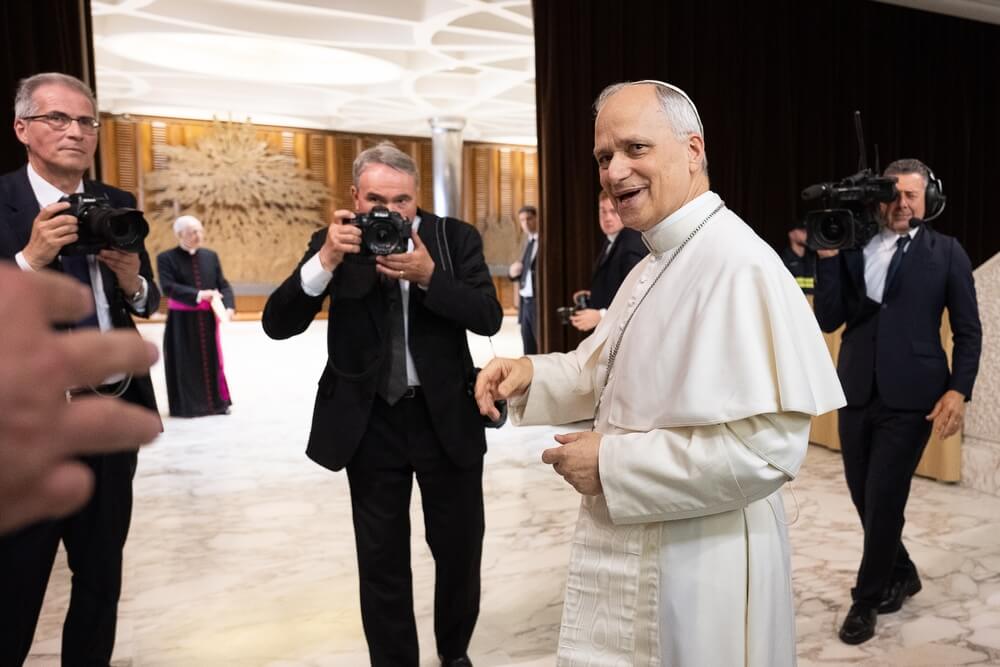 Christian Democrats might learn a thing or two from the pontiff’s approach - Pope Leo XIV
Christian Democrats might learn a thing or two from the pontiff’s approach. Imitating political entrepreneurs who only ever invoke Christianity as a matter of national belonging—what some call “Christianism”—is a dead end.
More to the point, Merz, a child of the old West Germany, which remains deeply imbued with Adenauer’s vision, could try to reclaim his party’s pro-European heritage.
With Europe under attack from the United States, Russia, and China, he should distance himself from the day-to-day domestic bickering about economic policy and migration (where he will never please the far right).
His mission should be to work with French President Emmanuel Macron—who might just have some political capital left to spend on foreign policy—and other European leaders to create a secure continent for the 21st century.
Jan-Werner Mueller, Professor of Politics at Princeton University, is a fellow at the Institute for Human Sciences in Vienna.
