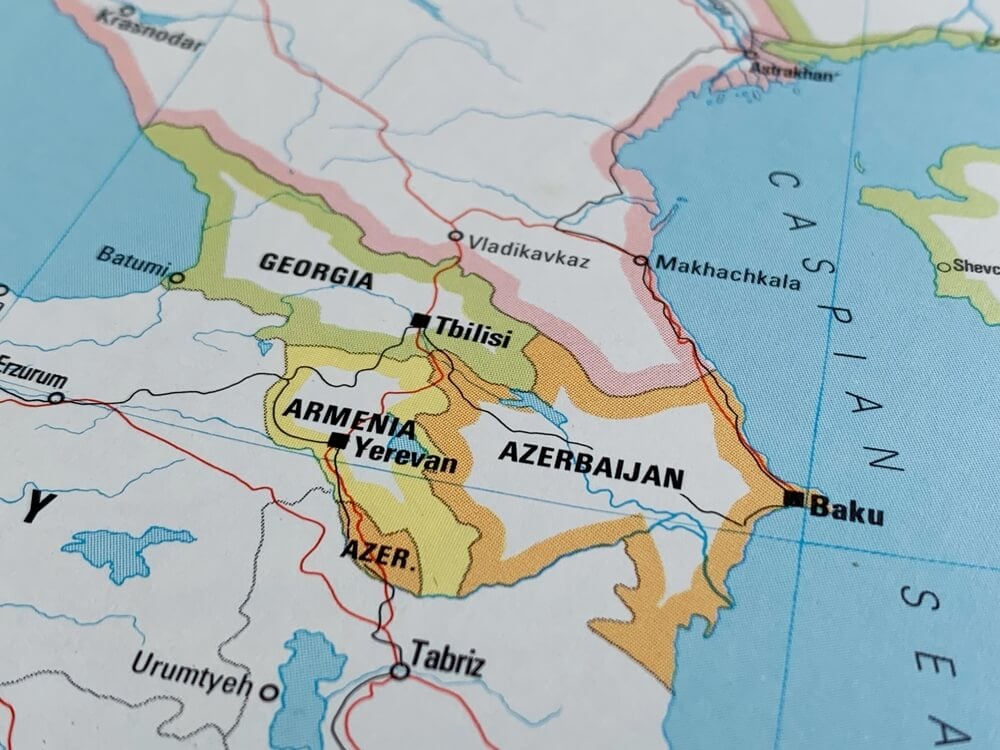
On 23 November, Armenian Prime Minister Nikol Pashinyan announced the start of preparatory work in Syunik, a province in the south of the country, for a railway and road that would connect the main part of Azerbaijan with Nakhchivan, an autonomous republic of Azerbaijan separated from the rest of the country by Armenian territory.
Armenia is developing a project with the United States called the Trump Route for International Peace and Prosperity, and whether the new connection will also serve Armenian companies depends on the contracts currently being prepared.
The section near Meghri, along the border with Iran, is about 43 kilometres long and would open a direct land passage to Nakhchivan for Azerbaijan.
Equally important for Armenia is the reconstruction of the railway near Yeraskh, south of Yerevan on the border with Nakhchivan, through which trains from the interior of the country would reach the new route.
If only the section near Meghri is constructed, Azerbaijan will gain a connection with Nakhchivan, and only afterwards will Armenia negotiate how to use the new railway for its own traffic.
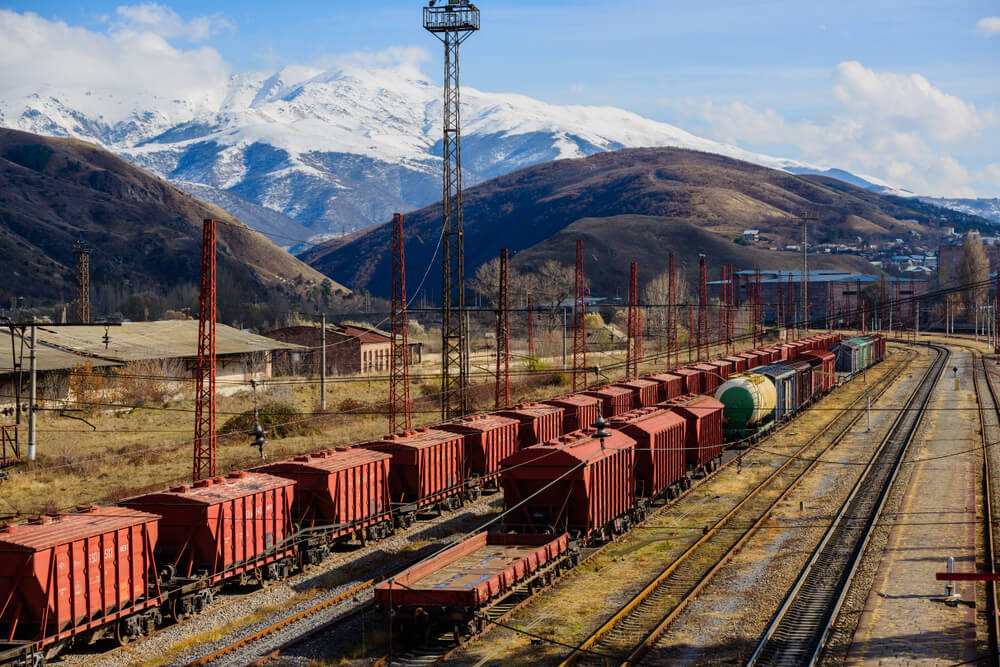
Cargo from Azerbaijan is already arriving in Armenia by rail via Georgia because the direct line between the two countries is still not in operation.
Pashinyan and Azerbaijani President Ilham Aliyev announced in Dublin on 12 November that 105,000 tonnes of goods had arrived in Armenia by this route since November 2025, which was approximately six per cent of total rail transport in Armenia in 2025.
The joint statement refers to goods moving in both directions, but the figure covers only deliveries to Armenia, so it does not show how much Armenian exporters have used the new route.
Armenia pays for land before money and rules of passage are known
On 28 October, the Armenian parliament ratified an agreement with the United States on a joint company to build and operate the project. Under the agreement, the American side would hold 74 per cent and Armenia 26 per cent of the ownership.
For the first 49 years, the company would have the exclusive right to use and develop the land designated for the project. If the two governments agree to extend this period by another 50 years, the Armenian share would increase to 49 per cent.
Yerevan has committed to provide the land at its own expense and resolve ownership issues, while Washington intends to provide funding or help secure it from public or private sources. The Armenian budget can therefore bear the costs before it is known who will pay for the construction and when.Control of the border remains in Armenian hands.
Under a plan announced by the two governments in January, a private operator would collect documentation and charge fees at the crossings, while Armenian customs officials would decide whether goods may pass.
 The World Bank estimated that investment in railways, ports and terminals on the Trans-Caspian route could more than triple traffic and halve transport time by 2040
Yerevan and Baku still need to agree which documents they will mutually recognise and how to proceed when one side’s customs stop a shipment.
The working groups for traffic and electricity transmission, which the two governments established together with the US on 7 November, can determine these rules while it is still being decided which connections will be contracted and in what order they will be built.
In September, the World Bank estimated that investment in railways, ports and terminals on the Trans-Caspian route, along which goods travel between Asia and Europe via the Caspian Sea, Azerbaijan, Georgia and Turkey, could more than triple traffic and halve transport time by 2040 compared with 2023.
If the countries harmonised customs procedures and introduced a single electronic document that the carrier completed only once for the entire journey, traffic could increase fourfold and transport time could be reduced by two-thirds.
Carriers using the railway across Georgia today compare total price and delivery time, and the investor in Syunik cannot reliably estimate revenue until they know how long cargo checks at the crossings will take.
The road to the new railway runs through a network managed from Moscow
In 2008, Yerevan transferred management of the existing railway network to South Caucasus Railways, a subsidiary of Russian Railways, for 30 years, with the option of a further 10-year extension.
The section at Meghri would be built by a new American-Armenian company, outside that concession, but the train from Yerevan to Meghri would still have to follow the existing network to Yeraskh, then pass through Nakhchivan and back into Armenia, as the Soviet-era railway in the south of the country ran along the Aras River through Nakhchivan.
On 14 October, Pashinyan discussed reconstructing the railway from Yeraskh to Nakhchivan with the director general of Russian Railways, Oleg Belozyorov. Rebuilding that section would give Yerevan a rail link to the south of the country, provided that Azerbaijan allows regular passage of Armenian trains through Nakhchivan.
The Russian concessionaire will decide the price for transporting goods to Yeraskh
Under the November 2020 ceasefire statement, traffic between Azerbaijan and Nakhchivan was to be monitored by the Russian border service, whereas under the agreement with the US, border and customs controls on that route are carried out by the Armenian authorities.
Russia no longer has a border role on that route, and its influence now comes from managing the railways that Armenian cargo must use to reach the new route. The Russian concessionaire will decide the price for transporting goods to Yeraskh and how it coordinates timetables with the operator of the new railway.
A producer from the Yerevan area who wants to guarantee regular weekly deliveries to a buyer in Baku must know in advance whether the goods will travel through Nakhchivan and Meghri on the same train, and how long they will have to wait if another carrier collects them at the border.
The Turkish railway needs Syunik, and Armenia needs an open Turkish border
In August 2025, Turkey began building a railway from Kars, a city in the north-east of the country, to Dilucu on the border with Nakhchivan. The line is 224 kilometres long, costs €2.4 billion, and Ankara expects it to be completed by the end of 2029.
For a train from this line to reach the main part of Azerbaijan, it would have to continue through Syunik or Iran, so Ankara has an interest in securing reliable transit through Armenia, while Yerevan insists that Turkey open its land border with Armenia, which has been closed since 1993.
The two countries are discussing the reconstruction of the railway from Kars to Gyumri, a city in north-western Armenia. Turkish Transport Minister Abdulkadir Uraloğlu said on 10 November that Turkey has completed preparations on its side and will open the crossing once Yerevan and Baku reach a comprehensive agreement.
Turkish cargo does not yet have a ready-made substitute for the railway through Syunik
Thus, Ankara links the opening of the border to the peace agreement that awaits Azerbaijan's signature; Azerbaijan's signature is conditional on changes to the Armenian constitution, and Pashinyan lacks six opposition votes to call a referendum on the new constitution.
Turkish cargo bound for Baku could still pass through Syunik even while the crossing at Gyumri remains closed, and Armenian goods would reach the Turkish market by direct rail only once all the conditions in the chain are resolved.
To connect with Nakhchivan, Baku is also developing a route through Iran along the Aras River, which forms the border between the two countries.
The road bridge between Aghband in Azerbaijan and Kalaleh on the Iranian bank is almost finished, but the road through Iran from Kalaleh to Julfa was only 53 per cent complete, and the border terminal in Kalaleh 65 per cent complete, according to data from Iran’s Ministry of Roads from October.
The railway bridges over the Aras are still only at the planning stage, so Turkish cargo does not yet have a ready-made substitute for the railway through Syunik.
Baku can afford to wait longer than Pashinyan
The text of the peace agreement was agreed and initialled – that is, confirmed with the initials of the ministers of foreign affairs – in August 2025 in Washington, but it has not yet been signed.
Baku is demanding that, before signing, Armenia amend the preamble – the opening part of its constitution – which refers to the 1990 Declaration of Independence, which in turn refers to the 1989 decision to unify Armenia and Nagorno-Karabakh.
On 26 September 2024, the Armenian Constitutional Court determined that this reference concerns only the principles and goals of the declaration, which are reflected in the articles of the constitution. In the initialled agreement, both parties accepted that they could not avoid fulfilling their obligations by invoking their own laws.
Following the decision of the Constitutional Court, the preamble no longer gives Armenia a legal basis for its claims on Karabakh, so Baku is seeking a constitutional amendment as a political guarantee that Yerevan will permanently renounce them.
 Pashinyan's government must negotiate the rights of Armenian carriers before the main works on the railway through Syunik are awarded
On 23 November, Pashinyan presented the draft of the new constitution, whose preamble omits the reference to the declaration. After the June elections, his Civil Contract party holds 64 of 105 parliamentary seats, while 70 votes are needed to approve a decision to call a referendum.
The two opposition parliamentary groups, Armenia and Strong Armenia, have again refused to support the referendum, and both voted against ratifying the agreement with the US on the railway.
The date of the referendum depends on their votes, and Pashinyan's government must negotiate the rights of Armenian carriers before the main works on the railway through Syunik are awarded, regardless of when the referendum takes place.
Pashinyan has offered to resign if voters reject the constitution and, if it is adopted, not to stand for prime minister in the next election, whether regular or early. Without early elections, that promise would take effect only in 2031, yet he is seeking the opposition's votes now.
Some voters see the omission of the declaration as a concession to Baku over Karabakh, from which, in September 2023, after the Azerbaijani military operation, more than 100,000 people fled to Armenia in one week. While Pashinyan seeks support in parliament, Baku can negotiate the terms of passage through Syunik and continue work on the route via Iran.
In the coming months, design work on the Meghri section and discussions about its financing are more likely to move forward than the dispute over the constitution is likely to be resolved.
The first reliable indication of how much Armenia will gain will be whether, alongside the construction contract at Meghri, a deadline is announced for the reconstruction of the railway near Yeraskh, as well as the rules governing the passage of Armenian cargo through Nakhchivan.
