Upcoming elections in Armenia will have repercussions not just for the Caucasus region but may also impact the future flow of energy across planned infrastructure projects being eyed by the US, Russia, European Union and Iran.
Donald Trump’s war against Iran has imperilled energy security in the Strait of Hormuz. It has also delayed the Trump Route for International Peace and Prosperity (TRIPP), a new transit route meant to bind peace between Armenia and Azerbaijan and pave the way for more secure East-West energy supplies at a time of deep concern over oil and gas bottlenecks.
Armenian elections on 7 June will decide whether Prime Minister Nikol Pashinyan’s pivot towards the US and EU is cemented. His opponent Samvel Karapetyan is backed by Russia, which also supplies 85% of Armenia’s gas.
Pashinyan has had a busy diplomatic schedule in recent weeks. Armenia and Turkey moved closer to a historic normalisation deal on 13 May when Ankara approved new rules to boost trade between the two countries.
Their joint border has been closed since the 1990s, and bitterness remains over the 1915 Armenian genocide when about 1.5 million people died in Ottoman Turkey. Turkey was also a strong backer of its linguistic and physical neighbour Azerbaijan in Baku’s conflict with Yerevan over the ethnic Armenian enclave of Nagorno-Karabakh.
From peace declarations to TRIPP delays
Baku’s lightning offensive led to its takeover of Nagorno-Karabakh in 2023, while Moscow’s failure to support Yerevan is remembered with bitterness.
Last August, Armenia and Azerbaijan signed a declaration falling short of a peace treaty but committing to peaceful relations at a ceremony in the presence of Trump, who believes the deal is one of many that makes him worthy of a Nobel peace prize.
The two countries also granted development rights for TRIPP, which is a strategic transit corridor through southern Armenia to the Azerbaijani exclave of Nakhchevan and Turkey.
The Trump administration claimed it would eventually allow for more energy exports and bypass dependence on Russian and Chinese infrastructure. In February, US Vice President JD Vance visited both countries and signed a strategic partnership with Azerbaijan and a nuclear deal with Armenia.
The Iran war has delayed any substantive work being implemented on TRIPP
TRIPP is supposed to form the South Caucasus link in the wider Middle Corridor, also known as the Trans-Caspian International Transport Route, connecting China and Central Asia through Azerbaijan, Georgia and Turkey to Europe. But few people believe the rail link planned under TRIPP will be completed by 2028.
Last week, Pashinyan said work on TRIPP is ongoing on a daily basis. “The territory, finances, investments, governance models, and the de jure nature of the existing agreement are being studied,” Pashinyan told a briefing last week, reported the Arka news agency.
But the Iran war has delayed any substantive work being implemented on TRIPP. Iranian drones have not only hit its neighbours, including the UAE, but also Nakhchevan, and four people were injured in early March.
“Had TRIPP infrastructure actually been built through Armenia's southern region, it would have been a tempting target for Iran’s formidable missile and drone arsenal. Armenia would have found itself caught between Iranian retaliation and Azerbaijani ambitions – with the Turkish border still closed, and relations with Russia in tatters,” wrote Eldar Mamedov on the Responsible Statecraft website.
Armenia’s EU ambitions and Moscow’s pressure
Pashinyan remains committed to TRIPP and greater Western ties. Earlier this month, he hosted a meeting of the European Political Community, a group of countries in and around the EU, which held its first bilateral summit with Armenia and offered up to €2.5 billion in infrastructure funding.
The EU is also sending to Armenia a team of experts specialised in combating Russian propaganda and interference and setting up a team of 20-30 civilian experts for a two-year mission aimed at improving the response to Russian cyber-attacks and information manipulation.
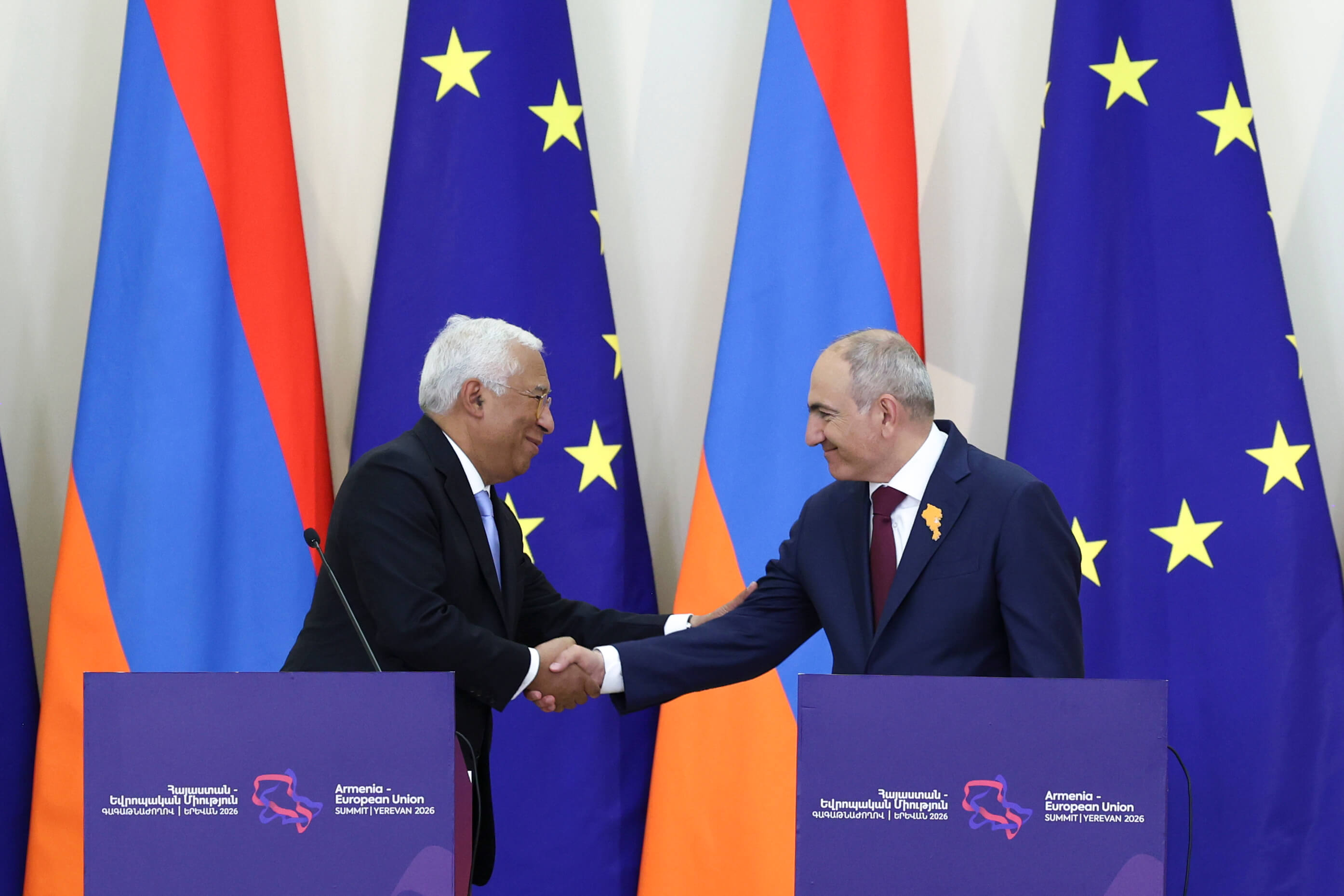 Although the EU was sidelined in TRIPP and is not a co-investor, the bloc welcomed the project as positive for the region - Antonio Costa with Nikol Pashinyan
Although the EU was sidelined in TRIPP and is not a co-investor, the bloc welcomed the project as positive for the region, while Russian President Vladimir Putin will be pleased by its delay as well as Trump’s travails over Iran.
Putin is eyeing Armenia’s EU ambitions, and he recently remarked on parallels with Ukraine, which also sought tighter Western ties before Moscow’s full-scale invasion in 2022. In a comment published by Russian state media on 9 May, he raised the question of Armenian-EU integration.
“In my view, it would be right both in relation to the population, the citizens of Armenia, and in relation to us, as the main economic partner, to decide as early as possible [further EU integration]. For example, to hold a referendum,” Putin said.
Armenia’s elections are potentially existential for the country’s three million people. Russia has warned that cheap gas supplies are at stake and has imposed restrictions on imports of Armenian cognac and mineral water. It remains to be seen how much further Moscow may go.
The EU, for its part, is hoping for a success similar to that in Moldova, where last year it also sent experts ahead of parliamentary elections in which pro-EU forces retained power. But Moscow’s revanchism may mean further trouble in the Caucasus.
