Many people fear that AI could cause a “job-pocalypse.” This year’s Davos gathering sounded the alarm over the technology’s implications for employment, while recent announcements about job cuts in white-collar industries are widely viewed as straws in the wind.
But AI’s broader effects on businesses have not received nearly enough attention.
While a majority of firms have so far not adopted AI, according to the most reliable surveys, continued uptake will likely be accompanied by significant corporate reorganization.
That is because AI is an information technology, affecting decision-making processes.
Prior waves of digital technology from the 1990s onwards transformed businesses in several ways.
Computational and communications advances underpinned the internet, which became mobile with the arrival of smartphones and wireless network technologies.
They enabled the shift from vertically integrated production to globally distributed supply chains, and from corporate hierarchies to “delayered” organizations.
To be sure, policy and regulatory changes aided the rise of globalized production and the massive growth of cross-border trade in components. But these shifts would not have been possible without technological innovations.
How will AI further rewire firms?
Another consequence of digitalization has been the rise of platform business models, which use algorithmic tools to mediate between suppliers and customers, building extensive logistics networks on digital infrastructure.
Data- and algorithm-driven platforms operate in many sectors, often dominating their markets, and have transformed both employment and consumption patterns.
The question now is how AI will further rewire firms. Last summer, at the World Intellectual Property Organization, Vivek Mohindra, Senior Vice President and special adviser to the Vice Chair and COO of Dell Technologies, argued that “organizational capabilities” are the source of a firm’s sustained competitive advantage (with Dell’s key intangible asset being its supply chain).
But AI, he added, is shifting the capabilities that matter and making them hard to measure.
Commentators have noted the technology’s potential to automate entry-level jobs in sectors like law, accounting, and finance
Some industries appear particularly vulnerable to AI disruption. Several commentators have already noted the technology’s potential to automate entry-level jobs in sectors like law, accounting, and finance.
Similarly, tech companies are increasingly using their own AI models to reduce the time and cost of software development, suggesting that fewer computer programmers will be needed in the future.
Generative AI will reshape corporate structures
But if the junior ranks of businesses are thinned out, how will businesses ensure that future employees gain the expertise they need?
For example, there is emerging evidence that using AI to write code compromises human workers’ skill acquisition.
Generative AI will also reshape corporate structures. One possible outcome is that the technology will continue the process of flattening organizations, enabling them to contract out ever more work.
Sam Altman of OpenAI has even predicted the possibility of a one-person “unicorn” (a billion-dollar startup).
Some economists predict that generative AI will recentralize organizations
AI agents could smooth the frictions inherent in negotiations between different entities and monitor complex supply chains.
But some economists predict that generative AI will recentralize organizations, because it will have the ability to capture the “tacit” knowledge embedded in human perception and practice – knowledge on which all businesses depend.
Consider a small example: the maintenance engineer working for the London Underground who realized that the wheels of carriages on the Victoria line require extra grease because of its unusually curved track.
When this employee retired, that know-how vanished, and the trains on the Victoria line began breaking down more often as their wheels succumbed to wear and tear.
Tacit knowledge like that of the maintenance engineer is rarely written down or formally taught.
But, if reflected in the repeated actions of human workers, new AI applications may be able to capture this know-how and codify it.
AI will rearrange the business landscape
Business and political leaders should track AI-induced organizational change as it occurs, to be better prepared to respond to the seemingly inevitable structural shifts.
An important part of this effort will be ensuring that individuals can navigate any large-scale labor-market disruption more easily and successfully than was the case in previous waves of automation.
They should take special care not to repeat the inadequate policy response to manufacturing automation in the 1990s, which left many advanced economies scarred by post-industrial blight.
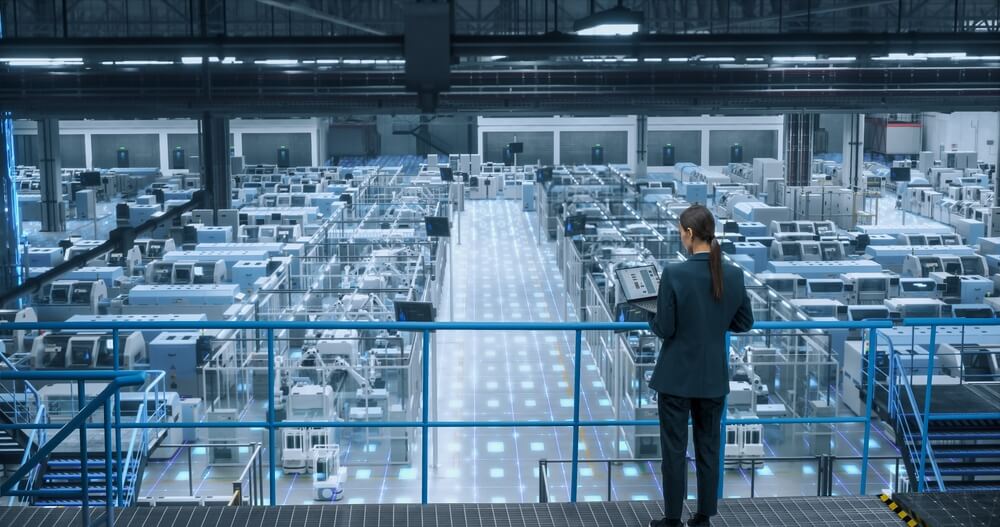 All corporate leaders need a plan to sustain their firm’s competitive edge amid this new technological wave
Being prepared will also help firms adopt AI in ways that can enhance their organizational capabilities and, in turn, increase economy-wide productivity.
All corporate leaders should be considering how generative AI will be embedded in their organizations, particularly how it could change their production processes, what tacit knowledge it could use more effectively, and who should be responsible for decision-making.
In short, they need a plan to sustain their firm’s competitive edge amid this new technological wave.
The structural change that economies are set to experience over the next decade will almost surely be as dramatic as those in the recent past, if not more so.
AI will transform work, as many now expect. But we should remember that it will also rearrange the business landscape.
Diane Coyle is a Professor of Public Policy at the University of Cambridge.
