On the night of 15 June, Russia launched another large-scale combined attack against Ukraine, using strike unmanned aerial vehicles (UAVs) as well as air- and ground-launched missiles.
Kyiv was the primary target, while the cities of Dnipro and Kharkiv also came under heavy fire.
In total, Russia used 681 aerial attack assets, including 70 missiles and 611 drones of various types.
However, only 15 of the 34 Iskander-M ballistic missiles were intercepted. The primary reasons were the extreme strain placed on Ukraine’s missile defence system and the shortage of interceptor missiles required to counter such a massive ballistic missile attack.
As a result of the large-scale strike on Kyiv, damage and fires were reported in every district of the capital.
Emergency and rescue services responded to over 50 locations. Residential buildings, warehouses, critical infrastructure facilities, and industrial enterprises sustained significant damage.
Dozens of vehicles were destroyed. Power transmission lines were also damaged, leaving hundreds of thousands of residents in the northern parts of the city without electricity.
Double-tap strike tactic
Particular attention was drawn to a strike on the grounds of the Kyiv Pechersk Lavra, one of the most important religious landmarks in Eastern Orthodox Christianity, where a fire broke out on the roof of the Dormition Cathedral.
Damage was also reported at the Mystetskyi Arsenal National Cultural, Arts and Museum Complex.
By morning, authorities had confirmed six fatalities and 37 injuries in Kyiv, including children and pregnant women.
A second strike targeted the same area while emergency responders were carrying out rescue operations
A separate and particularly concerning incident occurred in Kharkiv, where Russian forces used a so-called “double-tap” strike tactic.
After an initial attack that caused large fires and numerous civilian casualties, a second strike targeted the same area while emergency responders were carrying out rescue operations.
As a result, five rescue workers were killed and another five were injured. Significant damage was also reported in Dnipro, where numerous civilians were injured.
A UNESCO World Heritage List site was attacked
Russia has systematically targeted Ukraine’s cultural and historical heritage throughout the war.
The latest attack on the Dormition Cathedral of the Kyiv Pechersk Lavra – a site of global significance included on the UNESCO World Heritage List – provides further evidence of this pattern.
The cathedral was built nearly one thousand years ago, centuries before the first recorded mention of Moscow in historical chronicles.
Despite Vladimir Putin’s attempts to present himself as a devout and Orthodox Christian leader, Russian strikes on Orthodox religious sites in Kyiv reveal a profound contradiction between the values officially proclaimed by the Russian leadership and its actions on the ground.
These attacks on cultural heritage demonstrate the Kremlin’s intention to undermine Ukraine's national identity, historical memory, and cultural legacy
The Mystetskyi Arsenal National Cultural, Arts and Museum Complex also suffered substantial damage.
Furthermore, a missile strike on the Oleksandr Dovzhenko National Film Studio destroyed Ukraine’s largest and oldest costume collection, consisting of approximately 100,000 stage costumes and more than three million individual clothing items used in Ukrainian cinematography over many decades.
The Kharkiv Art Museum, which houses one of Ukraine’s most valuable art collections, was also attacked. Additional damage was reported at other important cultural institutions in Dnipro.
These attacks on cultural heritage demonstrate the Kremlin’s intention not only to damage Ukraine’s state infrastructure but also to undermine its national identity, historical memory, and cultural legacy.
Such actions are inconsistent with international humanitarian law, including the provisions of the Hague Convention for the Protection of Cultural Property in the Event of Armed Conflict.
Medical personnel and rescue workers
Repeated strikes on areas where emergency services are operating have become a characteristic feature of Russian military tactics.
Deliberately targeting medical personnel and rescue workers while they are performing their professional duties constitutes a serious violation of the Geneva Conventions and may amount to a war crime.
The Russian military’s failure to achieve decisive strategic success on the battlefield is increasingly being compensated by acts of terror against civilians in Ukraine’s rear areas.
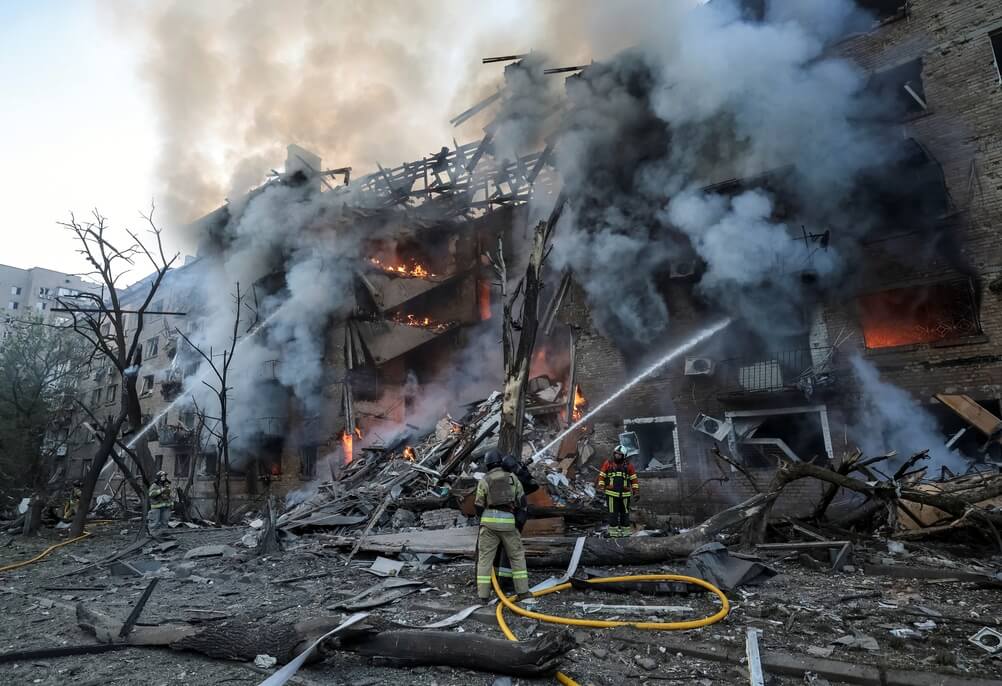 The Kremlin continues to target residential neighbourhoods, critical infrastructure, educational institutions, medical facilities, and cultural landmarks
Unable to break through Ukrainian defences, the Kremlin continues to target residential neighbourhoods, critical infrastructure, educational institutions, medical facilities, and cultural landmarks.
The objective of this strategy is to create a climate of constant fear, humanitarian distress, and psychological exhaustion to undermine the resilience of the Ukrainian state and its citizens.
At the same time, Moscow’s actions indicate preparations for a prolonged confrontation.
Increased military spending, the conversion of the economy to a wartime footing, large-scale resource mobilisation, and expanded military-technical cooperation with authoritarian regimes – particularly North Korea – demonstrate a lack of intention to end its aggression.
Under these circumstances, strengthening Ukraine’s air and missile defence capabilities through additional deliveries of modern Patriot, NASAMS, and IRIS-T systems remains critically important.
Every additional air defence battery and every interceptor missile translates into saved civilian lives, protected infrastructure, and preserved cultural heritage.
Oleksandr Levchenko, a former Ukrainian diplomat, is a professor at the State University (Kyiv) and a member of the Academy of Geopolitics and Geostrategy (Kyiv).
