Many European Union countries, starting with Germany, assume that higher defense spending will automatically generate the capabilities needed to keep Europe secure.
But if they pursue such spending in isolation, they will merely perpetuate the fragmented, outdated defense system that has left them dependent on the United States for more than 70 years—and possibly even create new risks.
When it comes to defense, Europe has three main problems: outdated technology, lack of scale, and ineffective governance.
The Ukraine war has thrown all three into sharp relief. As Ukraine uses innovative and nimble technologies to resist Russia’s much larger conventional arsenal, the limitations of legacy systems have become glaringly obvious.
Yet Europe has yet to seize fully the opportunity the war has created to test new weapons systems, scale up the production of the most effective ones, and translate this effort into progress on institutional consolidation.
If the current institutional and market fragmentation continues, higher defense spending could become politically untenable.
Research suggests that popular support for rearmament is stronger when citizens see additional spending as part of a credible European security project.
They support increased defense spending, but only if it follows, rather than precedes, European-level consolidation.
A more heavily armed Europe is not necessarily a safer one
Popular support is likely to wane if new resources appear to deliver inefficient, avoidable duplication across countries, raising the overall cost of closing capability gaps.
This would put governments under increasing pressure to deliver domestic industrial returns large enough to justify higher defense spending, which can come at the expense of social programs, climate measures, and more credible growth-enhancing public expenditure.
European countries’ increased spending will produce larger arsenals, however inefficiently
To be sure, European countries’ increased spending will produce larger arsenals, however inefficiently.
But a more heavily armed Europe is not necessarily a safer one. As long as states are acting mainly through national defense systems, Europe will remain strategically exposed.
If larger countries are governed by nationalist parties, the risk of a reckless maneuver or disastrous miscalculation rises.
Sovereignty is often invoked as a justification for uncoordinated national action on defense. But this is a red herring.
Many of the capabilities that matter most for strategic autonomy are beyond the reach of even the largest European states.
European Defense Union
European countries thus have two choices: either they can retain control over procurement while remaining dependent on the US for critical capabilities, or they can work with their European partners to build those capabilities.
Pooling demand, coordinating procurement, and consolidating production might reduce national discretion over individual contracts, but it would increase the EU’s capacity to defend itself and thus its collective sovereignty.
As we have argued elsewhere, only a genuine European Defense Union can deliver shared security in the long term.
In the medium term, however, a lot can be achieved through political agreements and commitments that do not require treaty-level intervention.
Without an EU-level framework capable of turning resources into scale, Europe’s defense capabilities will remain limited
A first step is to integrate military investments into a European framework that limits duplication and rewards interoperability and common procurement by a larger number of partners than currently required by the Security Action for Europe (SAFE) financing instrument. (As few as two countries can engage in “common procurement” under SAFE.)
Under this framework, investments that merely sustain existing national production lines should be distinguished from those that create shared European assets.
While it might be easier to gain political buy-in for the former, the latter are more likely to generate usable capabilities and reduce unit costs, making them vital to European security.
Without an EU-level framework capable of turning resources into scale, Europe’s defense capabilities will remain limited, no matter how much it spends. Yet, as it stands, Germany appears inclined to go it alone.
Germany faces a familiar choice
Thanks to the permanent exemption of defense-related borrowing from constitutional debt limits, and a friendly interpretation of EU fiscal rules, Germany’s capacity to spend on defense is formidable.
According to our calculations, when the country reaches its €200 billion ($229 billion) annual defense-spending target—probably around 2030—it will account for about half of total EU defense spending.
Given this asymmetric buying power, the temptation for Germany to bypass the slow-moving European coordination machine is strong.
Already, the country has withdrawn from landmark joint projects, such as the Future Combat Air System with France, and scrambled to purchase off-the-shelf, non-European defense solutions. This approach threatens to fracture the common defense effort from within.
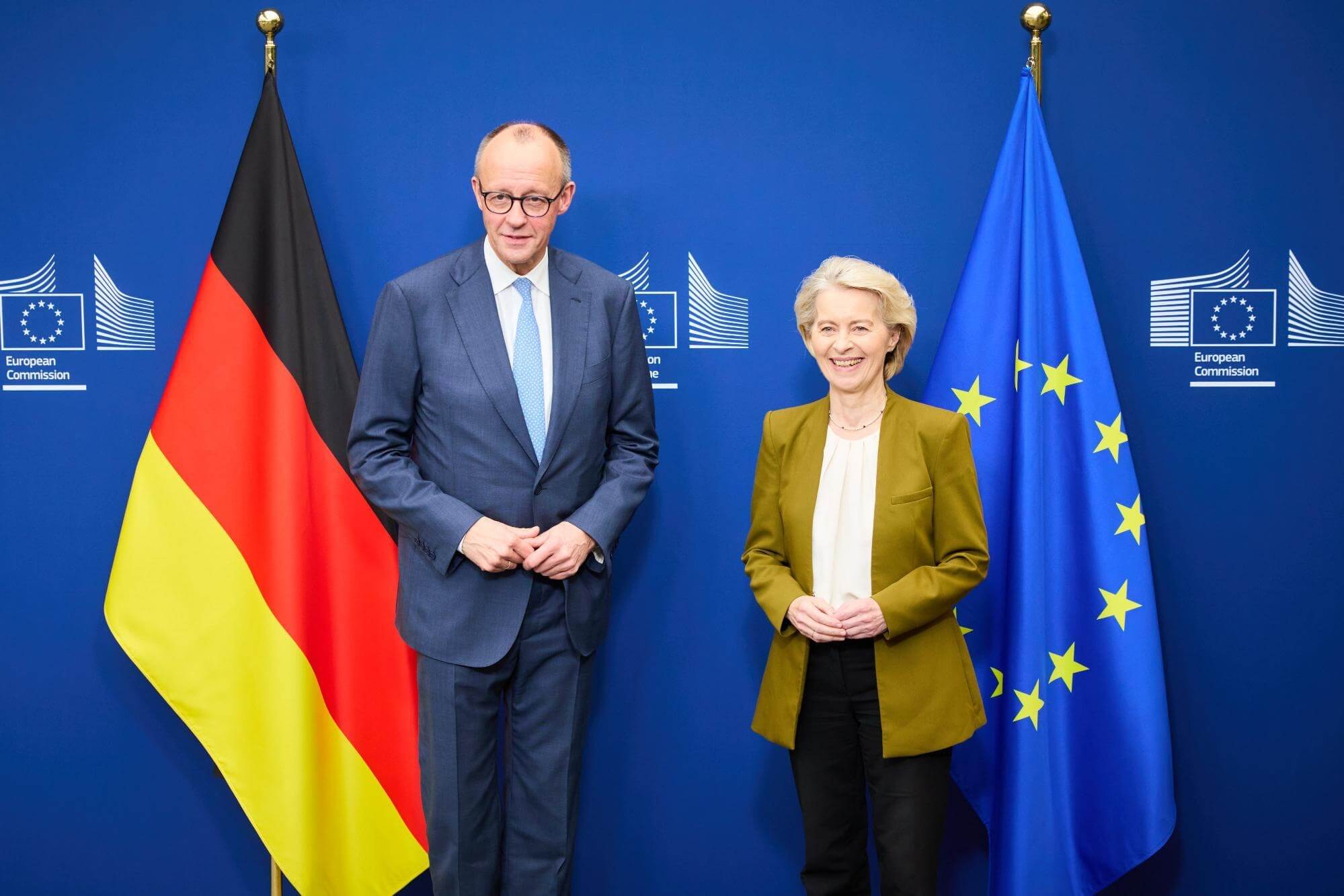 As the EU’s largest economy, Germany now faces a familiar choice: either it can act independently or it can assume the role of a benign hegemon
As the EU’s largest economy, Germany now faces a familiar choice: either it can act independently or it can assume the role of a benign hegemon.
If it takes a unilateral approach—and, worse, inspires others to follow its lead—the EU could well remain fully dependent on the US for key assets like low-Earth-orbit satellite communications, intelligence and targeting systems, ballistic air defense, nuclear weapons, and strategic lift capabilities.
These are genuine European public goods, which must be financed and delivered at the EU level.
Like Europe’s long-term security, a lasting resolution to this new “German question” may well lie in the European Defense Union.
As the Berlin Wall was coming down, German Chancellor Helmut Kohl, French President François Mitterrand, and European Commission President Jacques Delors managed to anchor a reunified Germany in Europe by launching the single currency. Today, it is a fully-fledged defense union that must form such an anchor.
Whether Chancellor Friedrich Merz, President Emmanuel Macron, and European Commission President Ursula von der Leyen will show the same vision and political will as their predecessors remains unclear.
But time is of the essence. Next year, elections in several EU countries will raise the “political discount rate”—political leaders’ preference for policies that yield visible benefits fast—and make bold decisions, particularly on defense, more difficult.
Marco Buti is Chair at the European University Institute’s Robert Schuman Center and an external fellow at Bruegel.
Francesco Nicoli, Associate Professor of Political Science at the Politecnico Institute of Turin, is Professor of Political Economy at Ghent University and an affiliate fellow at the department of economics of the University of Amsterdam.
