A new Gang Suppression Force authorised by the UN is due to be deployed next month to curb violence in Haiti. But analysts question whether it will have the capacity to make the country safe enough to hold elections in August, let alone allow democracy to return.
Haiti has suffered from a lack of focused international attention, not least from Donald Trump, who failed to invite Haiti to a regional security summit on the Americas last weekend.
On the one hand, Washington did push for the creation of the Gang Suppression Force (GSF) last year. On the other, this week it denied visas to seven players from Haiti who were set to play in California for the Jamaican team Mount Pleasant, a move that hardly signals confidence for progress in Haiti.
Additionally, the situation in Haiti would worsen if large numbers of the 350,000 Haitians in the US were forced to return if they lost their temporary protected status designation. A federal appeals court ruled earlier this month the Trump administration had unlawfully terminated the designation, which remains under legal wrangling.
Last month, US warships arrived off the coast of Haiti in a show of force just as the mandate of Prime Minister Alix Didier Fils-Aimé was expiring. Members of the Transitional Presidential Council (TPC) had flouted warnings from Washington and announced plans to remove Fils-Aimé.
After the warships arrived, the TPC stepped down as scheduled, and Fils-Aimé remains sole leader with US backing until elections are held in two rounds in August and December.
The warship diplomacy may have kept Washington’s man in place, but the challenge of curbing gang violence and creating conditions conducive to elections will prove a tough challenge. An elected president and legislature are due to take office early next year.
The toll of gang violence in Haiti
Gangs have united under the Viv Ansanm banner, and they control up to 90% of the Haitian capital, Port-au-Prince. More than one in ten Haitians have fled their homes, and food insecurity affects 5.7 million people, with nearly two million at emergency levels, says the UN.
But 80% of US-funded aid programmes in Haiti have ended after the Trump administration scrapped USAID last year.
“More than 8,100 killings were documented nationwide between January and November 2025,” António Guterres, UN secretary-general, said recently. “Reports also indicated an increase in the trafficking in children, with children continuing to be used by gangs in multiple roles, including in violent attacks.”
The TPC was created after the assassination of Haitian President Jovenel Moïse in 2021 when about two dozen mercenaries, mostly from Colombia, attacked his Port-au-Prince home. This week, his widow, Martine Moïse, testified in a Miami court during the trial of four of the men charged with plotting his murder.
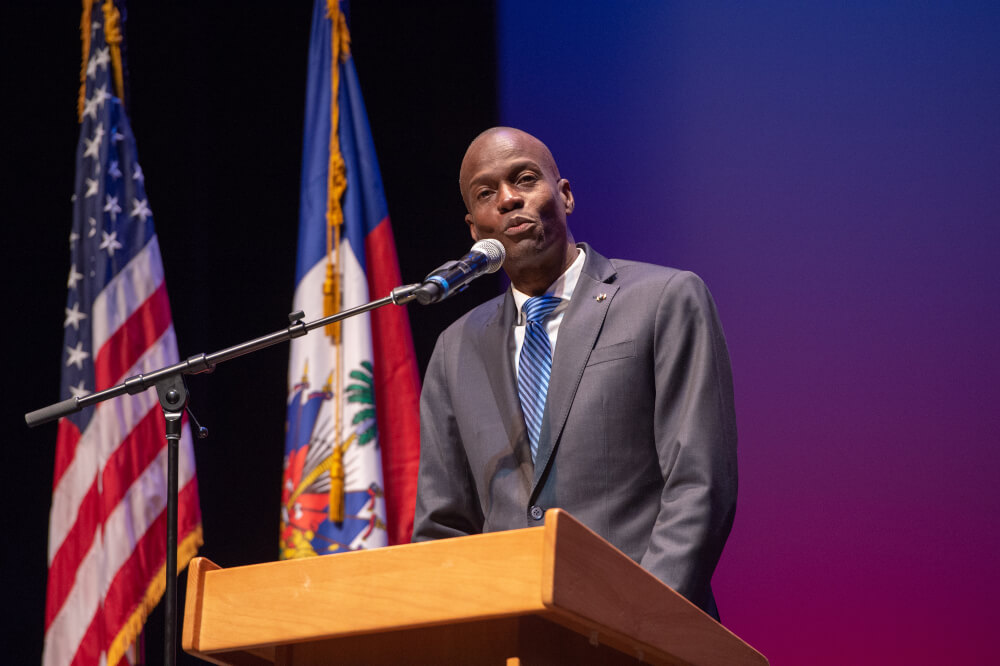 Jovenel Moïse was gunned down after what prosecutors say was a months-long conspiracy orchestrated by a Miami security company
Moïse, 53, was gunned down after what prosecutors say was a months-long conspiracy orchestrated by a Miami security company, Counter Terrorist Unit Federal Academy, which was hoping to overthrow the president in a “violent coup” in order to obtain lucrative security contracts from his replacement.
Defence lawyers say the four men were manipulated into taking the blame for the coup attempt in Haiti, where 17 Colombian soldiers and three Haitian officials also face charges. In the US, six other men have already pleaded guilty and are serving sentences, while the trial of another was postponed for medical reasons.
Security over humanitarian concerns
It is against this backdrop that the GSF is expected to impose order. It replaces a police mission formed during the administration of President Joseph Biden and led by Kenya that faced constant shortages of staff and equipment.
The new force is expected to total about 5,500 troops, and the first 1,500 of them are expected to arrive from Chad next month. Equipment for a UN Haiti Support Office to complement the GSF is being shipped from the UN logistics base in Brindisi and from Baghdad, including equipment from the now-closed UN Assistance Mission for Iraq.
Haitian authorities should urgently rein in the security forces and private contractors working for them before more children die - Juanita Goebertus
Washington was a key player in pushing last year for the creation of the GSF, which is not a UN peacekeeping force and whose operational command will be held by a coalition of countries including the US.
“It is surprising because at a moment in which the US has been extremely vocal in its criticism against the UN and the multilateral system... they have put so much effort to make sure that UN resolution on Haiti was passed and that the new deployment was designed and voted and funded,” Romain Le Cour-Grandmaison of the Global Initiative against Transnational Organised Crime told the AS/COA business forum.
The GSF will work with Haiti’s National Police, which is bolstered by military contractors who are mostly former American and Salvadoran soldiers. Furthermore, Vectus Global - a US private military firm formed by Erik Prince, who had headed the notorious Blackwater company of mercenaries - has for the last year deployed drones and contractors for a national security task force headed by Fils-Aimé.
Drone strikes by Haitian security forces and private contractors have killed at least 1,243 people and injured 738 since March last year, Human Rights Watch said in a report released on Tuesday.
The group did not find widespread drone use among the gangs. The UN’s high commissioner for human rights said in October that the drone strikes were disproportionate and likely unlawful.
“Haitian authorities should urgently rein in the security forces and private contractors working for them before more children die,” said Juanita Goebertus, Americas director at Human Rights Watch.
As Washington views the country through a security, not humanitarian, prism, few would bet on the Trump administration to change course.
