Pakistan is no stranger to military dictators steering the state and de facto ruler Field Marshal Asim Munir has stuck to tradition by cracking down on militants as well as freedoms.
He is faced with escalating domestic instability and severe economic challenges that could undermine the diplomatic wins that he seeks in foreign affairs as Pakistan seeks to become a key player in the regional security arena.
Munir has led the military since 2022 and is nominally under the leadership of Prime Minister Shehbaz Sharif, who ousted his predecessor Imran Khan with army backing.
But it is Munir who is often the public face of Pakistan. The goal he set in 2025 was to turn Pakistan into a “hard state” with centralised military control to stamp out terrorism and political dissent. This has helped to win him warm words from President Donald Trump, among others.
Munir’s crackdown on separatists in Balochistan, unrest in Kashmir and the Pakistani Taliban involves draconian measures, including curfews, internet blackouts and media restrictions that are being met with growing resistance.
Efforts to win against violent opponents might be boosted by economic stability. But some 29% of 255 million Pakistanis are living below the official poverty rate of around $30 a month, while income inequality is also growing.
Under the latest IMF bailout, interest payments on debt account for 40% of Pakistan’s revenues, according to the rating agency Fitch.
Fixing the cracks within
“What good is a bigger voice on the world stage if the house is on fire?” Maleeha Lodhi, a former Pakistani ambassador to the US and UK, told the FT. “Pakistan needs to fix the cracks within.”
Pakistan’s global aspirations were furthered when on 7 August it, together with Saudi Arabia and Turkey, signed the Mecca Joint Defence Agreement, which stipulates that an armed attack against any member would be regarded as an attack on all, echoing NATO's Article 5 collective defence clause.
Furthermore, the ruling Pakistan Muslim League - Nawaz (PML-N) party looks set to win a majority in the local assembly of Pakistan-administered Kashmir in three rounds of voting that took place between late July and 10 August, during which clashes between security forces and protestors left dozens dead.
Pakistan topped this year’s Global Terrorism Index with 1,045 incidents in 2025
A rerun of voting in 23 polling stations was scheduled on 15 August because of irregularities, while voting in seven constituencies has been indefinitely postponed because of security concerns.
Pakistan has blamed the violence in Kashmir on India-backed militants, while Imran Khan’s Pakistan Tehreek-e-Insaf (PTI) party boycotted the election over fraud concerns, leaving only the PML-N to run against the Pakistan Peoples Party, although nationally these two parties are allies.
Analysts expect further unrest in Kashmir that may even spread across the country. Pakistan topped this year’s Global Terrorism Index with 1,045 incidents in 2025, and many of the attacks taking place in Balochistan and Khyber Pakhtunkhwa.
Near total control
Islamists from the Tehreek-e-Taliban Pakistan (TTP) are a growing problem for Munir. Under his predecessor, Pakistan had a policy of repatriating their fighters from Afghanistan and allowing them to settle in Khyber Pakhtunkhwa in the hope they would reintegrate into civilian life.
Under Munir, repatriation and negotiations with the TTP ceased while around 2.5 million Afghans have left Pakistan since 2023, many forcibly.
Pakistani politics was further convulsed with reports this week that Imran Khan had died in custody, forcing the armed forces to make a rare refutation while still refusing to issue much detail about his fate.
Khan faces multiple charges, including corruption and unlawful marriage allegations
The three-year anniversary of Khan’s imprisonment fell on 5 August, and the 73-year-old’s detention conditions are described as inhumane by the UN. Khan faces multiple charges, including corruption and unlawful marriage allegations.
Officials from Khan’s PTI party have warned that continued denial of access to him “could spark uncontrollable nationwide protests, with senior figures asserting that millions of supporters were prepared to march toward Rawalpindi if his safety was not publicly verified by independent medical boards,” according to the Indian Firstpost web site.
Munir enjoys near total control over the nuclear-armed country, with the parliament simply rubber-stamping his decisions with little to no judicial oversight.
His heavy-handed tactics place him in like-minded company with fellow strongman leaders in Saudi Arabia and Turkey in the recent Mecca defence agreement.
The Mecca Accord
Pakistan is hoping the Mecca accord will help to draw badly-needed Gulf investment in return for its nuclear and military capabilities. “Pakistani leaders want the world to view their country as a helpful and impactful global player, not as the home to large levels of repression and terrorism,” said an Atlantic Council analysis.
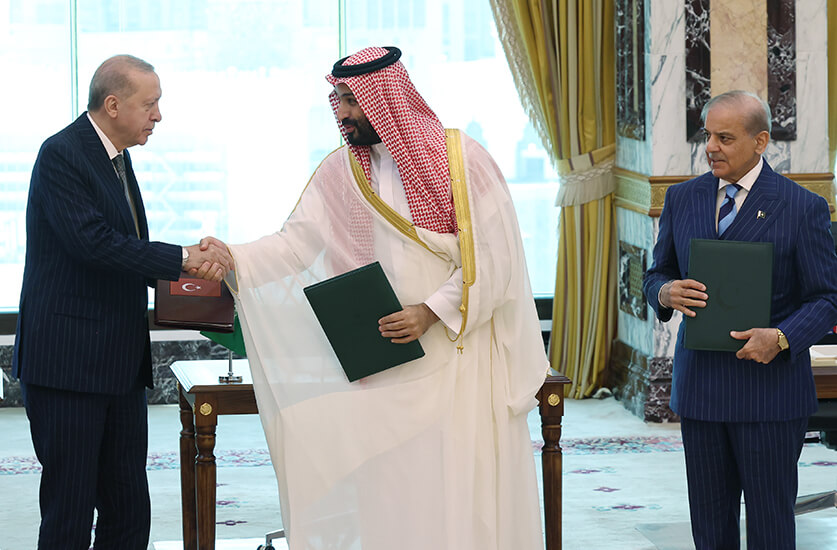 Pakistan is hoping the Mecca accord will help to draw badly-needed Gulf investment in return for its nuclear and military capabilities
But the accord comes with dangers for Pakistan, which has a large Shia minority, and Islamabad has so far kept up ties with Tehran as well as with Washington, Riyadh and Ankara during the US war with Iran.
The Mecca accord is also further deepening regional divisions, with Kanwal Sibal, former Indian foreign secretary, suggesting on X that India expand its strategic options with the United Arab Emirates, Israel, Greece, Cyprus and Afghanistan.
They would face the three Mecca accord countries, which also have close ties with Jordan and Egypt.
Another complicating factor for Islamabad could be if the Iran war further embroils Yemen, which fought a Saudi-led coalition that the Pakistan parliament declined to join in 2015.
The FT quoted an unnamed source saying the Mecca accord was a prelude to more Saudi military action against the Houthis in Yemen in which Turkey and Pakistan would be expected to participate.
Munir’s military balancing act at home could soon be joined by one abroad.
