The United Arab Emirates is considering a major overhaul of a project unveiled a little more than a year ago as the largest AI campus outside the United States.
According to information released on 11 September, the five-gigawatt, approximately 26-square-kilometre complex in Abu Dhabi could be split between multiple locations across the country.
Underground construction, reinforced materials, additional power and cooling systems, electronic jamming, and protection against drones and missiles are being considered for certain facilities.
G42, the Emirati company leading the project, states that work is progressing according to plan, with technical solutions being adapted to new safety and resilience requirements.
The final schedule has not yet been agreed, but the reasons for reconsidering the project point to a much wider change. Computing power, conceived as technological and energy infrastructure, has become part of military calculations.
The Iranian strikes changed the calculation
The landmark event took place in March, when Iranian drones hit two Amazon Web Services facilities in the UAE, while a third facility in Bahrain was damaged by an impact in the immediate vicinity.
AWS reported structural damage, power outages and further damage caused by firefighting, and advised customers to move data and workloads to other regions.
That incident exposed the limitations of the model on which the modern cloud depends.
Backup power and failover systems provide protection against fire, technical problems and network outages. However, if several data centres are built in close proximity to one another, a wider attack by drones or missiles can disable all of them at once.
Proximity to a military facility in itself does not determine the status of a commercial data centre, but it significantly affects the risk assessment
Risk soon acquired a precise address. In April, Iran's armed forces released a video that identified Stargate UAE as a potential target, together with a map showing the complex's location.
The project's proximity to Al Dhafra Air Base had not previously been publicly confirmed. The base is also used by American forces and was already a target during the war.
Proximity to a military facility in itself does not determine the status of a commercial data centre, but it significantly affects the risk assessment made by investors, operators and the state responsible for its protection.
Stargate also emerged from the US–UAE agreement on AI technology, relies on American chips and cloud companies, and is subject to rules agreed with Washington. It has thus become a strategically important facility for both the UAE and the United States.
The war has changed the calculus for large AI campuses
A capacity of five gigawatts at a single location reduces construction and operating costs by enabling shared energy, network and cooling infrastructure, simpler maintenance and the connection of the vast number of accelerators required for the most demanding AI systems.
The first phase of Stargate UAE includes a one-gigawatt cluster, valued at around $30 billion, with the first 200 megawatts scheduled to be commissioned in 2026. OpenAI, Oracle, Nvidia, Cisco and SoftBank are participating in the G42 project.
When the agreement was presented, the US Department of Commerce emphasised the regional role of the future complex and the application of US security standards.
The military risk, however, calls into question the cost-effectiveness of building such a large AI complex in a single location.
Spreading parts of a cluster over tens or hundreds of kilometres increases latency, complicates synchronisation and makes the transfer of huge volumes of data more expensive
The largest AI systems depend on extremely fast communication between processors. Spreading parts of a cluster over tens or hundreds of kilometres increases latency, complicates synchronisation and makes the transfer of huge volumes of data more expensive.
Training models across multiple data centres is already technically feasible, but high-capacity connections at a single site still provide better conditions for the most demanding tasks.
The Emirates will probably build several separate clusters in different locations and assign specific tasks to each one, rather than connecting them into a single system operating like a supercomputer spread across the country.
Resilience to attack requires investment that increases costs without increasing regular income. Duplicate power systems, additional optical links, spare hubs, physical reinforcement and capacities that remain unused for part of the time are needed.
Commercial calculations show a lower return on capital from such surplus capacity. A state that expects the same infrastructure to sustain finance, energy, administration and defence pays for it as continuity insurance.
This is precisely where the interests of the data centre owner and the government, which regards the infrastructure as a strategic resource, diverge.
From the server room to the defended facility
The most profound change concerns physical protection. Drone and missile interceptors, electronic jamming, reinforced concrete, underground rooms, and placing the most sensitive capabilities in mountain complexes belong to a completely different category of risk from that on which data centres were built in past decades.
Standard protections include strict access control, backup generators, multiple power supplies, fire suppression, and robust cyber defences.
Their baseline scenarios were crime, internal sabotage, natural disasters, and technical failures. A missile or drone swarm changes site selection, building design, insurance and state responsibility.
The border between civilian and military digital infrastructure is being erased
At the same time, the border between civilian and military digital infrastructure is being erased. The same commercial cloud is used by banks, hospitals, government, industry and the defence sector.
After the March attacks, UNIDIR (The United Nations Institute for Disarmament Research) warned that such interweaving increases the consequences of the physical destruction of data centres and makes their protection more difficult.
In the UAE, the separation of facilities for the most sensitive data, including military data, is already being considered.
Separating functions can be more valuable than thick walls, because housing civil services and militarily relevant computing power in the same complex allows a single successful strike to disrupt a large number of key systems.
The Gulf’s AI ambitions are entering a more expensive phase
The UAE has built its AI strategy on capital, abundant energy, political support and access to US technology.
The May 2025 agreement provided for five gigawatts of capacity in Abu Dhabi, with strict access controls on US technology and Emirati investment in data centres in the United States.
Abu Dhabi is expected to become one of the largest hubs in the American technology system outside the United States
Abu Dhabi is therefore expected to become one of the largest hubs in the American technology system outside the United States.
The Iranian strikes introduced a factor that did not carry the same weight in the original investment model: defending computer infrastructure against physical attack.
Its price now includes financing, insurance, contracts with major cloud companies, recovery plans, data storage and the allocation of backup capacity.
It will be particularly difficult to reconcile the desire to keep the most important data and AI models under domestic control with the need to move part of the system quickly out of the impact zone.
After the March attacks, AWS recommended that users in the Gulf migrate to regions in Europe, Asia or the United States.
Sovereign AI thus contains an internal contradiction. Concentrating capacity on national territory strengthens control in peacetime, while distributing capacity across multiple states increases the likelihood that services will survive war.
The Emirates will divide performance and survivability
The project is still expected to have a planned capacity of five gigawatts, but it will no longer be built as a single complex.
The first one-gigawatt phase is already under construction and should be completed with enhanced facility protection, while the remaining capacity is likely to be divided among several other sites.
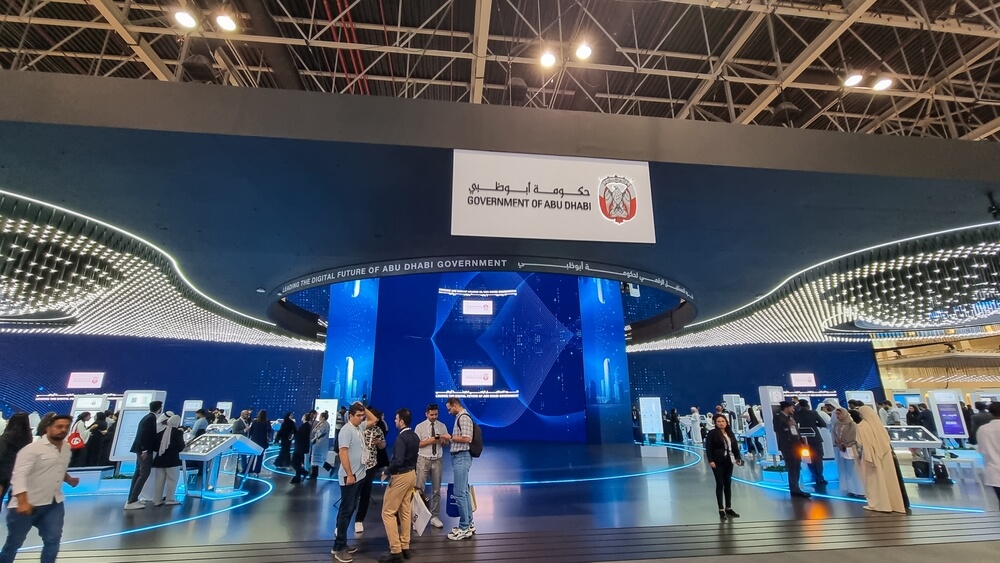 The Emirates entered the AI race counting on chips, electricity, capital and water. After the war, they must also factor in the cost of keeping this infrastructure running under attack
The most sensitive government and military systems will be housed in better-protected facilities, with independent power supplies and backup capacity for data storage and continued operation after an attack.
This arrangement preserves the advantages of large clusters for performance-critical jobs, while reducing the likelihood that a single strike could disable most of the nation’s AI infrastructure.
If the UAE manages to deploy workloads without serious performance degradation or uncontrolled cost growth, its model will quickly attract other states developing national AI capabilities in security-exposed areas.
Tenders for the new campuses will then include requirements previously associated with energy, telecommunications and military facilities: geographically separated capacity, backup locations, rapid switching of data and services, reinforced buildings and coordination with national air and cyber defence.
Large campuses will retain their economic advantage, but they will be accompanied by separate nodes whose main purpose is to keep the system operating after the initial impact.
The Emirates entered the AI race counting on chips, electricity, capital and water. After the war, they must also factor in the cost of keeping this infrastructure running under attack.
That shift will not remain confined to the Gulf. Governments that treat computing power as the basis of economic and military strength will demand that it remain available even after a site is destroyed.
How Abu Dhabi rearranges Stargate will reveal the price nations must pay to keep their AI systems running during wartime.
