Might a push from Washington reunite Libya whose oil riches are being eyed covetously by the US and Europe as energy flows remain restricted through the Strait of Hormuz?
The country of 7.5 million people has been divided since 2011 when a Nato-backed uprising overthrew Muammar Gaddafi and since when two rival political camps supported by violent militias have taken control.
Would a US plan for Libya make governance more stable and boost energy exports that are much-needed globally, while reflecting President Donald Trump’s transactional approach towards foreign policy?
Or, as many Libya-watchers predict, would his tactics risk entrenching deep corruption and raise the chances of renewed destabilisation further down the road?
Libya’s struggle for control
In western Libya, a UN-recognised government based in Tripoli is headed by Prime Minister Abdul Hamid Dbeibeh. He was appointed in 2021 as part of a UN-led bid to guide the country through elections.
The east is dominated by the Kremlin-backed warlord Khalifa Haftar, whose son Saddam leads the Libyan National Army. Another son, Belgasim, leads the state-funded Libyan Development and Reconstruction Fund, which controls billions of dollars of projects.
The two sides fought a war in 2019 when Khalifa tried to conquer Tripoli and the fighting became a proxy battle, with Turkey backing the UN-recognised government while Russia, Egypt, and the UAE supported Khalifa. An uneasy peace punctuated by armed clashes has hovered over Libya since.
Other outside powers are also making new ties in Libya, with Turkey getting closer to Saddam Haftar while Egypt is moving closer to the Dbeibeh government
Under Washington’s proposed power-sharing agreement being pushed by Massad Boulos, Donald Trump’s Africa envoy, the Dbeibeh family in western Libya and the Haftar family in the east would continue to dominate while a new generation from the respective families would replace the current leaders.
Ibrahim Dbeibeh, a Libyan powerbroker, would replace his cousin Abdul Hamid Dbeibeh as prime minister. Saddam Haftar, son of Khalifa Haftar, would become president.
“All of the outside powers, including the US, have basically given up on democratic elections in Libya,” a former senior Western official told the Middle East Eye news site. “Their preference is to work with the entrenched families and carve up the goodies among the two most corrupt. But the Haftars are toxic in western Libya, and Dbeibeh doesn’t fully control the west. This totally bypasses the Libyan people and could backfire.”
The news site said Ibrahim Dbeibeh had a close relationship with Trump’s envoy Boulos while Saddam Haftar met the deputy director of the CIA during a visit to Washington last year.
Other outside powers are also making new ties in Libya, with Turkey getting closer to Saddam Haftar while Egypt is moving closer to the Dbeibeh government.
Largest reserves, growing poverty
Oil is the major draw, with Libya holding the largest reserves in Africa, estimated at 48 billion barrels, mostly from the country’s oil fields in the east. In April, Libyan production reached 1.4 million barrels a day, the highest level since at least 2013, while oil revenues reached $2.9 billion from $1 billion in February.
The windfall raises the scope for even more corruption, which is already high, said a UN-commissioned report by a panel of experts presented to the Security Council in March.
Both Libyan regimes provide “an umbrella of impunity” to officials who “served the interests of competing networks of armed groups”, said a UN-commissioned report by a panel of experts presented to the Security Council in March.
The UN will present a final report to Libya’s leaders following a structured dialogue with people across the country
The Libyan economy is marked by “currency pressures, rising prices, fuel shortages, uncontrolled and opaque public spending, and growing poverty,” Hanna S. Tetteh, head of the UN Support Mission in Libya, said last month.
On human rights, she cited continuing reports of arbitrary detention, intimidation and reprisals against perceived political opponents, human rights defenders and public officials.
Next month, the UN will present a final report to Libya’s leaders following a structured dialogue with people across the country on four issues: security, governance, the economy, and national reconciliation and human rights.
The people’s views are supposed to inform reforms and create conditions for elections. It is hard to see Washington taking any notice.
Libya’s unstable path forward
Last month, Boulos hailed a unified national budget agreed by the two rival governments for the first time since 2013. He said the agreement would allow the National Oil Corporation to increase energy production and generate higher revenues. Critics see it as simply a financial deal between the Dbeibehs and Haftars that will do little to help the Libyan people.
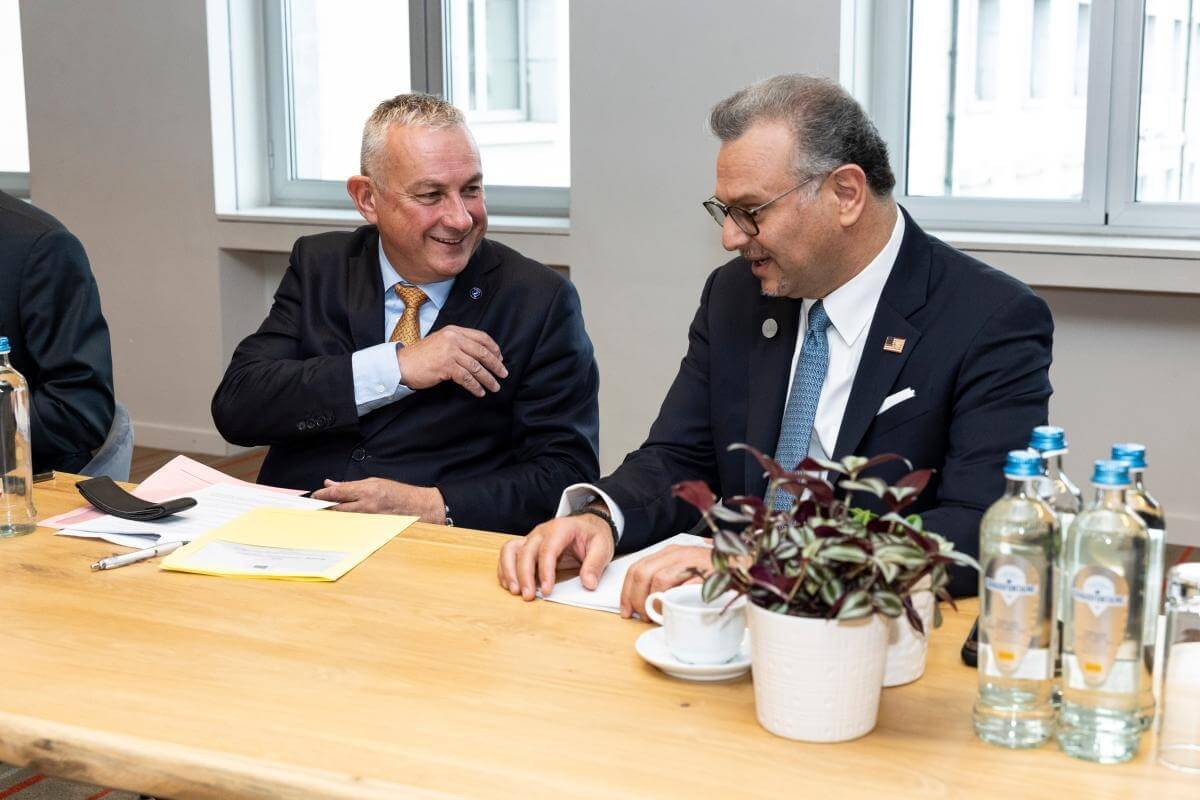 Last month, Massad Boulos (right) hailed a unified national budget agreed by the two rival governments for the first time since 2013
Representatives from the rival sides also participated in Flintlock, a joint military exercise with soldiers from about 30 countries under US leadership that took place last month in Libya and Ivory Coast.
The lack of enduring political arrangements or stable institutions has never deterred oil companies, and Libya is no exception.
ExxonMobil, for example, is scheduled to survey four offshore blocks, while a delegation of Italian lawmakers recently went to Libya with a view to increasing production through a pipeline that connects the two countries.
All this while Libya barely functions as a state. “The country lacks a unified, functional government structure with a clear delineation between the executive, legislative and judicial branches,” says the recently published Bertelsmann Transformation Index 2026.
Around a third of Libyans live below the poverty line and there are beggars on the streets of Tripoli and Benghazi. Few expect them to disappear any time soon.
