“It’s like we’re going in circles,” said Olga Skabeeva, one of the Kremlin’s leading propagandists, dissatisfied with the discussion in her TV studio, where the participants failed to offer any new ideas on how Russia should deal with Ukraine.
“In the fifth year of the war, we’re saying that we should strike even harder,” Skabeeva said, sounding disappointed and expecting more from her interlocutors.
Indeed, Skabeeva and several of her colleagues at the top of Putin’s propaganda industry, such as Margarita Simonyan and Vladimir Solovyov, have in recent days faced a very complex and seemingly hopeless task.
Massive Ukrainian strikes on targets deep inside Russia, particularly energy facilities, have brought the war to the doorstep of all Russians, including those in the largest cities, Moscow and St Petersburg.
The fuel supply crisis, caused by Ukrainian attacks that have destroyed a third of Russia’s oil-processing capacity, affects every Russian, forcing people to wait in long queues at petrol stations.
Meanwhile, the Crimean Peninsula, annexed by Russia in 2014, is facing an existential crisis due to Ukrainian strikes that have successfully severed its connections with the mainland.
The narrative of the strength and inviolability of Russian military power is collapsing rapidly, and in two ways. After more than four years, it is difficult to explain how Kyiv has acquired the ability to strike so powerfully, and at such distant points, across Russia’s vast territory.
Secondly, it is difficult to explain Russia’s inability to protect its airspace from Ukrainian attacks and, in particular, its failure to organise a regular supply of basic goods such as fuel.
An impossible task
For the Kremlin’s powerful propagandists, preserving Russians’ faith in the omnipotence of their state and the justice of its goals has now become an almost impossible task.
Grand rhetoric and dreams of restoring the empire are being tested today against petrol shortages, lack of work and wages, and daily explosions in the nearest neighbourhood.
The man at the apex of the Kremlin’s propaganda pyramid, Putin’s spokesman Dmitry Peskov, recently confirmed that long-standing strategies and tools have become ineffective and that the search for new ones has begun.
“Special military operation” had evolved into a “full-scale war”, Peskov told the Swiss magazine Die Weltwoche. This marks a significant, and not merely propagandistic but political, turning point of a kind the Kremlin has not undertaken since it launched its aggression against Ukraine in 2022.
Peskov’s shift outlines the direction in which Moscow intends to develop the narrative of the war in Ukraine
First, all lower-level implementers of the state propaganda course received a clear order to change the current terminology and have already begun doing so. Second, abandoning the term “special military operation” means Moscow is admitting to its own citizens that it has not achieved its limited goal in Ukraine, namely the overthrow of the government in Kyiv.
More importantly, the Kremlin has shown that it has no other PR response than to acknowledge that the country is facing a deep crisis as a result of Ukrainian counter-attacks on Russian territory. What has become obvious to millions of Russians has become impossible to conceal, despite the Kremlin’s efforts.
Ultimately, Peskov’s shift clearly outlines the direction in which Moscow intends to develop the narrative of the war in Ukraine: to present its invasion as a war not only against Ukraine, but also against Europe and the US.
“So in having Russia from one side and having the Kyiv regime plus a number of European countries and plus the United States that is supplying millions of tons of weapons to Ukraine. What it is? It’s not an operation anymore. It’s a war. It’s a full-scale war.”
Testing a new strategy
The new strategy has only just been implemented, and its effects are not yet visible. From an international perspective, it aims to bring Russia to the table for future peace negotiations not only with Kyiv, but also with the major actors, primarily the US and possibly Europe.
Russia has previously held talks in such a format, but its intention now is increasingly to exclude Zelenskyy’s government from future agreements as far as possible and to strike deals directly with the West.
At the same time, the shift announced by Peskov is directed equally at the domestic public. Alongside acknowledging the existence of a crisis in the security, energy and economic systems, it will trigger a new wave of national homogenisation.
“This is not just a turn of phrase. It is a deliberate information campaign to prepare the Russian population for a mobilisation that Russia is considering for the autumn. It is also preparing people for the restrictions that would accompany it, including a possible ban on leaving the country,” says Andrii Kovalenko, head of Ukraine’s Center for Countering Disinformation (CCD) under the National Security and Defense Council.
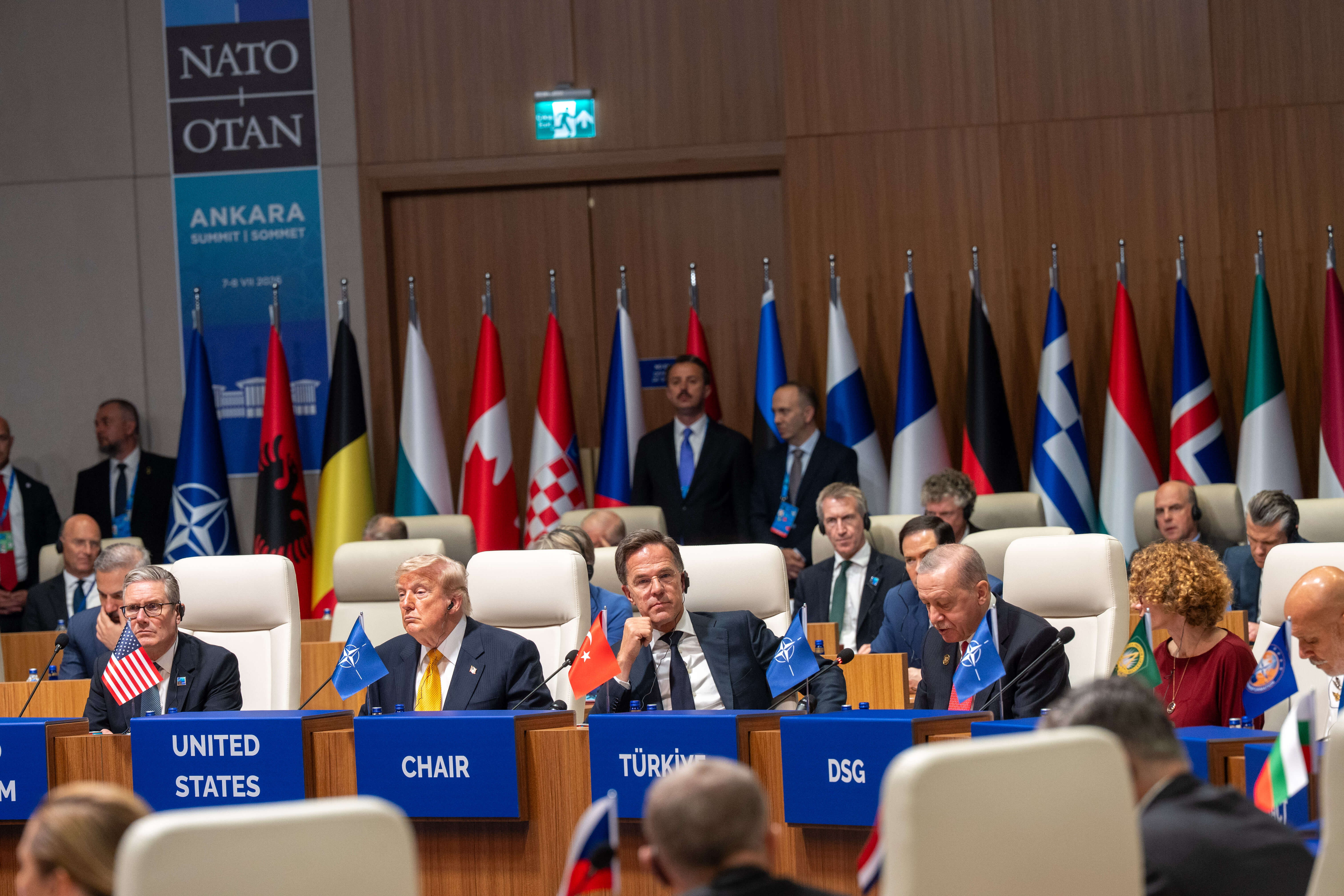 NATO, the principal target in recent years, demonstrated at the recent summit in Ankara both its full vitality and clear unity in continuing its full support for Ukraine’s struggle
Taking a new propaganda course is therefore a consequence of the difficult circumstances in which Russia finds itself in the fifth year of its invasion of Ukraine. It is also a consequence of the resilience shown by some of the main targets of the Kremlin’s propaganda and disinformation campaigns in the West.
NATO, the principal target among these in recent years, demonstrated at the recent summit in Ankara both its full vitality and clear unity in continuing its full support for Ukraine’s struggle.
For years, inciting conflicts within the Alliance and widening every crack in NATO, even the smallest, has been a priority goal of the Kremlin’s industry of false narratives and disinformation.
However, one of the participants in a TV discussion with Olga Skabeeva on the Russia 1 channel said reluctantly that the summit in Ankara was “a summit of consolidation, consolidation against us and in favour of supporting Ukraine.”
Searching for the best possible negotiating position
One indication that the Kremlin is frantically searching for a new propaganda course, because the current one no longer delivers results, is, according to observers, the recent interview given to The Economist by oligarch Andrey Melnichenko.
One of the richest Russians, with assets of about USD 20 billion, has outlined several scenarios for post-war Russia and argued, to a Western audience, for preserving Russia's sovereignty and thus its predictability in the international arena.
Putin is preparing the ground for the strongest possible negotiating position on peace in Ukraine
Part of the audience, however, judged Melnichenko's performance to have been coordinated with the Kremlin, or at least delivered with Moscow's approval.
“The fact that there is not a single critical word about Putin is, at least, understandable. He is afraid. And, in any case, it is difficult to imagine that such an interview could have been given without some form of permission,” wrote Arseniy Yatsenyuk, former Prime Minister of Ukraine (2014–2016), on X.
He is one of those who sense that Putin is seriously preparing the ground for the strongest possible negotiating position on peace in Ukraine, squeezed between military failures at the front, an increasingly unsustainable domestic economy, and, above all, frequent Ukrainian airstrikes on Russian energy hubs.
In this context, Moscow’s shift in propaganda is an extremely important element of its overall war strategy. Its future direction, however, is uncertain, as it will have to patch up too many “holes”, both domestically and with rival publics.
The very fact that the traditionally skilful Kremlin propaganda machine admits defeat and is frantically searching for new solutions shows that the options for political and military decisions are running out.
