Russia is no longer merely an authoritarian state. It is a security-service regime whose governing philosophy is coercion – at home through repression, and abroad through intimidation, sabotage, and assassination.
The signs are there for those willing to see them. Reporting out from the UK in recent weeks has focused on alleged sabotage and arson directed by Russian state-sponsored actors against the Prime Minister himself.
The British services will no doubt investigate further, but what does this latest revelation and escalation signal?
Domestically, within Russia, consider the reinstallation of a statue of Felix Dzerzhinsky at the FSB Academy in Moscow last month.
Actions are important, but symbolism is telling as well. "Iron Felix," founder of the Soviet secret police, openly championed organized terror as an instrument of state power.
When his statue was removed from Lubyanka Square after the collapse of the Soviet Union, it symbolized a break with that legacy.
Its return signals something different: a new era in which Putin's Russia is once again embracing the traditions of repression at home and coercion abroad. The gloves are off.
Active measures and direct measures
Russian statecraft under Putin relies heavily on two complementary intelligence tools dating back to the Cheka and KGB: active measures and direct measures.
Active measures include disinformation campaigns, influence operations, cyberattacks, propaganda, political interference, and efforts to weaken social cohesion within rival states.
Direct measures are more blunt: sabotage, assassination, intimidation, covert action, and violence carried out by intelligence services or their proxies.
Both are now being employed extensively in a new era of hybrid war against the West.
During the Cold War, the Soviet Union employed active measures on a global scale
Neither concept is new. During the Cold War, the Soviet Union employed active measures on a global scale, spreading disinformation and supporting proxy movements that advanced Moscow's interests.
Soviet intelligence services also engaged in direct action. The assassination of Bulgarian dissident Georgi Markov in London in 1978 – killed with a ricin-filled pellet delivered via a modified umbrella (provided by the KGB and its “poison factory”) – remains one of the most notorious examples.
Soviet services also provided varying degrees of support, training, weapons, or assistance to revolutionary and terrorist groups aligned with Soviet geopolitical objectives.
The methods may have evolved, but the mindset and approach ring familiar in headlines across Europe now.
Covert operations across Europe
Today, the interplay between active and direct measures is once again evident. The reported activities of GRU Unit 29155 provide a contemporary example.
Western governments and intelligence services have linked the unit to sabotage plots, assassination attempts, destabilization campaigns, and other covert operations across Europe.
Whether every operation succeeds is almost beside the point. The objective is often as much psychological as physical.
Business leaders, political figures, military officers, journalists, and dissidents are meant to understand that they could be targeted. Uncertainty itself becomes a weapon.
Russia has repeatedly demonstrated its willingness to export violence beyond its borders
From the poisonings of Alexander Litvinenko in London in 2005 and Sergei Skripal in Salisbury over a decade later, to reported sabotage plots across Europe and alleged plans targeting Western defense-industrial leaders (like an assassination plot against Rheinmetall’s CEO), Russia has repeatedly demonstrated its willingness to export violence beyond its borders. These are not isolated incidents. They are instruments of state policy.
That is the essence of modern Russian hybrid warfare. It seeks not only to inflict damage but to shape behavior through intimidation and fear.
The message is simple: nowhere is entirely safe, and no target is beyond reach.
Restoring credible deterrence
So what should the West do? The answer is simple in principle but difficult in practice: restore credible deterrence.
For too long, Western governments have allowed Putin to define the rules of engagement while repeatedly violating them himself.
Russia escalates through cyber attacks, sabotage, political interference, critical infrastructure attacks and “cable cuts”, energy coercion, and threats of violence.
At the same time, Western leaders often debate whether a firm response might “provoke further escalation.”
Yet deterrence has always required a willingness to impose costs.
The clearest example remains the Cuban Missile Crisis of 1962. President John F. Kennedy concluded that allowing Soviet nuclear missiles in Cuba would permanently undermine American credibility and security.
His response carried enormous risks. Critics feared it could lead to nuclear war, or as some may have said then, or today: “You are risking World War III.”
Kennedy understood those dangers better than most. A veteran of the Second World War, he knew the consequences of miscalculation and weakness alike.
Democracies often struggle to respond to authoritarian aggression
Yet he also understood that deterrence fails when an adversary concludes there is no meaningful price to be paid for aggression.
He wrote a book in the 1930s called “Why England Slept” on how difficult it was (and remains) for democracies to awaken to the threat of dictatorships.
We face a similar challenge today, albeit in a different form. Putin periodically employs nuclear saber-rattling as coercive rhetoric, particularly when Russia faces setbacks on the battlefield.
The purpose is not merely to impact the war; it is psychological as well. It seeks to convince democratic societies that resistance is more dangerous than accommodation. History suggests otherwise.
Democracies often struggle to respond to authoritarian aggression because they must balance competing interests, public opinion, and political constraints.
Autocracies can move faster. They can intimidate more easily. They can absorb greater human costs. But democracies possess advantages of their own – economic strength, alliances like NATO, legitimacy, innovation, and, ultimately, resilience.
As FDR said, America after Pearl Harbor would “rise in her righteous might.” And we did, with our allies, to eventual triumph.
The question is whether we are willing to rise to this new challenge and this new escalation.
The choice is between deterrence now or greater conflict later
We have spent decades assuming that large-scale conflict in Europe belonged to the past.
We have grown accustomed to viewing war as something distant, limited in scope, without large-scale civilian casualties, or manageable in other ways, such as through troop limits or “surges,” but never with a whole-of-society approach as World War II required.
Putin's Russia rejects these assumptions. It has embraced a form of permanent confrontation with the West that spans the military, economic, informational, and political domains.
Witness the type of schooling Russian children are subjected to, as reported by “Mr. Nobody.” Russia is preparing for long-term confrontation and endless wars.
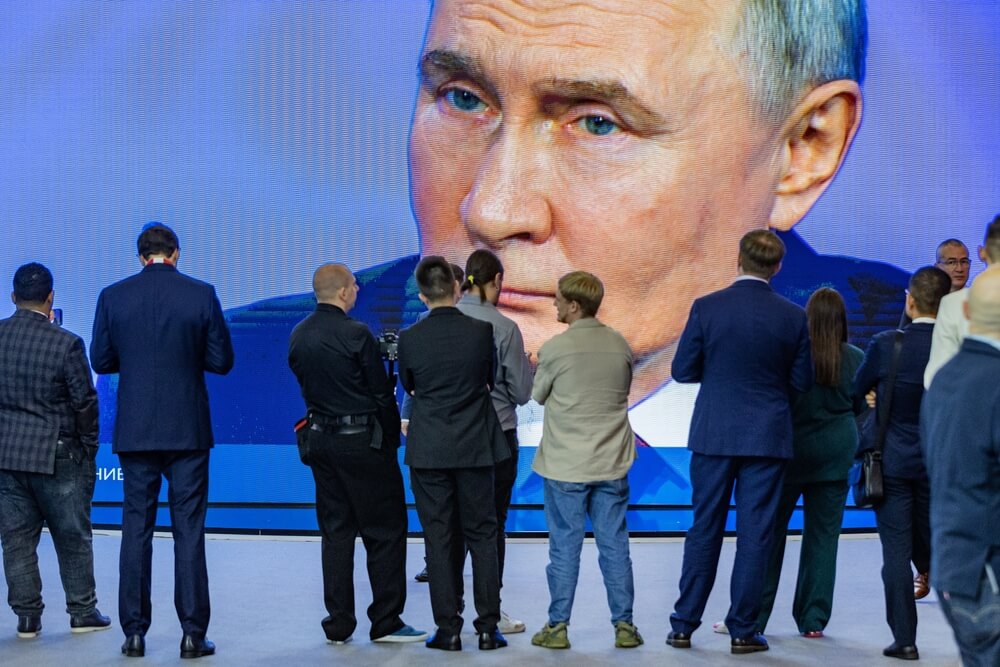 Putin's Russia has already made its choice. The question is whether the West is prepared to make its own
That reality demands leadership and a whole-of-society response. As Winston Churchill warned after Munich in 1938: "You were given the choice between war and dishonor. You chose dishonor, and you will have war."
The lesson is not that conflict is inevitable. It is that deterrence matters. If we fail to impose costs on an adversary that is already escalating through hybrid warfare, sabotage, assassination plots, and intimidation, we should not expect moderation in return. We should expect more aggression.
Europe should begin seizing the hundreds of billions in Russian assets and give them to Ukraine.
The U.S. and all our allies should start supplying long-range weapons to Ukraine – or support its own building of Flamingo and other assets – that can continue to strike Russian energy assets nationwide.
These are the costs of their aggression, of Putin’s War, and an answer to his continual escalation.
We in the West continually use half-measures and equivocation with Ukraine and against hybrid war, and Russia continually gets the benefit of the doubt.
Enough with half measures. As Churchill also said in the 1930s, we live in an “age where decisions have consequences.”
Only by understanding how Putin thinks, and how he values strength above almost everything else, can we hope to negotiate an end to the war in Ukraine or confront Russia's escalating hybrid war against the West.
The choice before us is not between confrontation and peace. It is between deterrence now or greater conflict later. Putin's Russia has already made its choice. The question is whether the West is prepared to make its own.
Sean Wiswesser is a former CIA Senior Operations Officer and expert on Russian intelligence, espionage, and defense issues. He is the author of “Tradecraft, Tactics, and Dirty Tricks: Russian Intelligence and Putin’s Secret War”.
