The death of British artist David Hockney at the age of 88 marked the loss of one of those rare individuals who had risen to the unofficial status of a ‘national treasure’.
All nations have their list of favourites. They are often cultural figures, like Hockney, but can also include entertainers, sporting stars, campaigners and scientists.
Politicians and billionaire entrepreneurs rarely make the cut.
Their attraction, often hard to define, tends to go beyond the scope and nature of their work to reflect a certain “je ne sais quoi” about the national character.
As in the case of Hockney, who spent much of his life abroad and could sometimes be scathing about the country of his birth, they encapsulate a positive essence of Britishness with which the British can identify.
In a world defined by politics, competition and international rivalries, such figures play a role – not that they would necessarily have chosen it for themselves – in representing what is admirable about their societies.
Their status can say more about the state of a nation than can statistics on GDP or shifting political allegiances.
What does it take?
So what does it take to become a national treasure? Being known to at least a sizeable minority of the country is an obvious essential.
Longevity can help, while gender is no barrier. France had the singer Édith Piaf, while the actress Melina Mercouri was Greece’s national treasure long before she served the country as its minister of culture.
In the UK, polling company YouGov last month confirmed that David Attenborough was the country’s most esteemed national treasure in a survey published in the week of the naturalist and broadcaster’s 100th birthday.
Like Hockney, Judi Dench was born in the northern county of Yorkshire, which for the rest of Britain implies an element of no-nonsense bluntness
The intimate, whispering tone with which he introduces his audience to some of the world’s most exotic animals, coupled with his life-long love of nature and his concerns about the future of the planet, have long endeared him to the UK public.
Other national treasures identified by the poll participants were members of the royal family, including King Charles, alongside musicians, comedians and actors.
The latter included Judi Dench, who in a seven-decade career has played the role of English queens and starred in the quintessentially British role of the spy chief M in James Bond films.
Like Hockney, she was born in the northern county of Yorkshire, which for the rest of Britain implies an element of no-nonsense bluntness.
The best of Britishness
But national treasures are not merely the personification of national clichés. Many of them are outsiders in terms of their origins, their beliefs and their personal inclinations.
One Briton who breaks the no-politicians rule is Alf Dubs, a former Labour MP and member of the House of Lords.
The Prague-born son of a Jewish father, he fled Czechoslovakia at the age of six shortly after the 1939 Nazi invasion and found sanctuary with his family in the UK as part of the Kindertransport child rescue operation.
His campaigns on behalf of subsequent generations of child refugees and support for civil rights causes and prisoners have earned him an enduring reputation for soft-spoken determination rarely enjoyed by his fellow politicians.
Another immigrant, the Somali-born Olympic runner Mo Farah, displays a self-effacing good humour that is also seen as an expression of the best of Britishness.
Despite time abroad, Hockney retained his distinctive Yorkshire accent and also retained a personality that was essentially British
Hockney himself was something of an outsider in the austere and strait-laced Britain in which he grew up. Having come out as gay when homosexual acts were still a criminal offence in the UK, the former art student decamped to the warmer climes and freer lifestyle of California.
Despite his time abroad, he retained his distinctive Yorkshire accent and, along with the dyed hair and flamboyantly elegant clothes, also retained a personality that was essentially British. He could come across as both humorous and occasionally curmudgeonly.
The one time I encountered the great man was outside New York’s Metropolitan Opera during the interval of a performance of Puccini’s Turandot, produced by Hockney’s sometime artistic rival, Franco Zeffirelli.
We had both sneaked out for a cigarette and quickly struck up a conversation on the latest UK smoking restrictions. “What a mean-spirited little country!”, declared Hockney, a militant smokers’ rights campaigner. National treasure or not, he would never have passed the interview for a diplomatic posting.
His rejection of the “bossiness” of anti-smoking activists will have struck a chord as another admirable British trait, even among the many who would not share his views on the virtues of tobacco.
The rise of celebrity culture
National treasure status for living individuals, which, unlike in the UK, is official in some countries, including Japan, has inevitably drawn the attention of academic researchers.
In a 2019 paper for the European Journal of Cultural Studies, two City University of London academics linked national treasure status to the post World War II rise of celebrity culture and the extension of the state honours system.
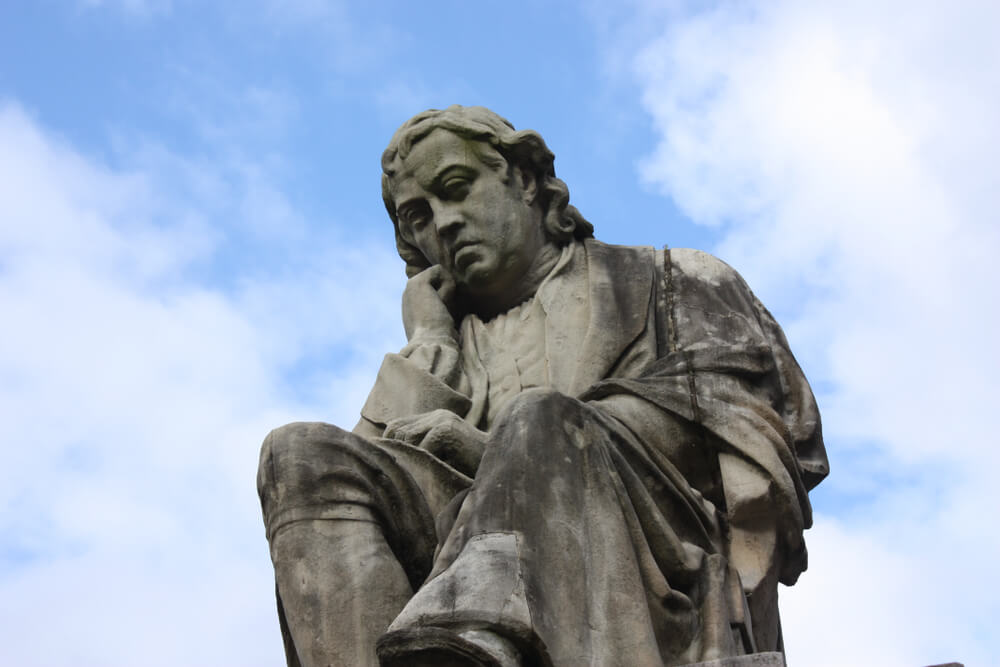 It’s hard to believe that someone such as the 18th-century English wit and polymath Samuel Johnson was not regarded as a national treasure, even if the exact term had yet to be coined
They proposed that the status emerges from the accumulation of three interlocking forms of validation: from an individual’s peers, the state and media. “In a context of a relentlessly bleak news cycle, they are a wholly virtuous expression of the national identity, signifying all that is great about Britain,” they concluded.
They described a quasi-formal system that created a celebritocracy. They argued that the institutional forms of validation that underpin the status transformation of such individuals contribute to the legitimation and reproduction of status hierarchies, cultural authority and inequality in the UK.
That is one academic view. But perhaps the phenomenon is older, more organic and less determined by elites than is suggested.
It’s hard to believe that someone such as the 18th-century English wit and polymath Samuel Johnson was not regarded as a national treasure, even if the exact term had yet to be coined.
Neither do figures such as the late former Prime Minister Margaret Thatcher or the entrepreneur Richard Branson deserve to be called national treasures just because Sunday Telegraph readers say so, as they did in 2008.
In times of crisis
In times of crisis, some individuals do rise to a semi-official national treasure status.
In wartime UK, singer Vera Lynn entertained the troops abroad and was dubbed the Forces’ Sweetheart. Her calm radio voice reflected national resilience and optimism, while her songs We’ll Meet Again and The White Cliffs of Dover became unofficial wartime anthems.
Not all national treasures are obvious role models
Not all national treasures are obvious role models. They can be less than virtuous, wildly eccentric and subtly subversive. Some are argumentative and controversial and even inveterate smokers.
But, in Britain as elsewhere, they can help capture the essence of a nation’s values and outlook even in societies that are rapidly evolving, whether that is because of AI or looming conflict.
They invariably reflect a country better than the ephemeral cohort that think they run it.
So who are the candidates for the coming generation? Perhaps somewhere out there is an up-and-coming TikTok influencer who will one day come to symbolise the hidden soul of the nation.
