World Bank President Ajay Banga said on 11 October, ahead of the annual meetings of the institution and the International Monetary Fund in Bangkok, that the Bank was in talks with 30 to 40 countries about possible emergency assistance.
The war in the Middle East, which began at the end of February, has driven up the prices of fuel and fertilisers and further strained the budgets of countries that already have large obligations to foreign creditors.
If these pressures continue, the World Bank could provide up to $100 billion over 15 months.
That amount would exceed the roughly $70 billion disbursed during the pandemic.
A key part of Banga’s statement concerns the origin of the money. Of the initial $50 billion to $60 billion earmarked for support, $25 billion has been set aside for crisis needs and has been available since the end of February.
A further $35 billion or so could be provided by reallocating money from previously approved projects.
More than half of the initial $60 billion has already been earmarked for development.
For the first $25 billion, only a small number of countries have applied so far, while, according to Banga, interest in reworking existing projects is greater.
New debt makes previously approved money more attractive
A new crisis loan increases the total debt that a state must repay. If, instead, it diverts funds from a previously approved project, the overall volume of already contracted loans remains unchanged, although actual debt rises once money that has not yet been paid out is drawn down.
For governments that carefully weigh each new obligation, this distinction is important, as a change of purpose can ease immediate financial pressure without taking on additional credit.
According to data presented by Banga, developing countries must pay about $400 billion to foreign creditors this year, and interest alone accounts for roughly one-third of that amount.
Heavy existing debt therefore probably explains why governments negotiating with the Bank are more interested in funds from earlier contracts.
Redirecting funds may be reasonable in a single crisis
The cost of such a choice becomes apparent later. Investing in the electricity grid reduces future supply costs, while irrigation can mitigate the effects of drought and low yields.
When money earmarked for such projects is diverted to cushion current inflation, the government can protect households and businesses, but it delays investments that would reduce exposure to the next shock.
Redirecting funds may be reasonable in a single crisis, but it becomes costly when each new disruption is financed by postponing development.
The June calculation was already out of date by July
On 11 June, the World Bank presented an initial support framework of $50 billion to $60 billion, with the possibility of expanding it to $80 billion to $100 billion.
Its economic forecast at the time was based on the assumption that the most severe disruptions in oil supply would begin to ease in July and that the average price of Brent crude in 2026 would be $94 a barrel.
However, the truce fell apart in July and the energy crisis continued to burden fuel importers.
The price of petrol has risen by an average of 26% and diesel by 38% since the start of the war - UNDP
A report by the UN Development Programme, published on 11 October, shows that across the 130 countries monitored, the price of petrol has risen by an average of 26% and diesel by 38% since the start of the war.
Diesel is factored into the cost of transporting food and farming the land, so the price increase also affects households that do not own a car.
At the same time, fertiliser prices have increased, and the UNDP warns of the possibility of an exceptionally strong El Niño, which could further threaten agricultural production.
According to UNDP estimates, if the entire increase in energy and food prices were passed on to consumers without safeguards, roughly 130 million more people could fall below the international poverty line of $6.85 a day, based on purchasing power parity.
Compensating all households for the increase in prices would cost about 1.1% of developing countries’ gross domestic product, while aid targeted only at people below that threshold would require about 0.3%.
The difference in cost is large, and UNDP estimates that direct fossil-fuel subsidies worldwide this year could exceed $1 trillion.
Targeted aid is cheaper, but countries without reliable data on household incomes and an efficient payment system often struggle to deliver it quickly.
As a result, many governments in a crisis resort to blanket subsidies, which cost more but can be rolled out faster.
Private capital bypasses the poorest countries
In September, the World Bank announced that during the 2026 financial year, which ended on 30 June, it had helped attract a record $112 billion in private capital to developing countries.
This total is up from $35 billion in the 2022 financial year, but the money is distributed very unevenly between countries.
In upper-middle-income countries, private capital attracted with the Bank’s support increased from $12 billion to $50 billion, and in lower-middle-income countries from $14 billion to $37 billion.
In the poorest countries, it remained at around $3 billion, the same amount as four years ago.
The World Bank and governments are increasingly relying on private investors to fund development
The World Bank and governments are increasingly relying on private investors to fund development, but capital flows more readily where contracts are reliable, payments are stable, and business risk is acceptable.
In countries with weak institutions and unstable public finances, even an essential power plant or road barely attracts investment.
Bank guarantees can mitigate some of the risk, but the four-year freeze in private investment in the poorest economies shows the limitations of this model.
It is in these countries that redirecting already approved development loans can leave a gap that private money will not fill.
Cheaper debt leaves more money for schools
The World Bank also supports arrangements in which countries replace costly existing loans with more favourable ones, backed by guarantees from institutions in its group.
In Angola, such work should enable the construction of 30 additional secondary schools for more than 32,000 students.
Côte d’Ivoire has already replaced roughly €400 million of costly commercial debt with a loan that has a lower interest rate, a longer repayment period and an initial grace period.
During the first five years, this arrangement frees up about €330 million for the budget, largely thanks to the postponement of repayments to later years.
The total savings over the duration of the new loan, when future amounts are converted into their present value, are estimated at a minimum of €60 million. Part of the released money is earmarked for education.
Côte d’Ivoire thus received more money for schools in the following years, but will repay part of its obligations later.
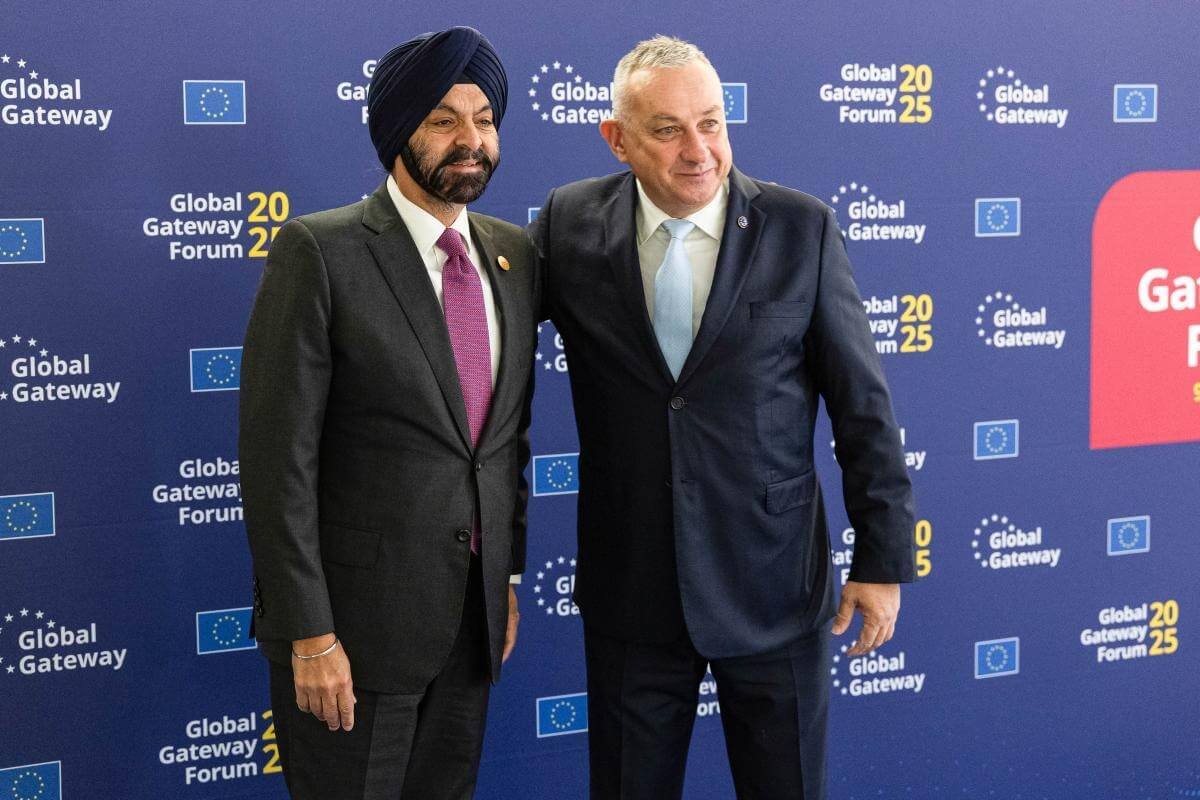 Countries whose debt is already unsustainable face much tougher negotiations to reduce and restructure it - Ajay Banga (left)
Banga cites another 14 to 15 similar deals in the pipeline. If each were the size of the deal with Côte d’Ivoire, they would collectively cover $6 billion to $7 billion in debt, a small fraction of the $400 billion that developing countries are expected to pay to creditors this year.
Such loan swaps mostly help countries that can still service their debt properly, but have some loans that are too expensive.
Countries whose debt is already unsustainable face much tougher negotiations to reduce and restructure it.
The Rockefeller Foundation’s proposal, released on 7 October, seeks to address the same problem.
The foundation calls for more favourable long-term funding from the IMF and the World Bank for roughly 40 low- and lower-middle-income countries whose debt remains sustainable.
During the programme, bilateral creditors would not charge those countries more than the value of newly approved funds, while guarantees from international development banks would be used to replace particularly expensive loans from private creditors.
The countries covered by the proposal need to repay roughly $80 billion in principal to G20 members by 2030. The proposal has not yet been adopted.
The next crisis will find some countries with incomplete investments
Based on discussions with the Bank so far, heavy maturing debts and elevated energy and food prices, governments will probably continue refinancing existing development projects over the next six months rather than taking out new crisis loans.
Falling oil prices could reduce the need for emergency aid, but maturities would remain high, and projects that are already delayed would have to wait for a new funding decision.
Countries that import fuel, have high levels of debt and lack a reliable way to support poor households quickly are expected to suffer the most severe consequences.
The World Bank can probably prevent some countries from falling into a serious financial crisis this year
For their governments, reallocating existing loans is easier than taking on new borrowing, while countries that manage to attract private investors will have more opportunities to continue development projects.
The World Bank can probably prevent some countries from falling into a serious financial crisis this year, but some of the money for that protection will come at the expense of power grids, irrigation systems and other investments that would reduce dependence on expensive imports.
The next big jump in prices will find the most vulnerable countries with the same unfinished projects that are exposing them to the consequences of the crisis today.
